Skip to content
  • MySensors
  • OpenHardware.io
  • Categories
  • Recent
  • Tags
  • Popular
Skins
  • Light
  • Brite
  • Cerulean
  • Cosmo
  • Flatly
  • Journal
  • Litera
  • Lumen
  • Lux
  • Materia
  • Minty
  • Morph
  • Pulse
  • Sandstone
  • Simplex
  • Sketchy
  • Spacelab
  • United
  • Yeti
  • Zephyr
  • Dark
  • Cyborg
  • Darkly
  • Quartz
  • Slate
  • Solar
  • Superhero
  • Vapor

  • Default (No Skin)
  • No Skin
Collapse
Brand Logo
  1. Home
  2. Hardware
  3. PCB design with nRF24L01 and Arduino Pro Mini

PCB design with nRF24L01 and Arduino Pro Mini

Scheduled Pinned Locked Moved Hardware
21 Posts 8 Posters 13.2k Views 4 Watching
  • Oldest to Newest
  • Newest to Oldest
  • Most Votes
Reply
  • Reply as topic
Log in to reply
This topic has been deleted. Only users with topic management privileges can see it.
  • RaPoR Offline
    RaPoR Offline
    RaPo
    wrote on last edited by
    #10

    Are there any hints/advises or best practices, if I decide to re-design from scratch ?
    Thanks.

    1 Reply Last reply
    0
    • pansenP Offline
      pansenP Offline
      pansen
      wrote on last edited by
      #11

      Unfortunately I am not a PCB designer..I would advise you to ask this question (and also why the boards does not work) on a dedicated electronics forum. EEVBlog forums are very good for that purpose.
      Good luck!

      P.S.: I guess you also tried different nrf24 boards right?

      Orange Pi Plus 2e connected to nrf24 PA via SPI running git-development MySensors gateway, OpenHAB2, mosquitto and MySQL persistence.

      RaPoR 1 Reply Last reply
      0
      • RaPoR RaPo

        @HarryDutch Thanks for the reply. I think if I remove nrf and keep away from board it will definetly work. As shown in one of the pictures above when I put the NRF little higher than Arduio, it works flawless. I tried to share the board and schematic files, but I could not upload seems I do not have privilege to upload them. If there special way to upload .brd and .sch files ?

        H Offline
        H Offline
        HarryDutch
        wrote on last edited by
        #12

        @RaPo You can zip your .brd and .sch files and upload the zip file.

        1 Reply Last reply
        0
        • scalzS Offline
          scalzS Offline
          scalz
          Hardware Contributor
          wrote on last edited by scalz
          #13

          Hi.

          I'm thinking like others..for bad antenna orientation regarding your pcb. Sometimes this can work, but it adds noise to your radio.. what makes me think is on your pic you place it a little bit more above then it works.. the @sundberg84 notes can be interesting to check too ;)

          Not really needed here, because you've only one thing on SPI bus, but it's good practice to have a pullup on CS line, to be sure to enable SPI periph only when needed. but not mandatory here sure!

          For a battery powered node, i would better use a si7021 than dht22 ;) you can find si7021 breakout board at ali for a reasonable cost, and you'll definitely get a better battery lifetime.
          And don't forget the resistor divider for batt voltage will consumes power. If directly powered from battery, you can simply use the VCC lib to read the voltage, or in other case (with any kind of reg) would need a mosfet to switch off your resistor divider.

          Keep the good work, you'll get it i'm sure :+1:

          RaPoR 1 Reply Last reply
          1
          • RaPoR RaPo

            Hello all,

            I am quite new to this form. I really like the idea of using small nrf24l01+arduino nodes around the home to control electronics.

            I have successfully hand built few nodes (2 based on Arduino Nano and 1 based on Arduino Pro Mini) and deployed around the home.
            Here are some of the pictures of my nodes
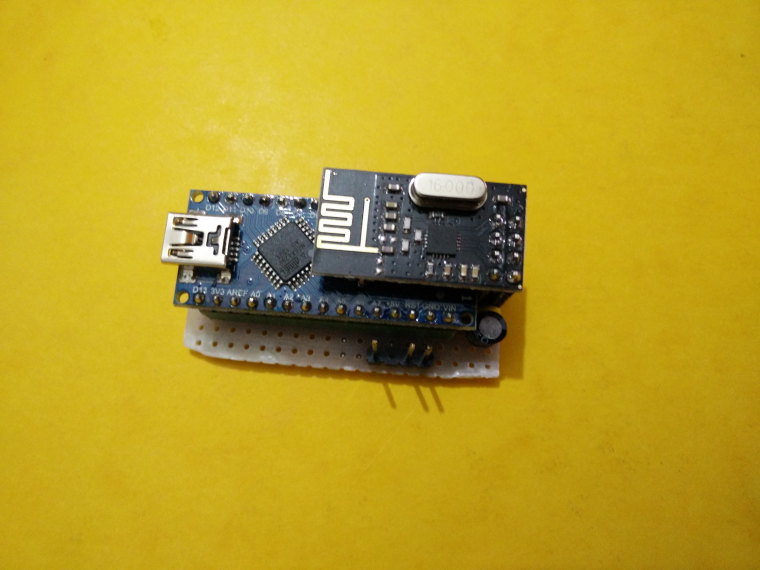
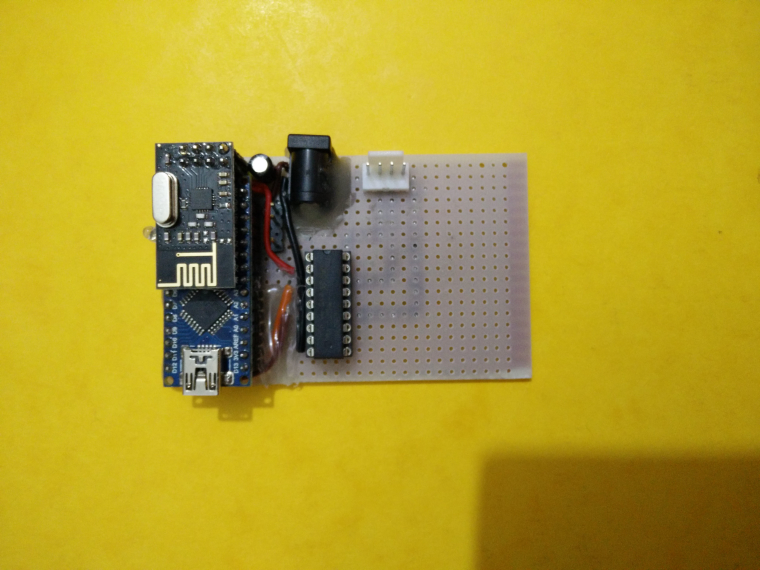
            0_1486031804614_IMG_20151203_204938.jpg
            0_1486031813134_IMG_20151203_205126.jpg
            0_1486031819470_IMG_20160927_203520.jpg

            It takes lot of time to hand build these nodes. So I decided to make a small generic PCB uing Arduino Pro Mini and fabricate it and use it. I designed the PCB in Eagle SW and fabricated with Seedstudios.

            Here is my board looks like
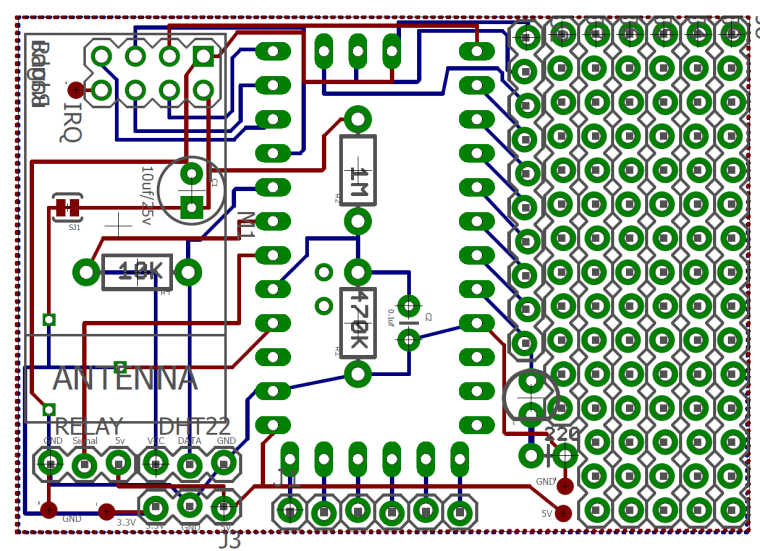
            0_1486032150906_PCB_board_1.PNG

            After mounting the components, I found it is not working. Tx/Rx was completely failure. After several hours of debugging, found that my circult is correct and I assume there were some EMC effects.
            If I touch the antenna of nrf with my finger, Tx/Rx is successful and everything works perfect. If I remove my finger it does not work again.

            I thought because of placement of nrf module there were some EMC effects and created a V2 of my board by just changing position of nrf. It looks like this
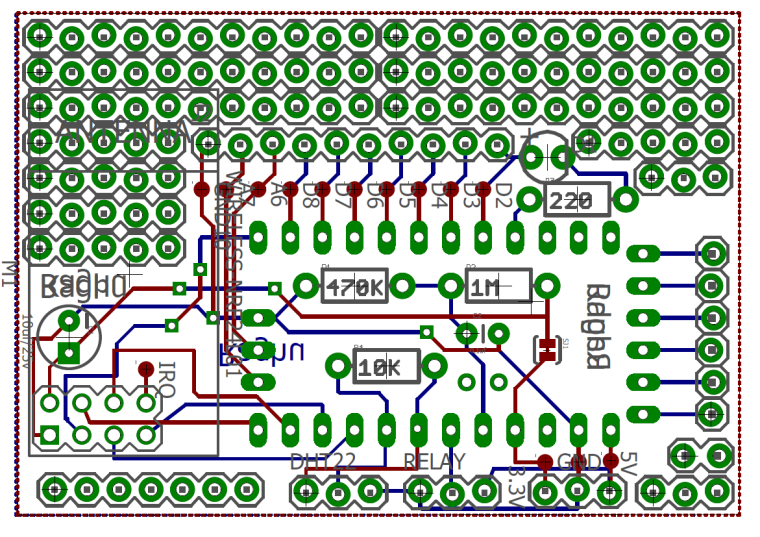
            0_1486032367448_PCB_board_2.PNG

            Unfortunately, even this board/design has the same problem.
            These are how the boards look like
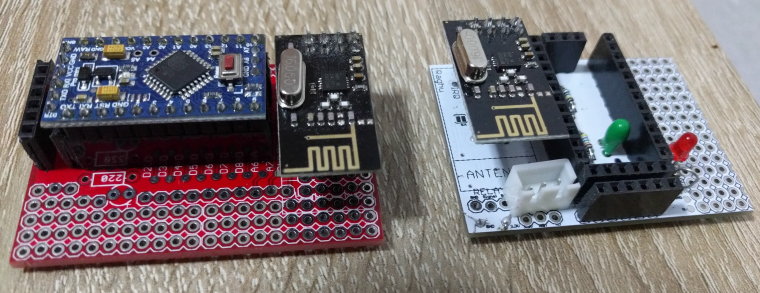
            0_1486062345251_IMG_20170202_195402.jpg

            I also tried changing the position of nrf module by placing it in proto area and rewiring from the actual position, seems to have same problem.

            On both of these board when I lift the nrf module at higher level than the Arduino Pro by stacking additional female headers for nrf (as shown in below picture), they seem to be working.
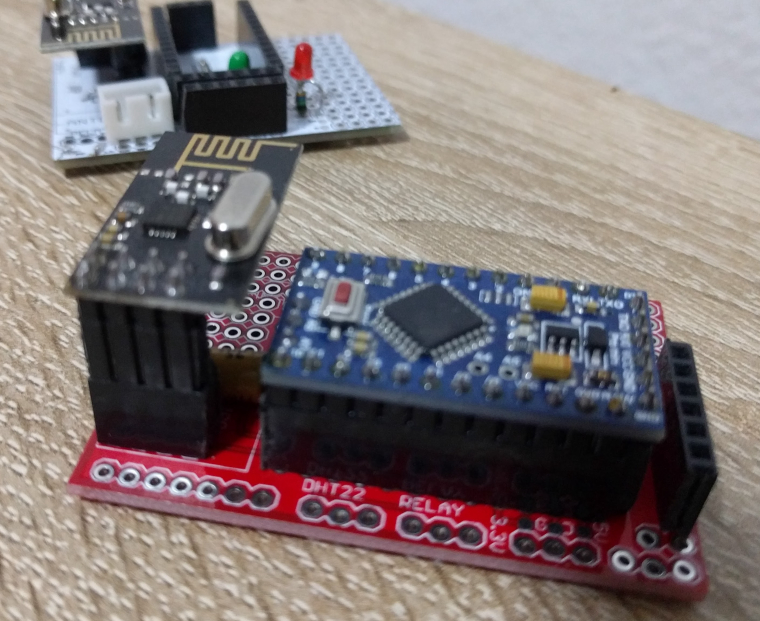
            0_1486062405279_IMG_20170202_195453.jpg

            Could some please help me understand whats happening on my board. :-( I want to go for V3 of board which solves these problem but I could not figure out what exactly is causing the problem.

            Thank you so much for your support.

            Unfortunately, I do not have privilege to upload board and schematic files, so I adding screenshots here.
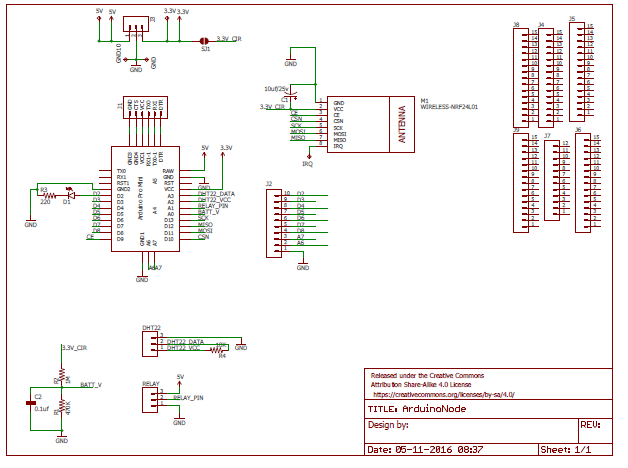
            0_1486063048271_MyNode.PNG

            mfalkviddM Offline
            mfalkviddM Offline
            mfalkvidd
            Mod
            wrote on last edited by
            #14

            @RaPo I think all the conductive material near the antenna absorbs/blocks the radio signal. That's why you get a better signal when the nrf is put on taller headers. Let the antenna stick out over the side of the board or make sure there is a sufficiently large area without any connections around the antenna. I do not know how much is considered sufficient though.

            RaPoR 1 Reply Last reply
            0
            • bjacobseB Offline
              bjacobseB Offline
              bjacobse
              wrote on last edited by
              #15

              Hi you are welcome to copy my design
              https://www.openhardware.io/view/56/Mys-Interposer-NRFArduino-Pro-Mini

              RaPoR 1 Reply Last reply
              0
              • pansenP pansen

                Unfortunately I am not a PCB designer..I would advise you to ask this question (and also why the boards does not work) on a dedicated electronics forum. EEVBlog forums are very good for that purpose.
                Good luck!

                P.S.: I guess you also tried different nrf24 boards right?

                RaPoR Offline
                RaPoR Offline
                RaPo
                wrote on last edited by
                #16

                @pansen Hi thanks, I will try in that forum you mentioned and yes I have tried different nrfs too ..

                1 Reply Last reply
                1
                • scalzS scalz

                  Hi.

                  I'm thinking like others..for bad antenna orientation regarding your pcb. Sometimes this can work, but it adds noise to your radio.. what makes me think is on your pic you place it a little bit more above then it works.. the @sundberg84 notes can be interesting to check too ;)

                  Not really needed here, because you've only one thing on SPI bus, but it's good practice to have a pullup on CS line, to be sure to enable SPI periph only when needed. but not mandatory here sure!

                  For a battery powered node, i would better use a si7021 than dht22 ;) you can find si7021 breakout board at ali for a reasonable cost, and you'll definitely get a better battery lifetime.
                  And don't forget the resistor divider for batt voltage will consumes power. If directly powered from battery, you can simply use the VCC lib to read the voltage, or in other case (with any kind of reg) would need a mosfet to switch off your resistor divider.

                  Keep the good work, you'll get it i'm sure :+1:

                  RaPoR Offline
                  RaPoR Offline
                  RaPo
                  wrote on last edited by
                  #17

                  @scalz HI, thanks for the kind words. Its a very useful hint about VCC lib. Even I was thinking around saving the power loss at the resistor. Thanks again.

                  1 Reply Last reply
                  0
                  • mfalkviddM mfalkvidd

                    @RaPo I think all the conductive material near the antenna absorbs/blocks the radio signal. That's why you get a better signal when the nrf is put on taller headers. Let the antenna stick out over the side of the board or make sure there is a sufficiently large area without any connections around the antenna. I do not know how much is considered sufficient though.

                    RaPoR Offline
                    RaPoR Offline
                    RaPo
                    wrote on last edited by
                    #18

                    @mfalkvidd Thanks for the hints. I will definitely consider this in my design.

                    1 Reply Last reply
                    0
                    • bjacobseB bjacobse

                      Hi you are welcome to copy my design
                      https://www.openhardware.io/view/56/Mys-Interposer-NRFArduino-Pro-Mini

                      RaPoR Offline
                      RaPoR Offline
                      RaPo
                      wrote on last edited by
                      #19

                      @bjacobse Hi, Thank you so much. This exactly meets my requirements too, I will re-use it.

                      1 Reply Last reply
                      0
                      • RaPoR Offline
                        RaPoR Offline
                        RaPo
                        wrote on last edited by
                        #20

                        Hello all,
                        Thank you so much for all your kind support. From a review from one my colleague, I learned that 90 degree sharp bends should be avoided. These sharp edges acts as local antenna and EMC interference. Unfortunately, my design has several of such sharp bends.


                        1 Reply Last reply
                        0
                        • tinomsonT Offline
                          tinomsonT Offline
                          tinomson
                          Banned
                          wrote on last edited by
                          #21

                          I guess it took a lot of time to create it.

                          1 Reply Last reply
                          0
                          Reply
                          • Reply as topic
                          Log in to reply
                          • Oldest to Newest
                          • Newest to Oldest
                          • Most Votes


                          24

                          Online

                          11.7k

                          Users

                          11.2k

                          Topics

                          113.1k

                          Posts


                          Copyright 2025 TBD   |   Forum Guidelines   |   Privacy Policy   |   Terms of Service
                          • Login

                          • Don't have an account? Register

                          • Login or register to search.
                          • First post
                            Last post
                          0
                          • MySensors
                          • OpenHardware.io
                          • Categories
                          • Recent
                          • Tags
                          • Popular