
PIR sensor comparison
-
Hi, there!
I have measured and approximated the transient responses of 11 analog dual-element pyroelectric detectors both expensive lithium tantalate and cheap lead zirconate titanate used in motion sensors under the same conditions. I published the results in the brochure.
In principle, it is possible to collect the database of the pyroelectric detectors and discuss which of which is better or worse for this or that application. I am the originator/inventor of this method of testing that I call "The Time Domain Method". It differs from the classic "Frequency Domain Method" used for the decades. Before publishing, I have not yet seen any academic work that would explain this topic in details. Moreover, I didn't meet any paper that would relate to testing pyroelectric detectors in the time domain. This seems to be the world's first achievement in this area. What are you thinking about it? -
Hmm, thanks for the effort.
I am missing units of measure in the graphs,
Why is there a significant dip at 50?
Maybe overlaying the sensors in one graph per category would allow for a quick comparison of the response.
A summary/conclusion would also be helpful to the reader.
All the very best. -
Dear MaxG.
Thank you for your interest.
«I am missing units of measure in the graphs» - You are right. I didn't put the units of measurement in the graphs. I described the graphs in the beginning of every paragraph.
«Why is there a significant dip at 50?» - every sensor has its own transient response. Some pyroelectric detectors are faster, some not. Serial opposed dual pyroelectric detectors have transient responses longer than parallel. I found value 50s to be approximately good for all of the samples. Also, this value is comparable with the scale of percentage, so 100s, or 100%, is the length of the full period, and 50s, or 50%, if that of one of the two transient responses, heating or cooling respectively.
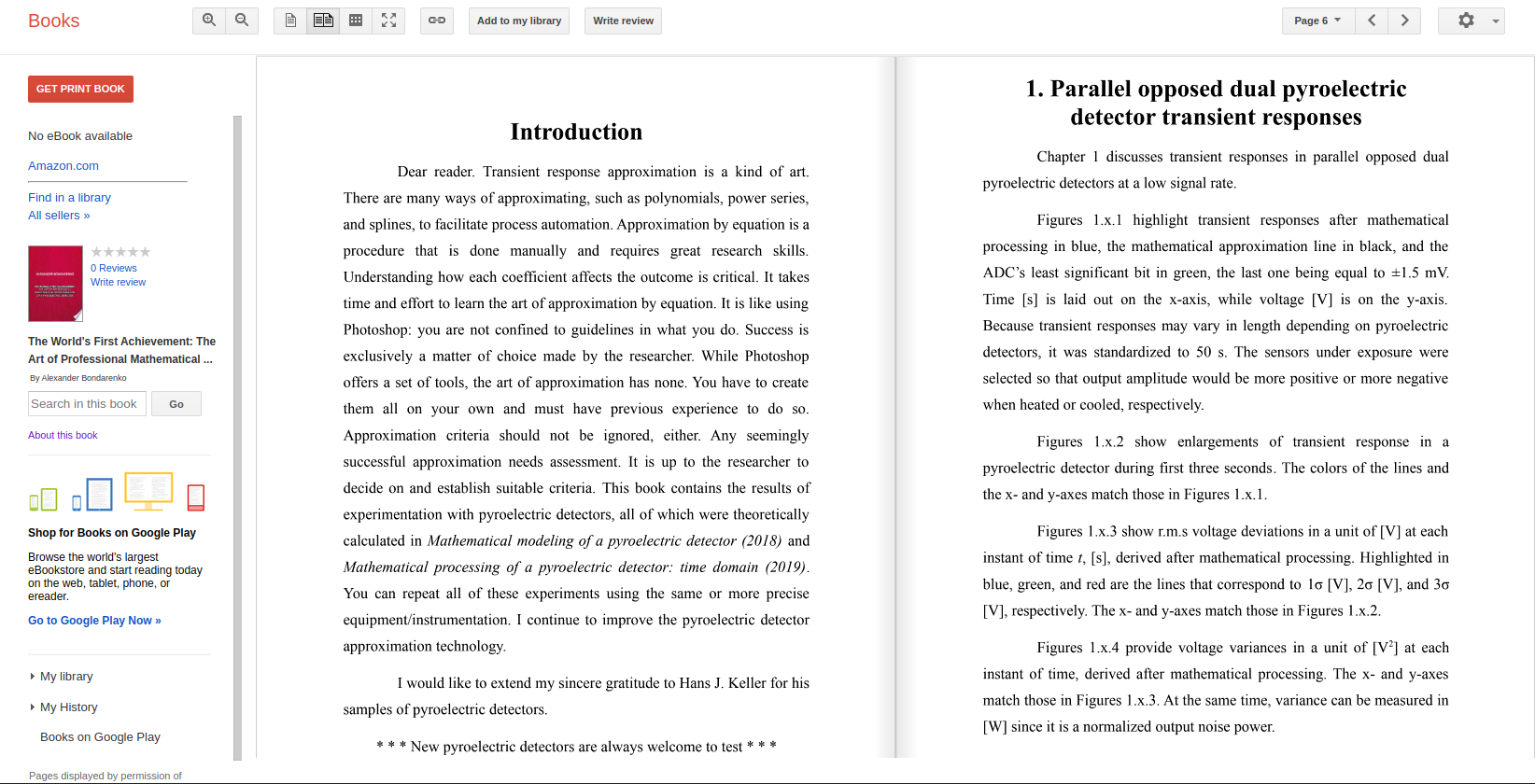
«Maybe overlaying the sensors in one graph per category would allow for a quick comparison of the response.» - every graph includes four lines. If I overlay all of them one another, I'm afraid, we will receive chaos. I think It would be a good idea to overlay the approximations only. What are you thinking?
«A summary/conclusion would also be helpful to the reader.» - You are right twice. But I didn“t do it for the next reasons.- This method is too young, the first attempt. I don't have enough knowledge, skills or practical experience do write conclusion. When a half of the year have passed by, I will, probably, be able to write good, professional conclusions.
- As the author, I am also interested in the opinion/conclusions of the other people. This is why I have posted it here.
If you have more questions, please, feel free to ask. If you know the other people interesting in pyroelectric measurements, invite them to this discussion. This topic is brand new. I am looking for more feedbacks and opinions. I'll be glad to receive positive, but also accept critics. The truth is born in discussions.
Kind regards in return.
P.S. you can even think about carrying out the same measurements all by yourself. If you find a way how to test motion sensors to avoid false alarms, you will be able to earn something.

Hello! It looks like you're interested in this conversation, but you don't have an account yet.
Getting fed up of having to scroll through the same posts each visit? When you register for an account, you'll always come back to exactly where you were before, and choose to be notified of new replies (either via email, or push notification). You'll also be able to save bookmarks and upvote posts to show your appreciation to other community members.
With your input, this post could be even better 💗
Register Login