
Soldering tips for atmega328p-au?
-
Yeah, I forgot to mention the flux, but I totally agree. Dave Jones says "you can never have too much flux" in his video, and I agree with that too (except it does mean more work cleaning off the excess with IPA). It's getting the initial orientation right that's the tricky part. Once that's fixed in place by the tacking, it seems to go relatively easy.
Seems like a reflow oven might have a different set of issues to contend with. Would a reflow oven be any easier or faster?
-
Yeah, I forgot to mention the flux, but I totally agree. Dave Jones says "you can never have too much flux" in his video, and I agree with that too (except it does mean more work cleaning off the excess with IPA). It's getting the initial orientation right that's the tricky part. Once that's fixed in place by the tacking, it seems to go relatively easy.
Seems like a reflow oven might have a different set of issues to contend with. Would a reflow oven be any easier or faster?
@NeverDie I have no experience with reflow ovens but to me it seems that it's mostly useful for batches of boards, since you need to create a stencil for the solderpaste. For a couple of boards handsoldering still seems like the best solution to be. I've been surprised what can be handsoldered - even small DFN packages (like the Si7021) is pretty easy to handsolder
-
@NeverDie I have no experience with reflow ovens but to me it seems that it's mostly useful for batches of boards, since you need to create a stencil for the solderpaste. For a couple of boards handsoldering still seems like the best solution to be. I've been surprised what can be handsoldered - even small DFN packages (like the Si7021) is pretty easy to handsolder
-
@chrille
Have you tried hand soldering a BME280? It looks a bit more challenging to me than the si7021, but perhaps it's still do-able.@NeverDie said:
Have you tried hand soldering a BME280? It looks a bit more challenging to me than the si7021, but perhaps it's still do-able.
I only tried the Si7021, where the pads is both on the bottom and a bit on the side. For DFN/QFN's where the pads is only on the bottom I agree it's harder. I saw a interesting concept where the layout had a lot of vias directly under the DFN/QFN and you could heat the PCB from the opposite site using a traditional soldering iron. Of course you would still need solder paste for this
-
-
Given a decent hot air station costs ca. $35 these days, it's definitely worth considering.
-
@Toyman
Are you referring to a hot air pencil, or the underneath air heater that pre-heats the whole board? -
@Toyman said:
@NeverDie said:
@Toyman
Are you referring to a hot air pencil, or the underneath air heater that pre-heats the whole board?Something like this:
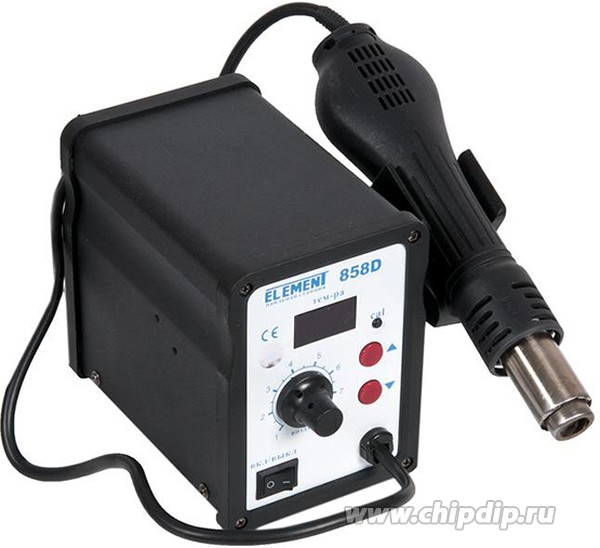
Yup, I have one of those, mostly because Dave Jones gave that model his thumbs up.
Not quite the same as a reflow oven though because it can blow parts around (though maybe that's just me being a noob). -
@Toyman said:
@NeverDie said:
@Toyman
Are you referring to a hot air pencil, or the underneath air heater that pre-heats the whole board?Something like this:
Yup, I have one of those, mostly because Dave Jones gave that model his thumbs up.
Not quite the same as a reflow oven though because it can blow parts around (though maybe that's just me being a noob). -
I haven't tried it on an atmega328p-au. Have you? Are you able to get all the solder paste molten at once so that the chip does auto-alignment with the pads like it would in a reflow oven?


Hello! It looks like you're interested in this conversation, but you don't have an account yet.
Getting fed up of having to scroll through the same posts each visit? When you register for an account, you'll always come back to exactly where you were before, and choose to be notified of new replies (either via email, or push notification). You'll also be able to save bookmarks and upvote posts to show your appreciation to other community members.
With your input, this post could be even better 💗
Register Login