Skip to content
  • MySensors
  • OpenHardware.io
  • Categories
  • Recent
  • Tags
  • Popular
Skins
  • Light
  • Brite
  • Cerulean
  • Cosmo
  • Flatly
  • Journal
  • Litera
  • Lumen
  • Lux
  • Materia
  • Minty
  • Morph
  • Pulse
  • Sandstone
  • Simplex
  • Sketchy
  • Spacelab
  • United
  • Yeti
  • Zephyr
  • Dark
  • Cyborg
  • Darkly
  • Quartz
  • Slate
  • Solar
  • Superhero
  • Vapor

  • Default (No Skin)
  • No Skin
Collapse
Brand Logo
  1. Home
  2. Hardware
  3. Battery Sensor with stepup and on/off transistor

Battery Sensor with stepup and on/off transistor

Scheduled Pinned Locked Moved Hardware
33 Posts 14 Posters 23.0k Views 8 Watching
  • Oldest to Newest
  • Newest to Oldest
  • Most Votes
Reply
  • Reply as topic
Log in to reply
This topic has been deleted. Only users with topic management privileges can see it.
  • N n3ro

    @ht81 Hey, the NRF is directly connected to the battery. only the DHT use the stepup.

    i use this stepup: http://www.banggood.com/2Pcs-500mA-DC-DC-1V-5V-Converter-Step-Up-Module-Power-Module-p-945167.html

    Just put a transistor in front of the stepup. this is all :)

    Suresh MaliS Offline
    Suresh MaliS Offline
    Suresh Mali
    wrote on last edited by
    #24

    @n3ro Why would you need a step up for DHT, I am running DHT11 on 3.3v and it work fine.

    N 1 Reply Last reply
    0
    • Suresh MaliS Suresh Mali

      @n3ro Why would you need a step up for DHT, I am running DHT11 on 3.3v and it work fine.

      N Offline
      N Offline
      n3ro
      wrote on last edited by n3ro
      #25

      @Suresh-Mali My sensor node is powered with two AAA Batts. Over the time the voltage drops down to 1,9v.

      The DHT only works with ~3v. so i need the stepup only to power the dht

      i use this setup with my multisensor nodes.
      http://forum.mysensors.org/topic/1514/multisensor_pir_dht_ldr_battery/3

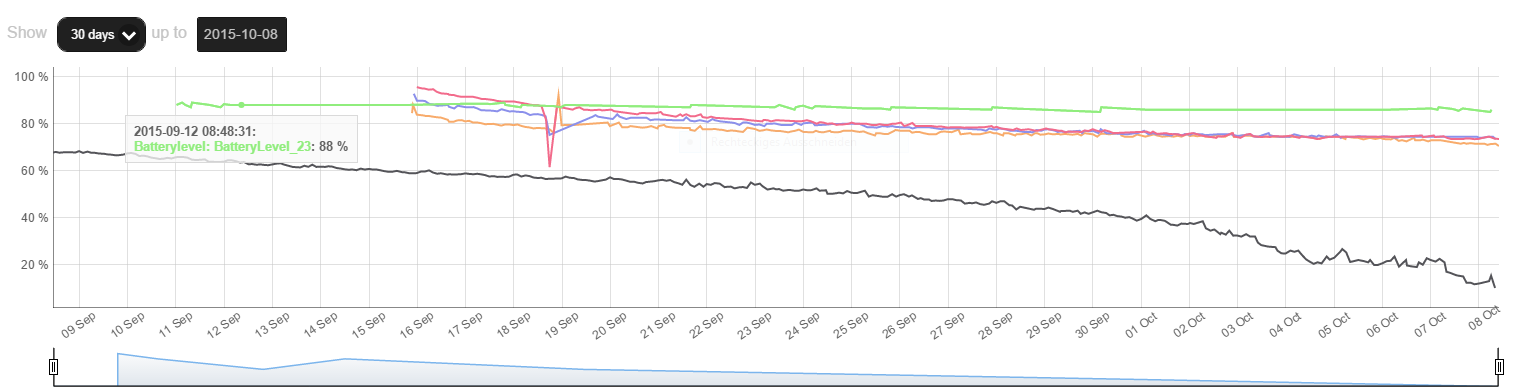
      Without transistor the battery is drained in ~2 month (black line)
      with transistors in ~10 month
      drain.PNG

      pimatic + MySensors + Homeduino + z-way
      https://github.com/n3roGit/MySensors_n3ro

      Suresh MaliS 1 Reply Last reply
      1
      • N n3ro

        @Suresh-Mali My sensor node is powered with two AAA Batts. Over the time the voltage drops down to 1,9v.

        The DHT only works with ~3v. so i need the stepup only to power the dht

        i use this setup with my multisensor nodes.
        http://forum.mysensors.org/topic/1514/multisensor_pir_dht_ldr_battery/3

        Without transistor the battery is drained in ~2 month (black line)
        with transistors in ~10 month

        drain.PNG

        Suresh MaliS Offline
        Suresh MaliS Offline
        Suresh Mali
        wrote on last edited by
        #26

        @n3ro Gr8, makes sense.:+1:

        1 Reply Last reply
        0
        • N Offline
          N Offline
          n3ro
          wrote on last edited by
          #27

          Hey togehter,

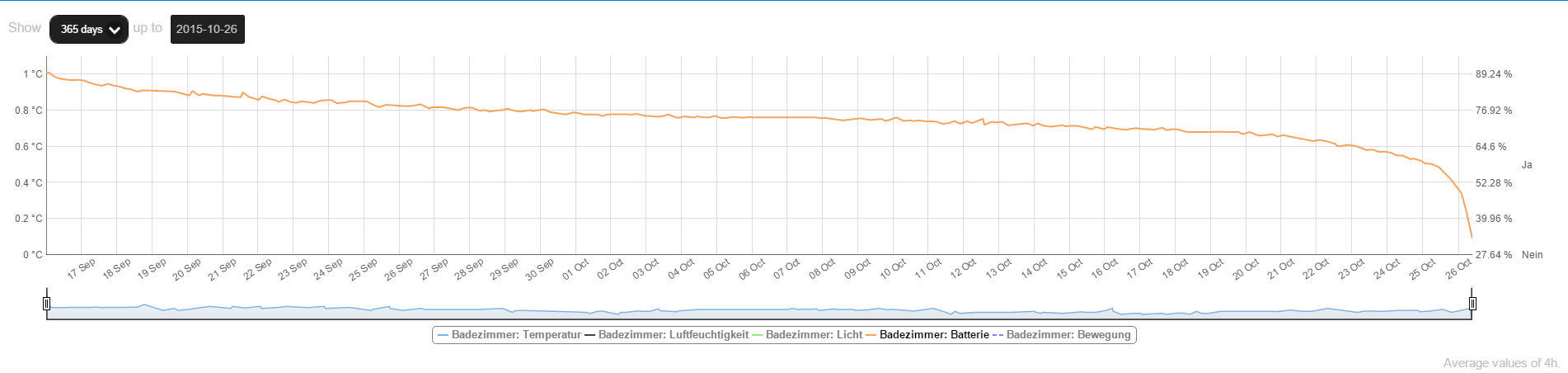
          is a battery drain graph like this normal with alkaline batteries?
          mysensors_batt.PNG

          regards,
          n3ro

          pimatic + MySensors + Homeduino + z-way
          https://github.com/n3roGit/MySensors_n3ro

          mfalkviddM 1 Reply Last reply
          0
          • N n3ro

            Hey togehter,

            is a battery drain graph like this normal with alkaline batteries?

            mysensors_batt.PNG

            regards,
            n3ro

            mfalkviddM Offline
            mfalkviddM Offline
            mfalkvidd
            Mod
            wrote on last edited by mfalkvidd
            #28

            @n3ro said:

            is a battery drain graph like this normal with alkaline batteries?

            If you mean the sudden drop at the end, the answer is yes. This is called a S curve because it looks like a (very stretched) S. That's the typical behavior of most batteries.

            1 Reply Last reply
            0
            • G Offline
              G Offline
              GertSanders
              Hardware Contributor
              wrote on last edited by GertSanders
              #29

              The fact that you drain the battery in less then 2 months is probably due to the presence detection. I'm assumung this is using passive IR and is always on ? As mentioned by @mfalkvidd the shape is normal.
              I use the breakout for SI7021 from Aliexpress and these use very little current. Also, there is no need for a step up, as this sensor works down to 1.8V. For light detection I use a LDR and 1MOhm resistor combination connected to a digital pin for power and analog pin for measuring. Works nicely because I let it settle (I first call the SI7021 to get the temperature and check the battery voltage, then I measure the analog value of the LDR. I only need relative values for light, so LDR is more then accurate enough for me.

              N 1 Reply Last reply
              0
              • G GertSanders

                The fact that you drain the battery in less then 2 months is probably due to the presence detection. I'm assumung this is using passive IR and is always on ? As mentioned by @mfalkvidd the shape is normal.
                I use the breakout for SI7021 from Aliexpress and these use very little current. Also, there is no need for a step up, as this sensor works down to 1.8V. For light detection I use a LDR and 1MOhm resistor combination connected to a digital pin for power and analog pin for measuring. Works nicely because I let it settle (I first call the SI7021 to get the temperature and check the battery voltage, then I measure the analog value of the LDR. I only need relative values for light, so LDR is more then accurate enough for me.

                N Offline
                N Offline
                n3ro
                wrote on last edited by
                #30

                @GertSanders
                thx :)

                I have just ordered some SI7021 for testing.

                My Pir sensors are these ones:
                http://www.amazon.de/gp/product/B008EGH3FM

                50 Mikroampere

                i dont know if this is aktive or passiv :-/

                regards,
                n3ro

                pimatic + MySensors + Homeduino + z-way
                https://github.com/n3roGit/MySensors_n3ro

                1 Reply Last reply
                0
                • G Offline
                  G Offline
                  GertSanders
                  Hardware Contributor
                  wrote on last edited by
                  #31

                  It's a passive IR module, and using 50uA, which is about 5 times the average consumption of my temperature/humidity sensors (between 8 and 11 uA depending on the amount of message resends needed).

                  The nice thing about the module you use is the low voltage it needs to work (0.8V <-> 9V).

                  N 1 Reply Last reply
                  0
                  • G GertSanders

                    It's a passive IR module, and using 50uA, which is about 5 times the average consumption of my temperature/humidity sensors (between 8 and 11 uA depending on the amount of message resends needed).

                    The nice thing about the module you use is the low voltage it needs to work (0.8V <-> 9V).

                    N Offline
                    N Offline
                    n3ro
                    wrote on last edited by
                    #32

                    @GertSanders said:

                    (0.8V <-> 9V)

                    Yes. I had a few problems with the 5v PIRs. That's why I ordered this.

                    pimatic + MySensors + Homeduino + z-way
                    https://github.com/n3roGit/MySensors_n3ro

                    abmantisA 1 Reply Last reply
                    0
                    • N n3ro

                      @GertSanders said:

                      (0.8V <-> 9V)

                      Yes. I had a few problems with the 5v PIRs. That's why I ordered this.

                      abmantisA Offline
                      abmantisA Offline
                      abmantis
                      wrote on last edited by
                      #33

                      @n3ro Couldn't you power the step-up from one of the arduino's digital pins? Then set the pin to HIGH/LOW to power the sensor on/off?
                      Maybe it draws too much power?

                      1 Reply Last reply
                      0

                      Hello! It looks like you're interested in this conversation, but you don't have an account yet.

                      Getting fed up of having to scroll through the same posts each visit? When you register for an account, you'll always come back to exactly where you were before, and choose to be notified of new replies (either via email, or push notification). You'll also be able to save bookmarks and upvote posts to show your appreciation to other community members.

                      With your input, this post could be even better 💗

                      Register Login
                      Reply
                      • Reply as topic
                      Log in to reply
                      • Oldest to Newest
                      • Newest to Oldest
                      • Most Votes


                      26

                      Online

                      12.0k

                      Users

                      11.2k

                      Topics

                      113.4k

                      Posts


                      Copyright 2025 TBD   |   Forum Guidelines   |   Privacy Policy   |   Terms of Service
                      • Login

                      • Don't have an account? Register

                      • Login or register to search.
                      • First post
                        Last post
                      0
                      • MySensors
                      • OpenHardware.io
                      • Categories
                      • Recent
                      • Tags
                      • Popular