Skip to content
  • MySensors
  • OpenHardware.io
  • Categories
  • Recent
  • Tags
  • Popular
Skins
  • Light
  • Brite
  • Cerulean
  • Cosmo
  • Flatly
  • Journal
  • Litera
  • Lumen
  • Lux
  • Materia
  • Minty
  • Morph
  • Pulse
  • Sandstone
  • Simplex
  • Sketchy
  • Spacelab
  • United
  • Yeti
  • Zephyr
  • Dark
  • Cyborg
  • Darkly
  • Quartz
  • Slate
  • Solar
  • Superhero
  • Vapor

  • Default (No Skin)
  • No Skin
Collapse
Brand Logo
  1. Home
  2. Troubleshooting
  3. 433MHz amplified (>5V)

433MHz amplified (>5V)

Scheduled Pinned Locked Moved Troubleshooting
22 Posts 4 Posters 11.5k Views 3 Watching
  • Oldest to Newest
  • Newest to Oldest
  • Most Votes
Reply
  • Reply as topic
Log in to reply
This topic has been deleted. Only users with topic management privileges can see it.
  • A Offline
    A Offline
    andriej
    wrote on last edited by
    #1

    Hi!

    For the remote wall plugs I currently have a 433 Mhz transceiver which sends proper code and turns them on and off.
    When I've moved to new location I have problems with signal reaching the outlets as the distance went a little further (but nothing above 'normal flat' values).

    In specification of TX 433MHz (basic, cheap China one0 it's stated that it can be powered with voltage 5-12V. Now it's powered from Arduino but I'd like to connect 9V-12V power supply and feed the power staight to module.

    Unfortunately specs also say that 'HIGH" voltage value of DATA pin should be at least 1/2 of Vcc, so for 12V it's 6V, which Arduino won't supply. I've tried to connect PN2222A to drive the power exactly to pin, but I couldn't get it to work (it worked for 1 of 5 tries to send code which reached outlet).
    Any ideas/schematics how to connect and rive the module to get maximum output power while being properly sent by Arduino?
    Unfortunately, itnernet seems to be quiet about the topic and I can see a lot of experienced PCB-designers, so maybe with a little help I can finally make something more reliable...

    Regards,
    Andrew

    :-)

    1 Reply Last reply
    0
    • BulldogLowellB Offline
      BulldogLowellB Offline
      BulldogLowell
      Contest Winner
      wrote on last edited by
      #2

      @andriej said:

      Any ideas/schematics how to connect and rive the module to get maximum output power while being properly sent by Arduino?

      have you thought about transistor switching?

      1 Reply Last reply
      0
      • A Offline
        A Offline
        andriej
        wrote on last edited by
        #3

        I've thought and I've once even tried.
        I don't know if I wired it properly, but it wasn't much more reliable than it was without transistor.

        I can't find schematics including transistor and resistors how to connect it properly and how to prevent arduino resetting while TX module was transmitting (I've encountered this problem).

        :-)

        1 Reply Last reply
        0
        • BulldogLowellB Offline
          BulldogLowellB Offline
          BulldogLowell
          Contest Winner
          wrote on last edited by
          #4

          @andriej said:

          how to prevent arduino resetting while TX module was transmitting

          separate the power supplies and test it, powering each one separately. Use the transistor to switch the radio's Vcc (with the base of the transistor connected to your arduino's output pin).

          The signal from the arduino with this switching method can be shifted up to the voltage for the radio.

          look for a small signal NPN transistor, and google "Transistor Switching"

          1 Reply Last reply
          0
          • A Offline
            A Offline
            andriej
            wrote on last edited by
            #5

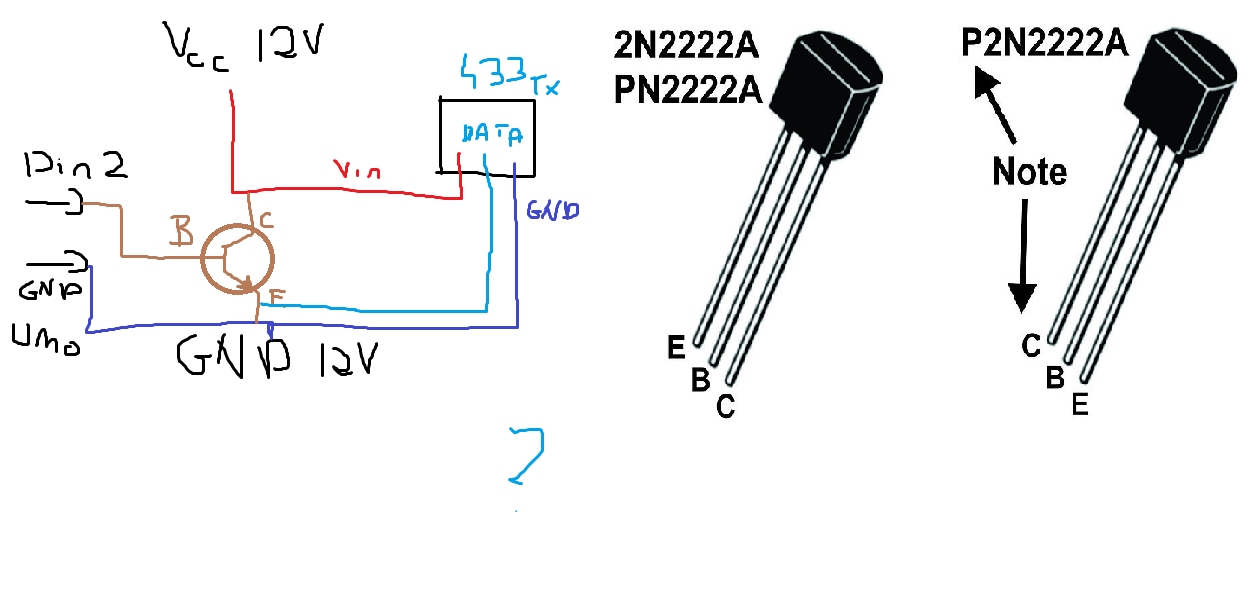
            I got the PN2222A but I struggle what should be connected to emitter, base and collector. What my thougt was: emitter to Data pin, collector to Vcc of 12v supply and base to arduino data pin, no resistors used.
            But should the gnd be both connected? And Vcc of 433 TX is connected to +12v power supply.
            It is Uno so I can power it with usb separately.

            :-)

            1 Reply Last reply
            0
            • A Offline
              A Offline
              andriej
              wrote on last edited by
              #6

              This is how I see it - is it proper idea?idea.png

              :-)

              SparkmanS 1 Reply Last reply
              0
              • A andriej

                This is how I see it - is it proper idea?idea.png

                SparkmanS Offline
                SparkmanS Offline
                Sparkman
                Hero Member
                wrote on last edited by Sparkman
                #7

                @andriej That's not the right way as there's nothing (other than the transistor) limiting the current between Vcc and GND. What you need to do is level shift the output of Pin 2 (0 to 5V) to the data input of the 433 module. The best way to level shift would be to do something like this:
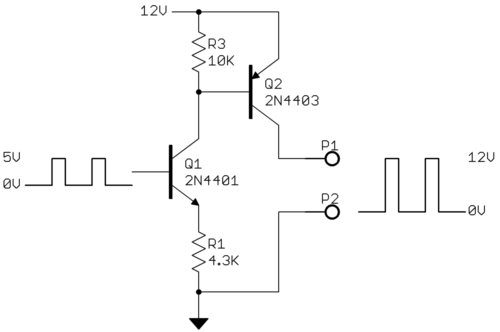
                level shift.gif

                See http://electronics.stackexchange.com/questions/17581/best-way-to-get-5v-or-12v-or-0v-from-arduino-pin for details on this circuit.

                Cheers
                Al

                A 1 Reply Last reply
                0
                • SparkmanS Sparkman

                  @andriej That's not the right way as there's nothing (other than the transistor) limiting the current between Vcc and GND. What you need to do is level shift the output of Pin 2 (0 to 5V) to the data input of the 433 module. The best way to level shift would be to do something like this:

                  level shift.gif

                  See http://electronics.stackexchange.com/questions/17581/best-way-to-get-5v-or-12v-or-0v-from-arduino-pin for details on this circuit.

                  Cheers
                  Al

                  A Offline
                  A Offline
                  andriej
                  wrote on last edited by
                  #8

                  @Sparkman thank you for your reply!
                  So I'd need two transistors - that's ok... But how (and which one) do I connect to DATA pin (as I assume)?
                  Or i could bridge P1 and P2 mentioned on schematics above?

                  :-)

                  SparkmanS 1 Reply Last reply
                  0
                  • A andriej

                    @Sparkman thank you for your reply!
                    So I'd need two transistors - that's ok... But how (and which one) do I connect to DATA pin (as I assume)?
                    Or i could bridge P1 and P2 mentioned on schematics above?

                    SparkmanS Offline
                    SparkmanS Offline
                    Sparkman
                    Hero Member
                    wrote on last edited by
                    #9

                    @andriej P1 would connect to the data pin. Ignore P2 as it is just ground.

                    Cheers
                    Al

                    A 1 Reply Last reply
                    0
                    • SparkmanS Sparkman

                      @andriej P1 would connect to the data pin. Ignore P2 as it is just ground.

                      Cheers
                      Al

                      A Offline
                      A Offline
                      andriej
                      wrote on last edited by
                      #10

                      @Sparkman Right, now I see.
                      Will NPN (2N2222 which I have) do the job?

                      :-)

                      SparkmanS 1 Reply Last reply
                      0
                      • A andriej

                        @Sparkman Right, now I see.
                        Will NPN (2N2222 which I have) do the job?

                        SparkmanS Offline
                        SparkmanS Offline
                        Sparkman
                        Hero Member
                        wrote on last edited by Sparkman
                        #11

                        @andriej It'll do the job of Q1, but Q2 is a PNP transistor. For it you would need something like the 2N2907, 2N3906 or 2N4403.

                        A 1 Reply Last reply
                        0
                        • SparkmanS Sparkman

                          @andriej It'll do the job of Q1, but Q2 is a PNP transistor. For it you would need something like the 2N2907, 2N3906 or 2N4403.

                          A Offline
                          A Offline
                          andriej
                          wrote on last edited by andriej
                          #12

                          @Sparkman time for getting parts as I don't have PNP in house.
                          Thank you. :-) Tommorow I'll test it out.

                          Just to be 100% sure - both GND's should be connected together (Uno's and 12V supply?)

                          :-)

                          SparkmanS 1 Reply Last reply
                          0
                          • A andriej

                            @Sparkman time for getting parts as I don't have PNP in house.
                            Thank you. :-) Tommorow I'll test it out.

                            Just to be 100% sure - both GND's should be connected together (Uno's and 12V supply?)

                            SparkmanS Offline
                            SparkmanS Offline
                            Sparkman
                            Hero Member
                            wrote on last edited by
                            #13

                            @andriej said:

                            Just to be 100% sure - both GND's should be connected together (Uno's and 12V supply?)

                            Yes, that's correct.

                            Cheers
                            Al

                            A 1 Reply Last reply
                            0
                            • SparkmanS Sparkman

                              @andriej said:

                              Just to be 100% sure - both GND's should be connected together (Uno's and 12V supply?)

                              Yes, that's correct.

                              Cheers
                              Al

                              A Offline
                              A Offline
                              andriej
                              wrote on last edited by
                              #14

                              @Sparkman thank you very much, it worked absolutely flawless. I can now again control the switches, will test it with different voltages and antennas.

                              One more thing - I've read some time ago that it might be worth considering a capacitor (polarized one) at least 10uF conected to transmitter's Vcc and GND.
                              Do you think it could stabilize power and smooth it even more, so the quality of signal and strenght could be even better?

                              As a antenna currently I use the core from coax tv cable, 174mm long - straight without any shielding.

                              Regards

                              :-)

                              SparkmanS 1 Reply Last reply
                              0
                              • A andriej

                                @Sparkman thank you very much, it worked absolutely flawless. I can now again control the switches, will test it with different voltages and antennas.

                                One more thing - I've read some time ago that it might be worth considering a capacitor (polarized one) at least 10uF conected to transmitter's Vcc and GND.
                                Do you think it could stabilize power and smooth it even more, so the quality of signal and strenght could be even better?

                                As a antenna currently I use the core from coax tv cable, 174mm long - straight without any shielding.

                                Regards

                                SparkmanS Offline
                                SparkmanS Offline
                                Sparkman
                                Hero Member
                                wrote on last edited by
                                #15

                                @andriej Glad to hear it's working. A capacitor between Vcc an GND can help smooth any ripple. It won't hurt to add it if you have one kicking around.

                                Cheers
                                Al

                                A 1 Reply Last reply
                                0
                                • SparkmanS Sparkman

                                  @andriej Glad to hear it's working. A capacitor between Vcc an GND can help smooth any ripple. It won't hurt to add it if you have one kicking around.

                                  Cheers
                                  Al

                                  A Offline
                                  A Offline
                                  andriej
                                  wrote on last edited by
                                  #16

                                  @Sparkman strange thing happened and suddenly everything stopped working.
                                  After rewiring (still leaving everything the same, just restarting of power supply) it worked for few minutes and stopped.
                                  Currently I've moved from ethernet shield to plain Uno (so only 2 pins are used: GND and D2 - TX Data) and still can't get signal out of the module...
                                  I even rewrote the code leaving everything not needed outside. Now I will be removing the cap between Vcc and GND.
                                  Hope it helps..

                                  :-)

                                  1 Reply Last reply
                                  0
                                  • A Offline
                                    A Offline
                                    andriej
                                    wrote on last edited by
                                    #17

                                    The only idea I have is that it stopped working because voltage went 12,4V…
                                    But all components (except TX module?) should accept it.
                                    I've switched from LAN to serial now and back to normal 5V with special antenna.

                                    :-)

                                    SparkmanS 1 Reply Last reply
                                    0
                                    • A andriej

                                      The only idea I have is that it stopped working because voltage went 12,4V…
                                      But all components (except TX module?) should accept it.
                                      I've switched from LAN to serial now and back to normal 5V with special antenna.

                                      SparkmanS Offline
                                      SparkmanS Offline
                                      Sparkman
                                      Hero Member
                                      wrote on last edited by
                                      #18

                                      @andriej Have you tested each component to see if one of them has failed?

                                      Cheers
                                      Al

                                      A 1 Reply Last reply
                                      0
                                      • SparkmanS Sparkman

                                        @andriej Have you tested each component to see if one of them has failed?

                                        Cheers
                                        Al

                                        A Offline
                                        A Offline
                                        andriej
                                        wrote on last edited by
                                        #19

                                        @Sparkman it will be hard for me to test now, as I've soldered everything on breadboard.

                                        What other PNP transistor would you fit instead of 2N4403?
                                        I will be buying few of them and can't exactly find the 440x's

                                        :-)

                                        SparkmanS 1 Reply Last reply
                                        0
                                        • A andriej

                                          @Sparkman it will be hard for me to test now, as I've soldered everything on breadboard.

                                          What other PNP transistor would you fit instead of 2N4403?
                                          I will be buying few of them and can't exactly find the 440x's

                                          SparkmanS Offline
                                          SparkmanS Offline
                                          Sparkman
                                          Hero Member
                                          wrote on last edited by Sparkman
                                          #20

                                          @andriej Digikey has a good transistor selector. You can see the specs for the 4403 and then find something with similar specs that may be more readily available where you live.

                                          http://www.digikey.com/product-search/en?pv7=2&FV=fff40015%2Cfff80078%2C1140050%2C1280002%2C142c0044%2C142c02ca%2C142c1dec&k=transistor&mnonly=0&newproducts=0&ColumnSort=0&page=1&quantity=0&ptm=0&fid=0&pageSize=25

                                          Cheers
                                          Al

                                          A 1 Reply Last reply
                                          0
                                          Reply
                                          • Reply as topic
                                          Log in to reply
                                          • Oldest to Newest
                                          • Newest to Oldest
                                          • Most Votes


                                          20

                                          Online

                                          11.7k

                                          Users

                                          11.2k

                                          Topics

                                          113.1k

                                          Posts


                                          Copyright 2025 TBD   |   Forum Guidelines   |   Privacy Policy   |   Terms of Service
                                          • Login

                                          • Don't have an account? Register

                                          • Login or register to search.
                                          • First post
                                            Last post
                                          0
                                          • MySensors
                                          • OpenHardware.io
                                          • Categories
                                          • Recent
                                          • Tags
                                          • Popular