
SSR 3-way relay suggestion
-
Hello,
Can anyone suggest ONE SSR 3-way relay? I need to "MySensorise" a fan in the bathroom and it is isolated, i.e. 3 different wires are switched on/off (L, N and other one, I guess a load (black colour)). I do not want to waist three different relays - I have a few 25-50A Croydom SSRs.
Load - 10-15A and 240V AC.
Input - 3V DC (to be managed by a node)
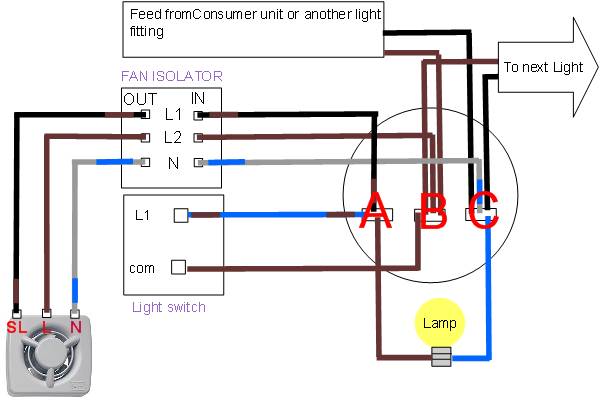
So it must be DC controlledEDIT: I am replacing isolator fan switch in this diagram:
-
Hello,
Can anyone suggest ONE SSR 3-way relay? I need to "MySensorise" a fan in the bathroom and it is isolated, i.e. 3 different wires are switched on/off (L, N and other one, I guess a load (black colour)). I do not want to waist three different relays - I have a few 25-50A Croydom SSRs.
Load - 10-15A and 240V AC.
Input - 3V DC (to be managed by a node)
So it must be DC controlledEDIT: I am replacing isolator fan switch in this diagram:
@alexsh1 You should not replace the isolator.
The isolator is there to enable disconnection of all power for service/cleaning/replacement/emergency disconnect. Also your labeling of the light switch is wrong. Com is actually Live and L1 should be SL. There is no common or neutral wire in a light switch.
At the moment, the light switch controls whether the fan is on or off. There is also the permanent live and neutral connections to the fan so I expect the fan has a time delay built in so that it continues working for a while after the light is switched off.
To control the fan independently of the light switch you simply need to connect a relay in the line from the fan isolator output L1 and input SL on the fan (SL = Switched Live).
You only need a single pole relay/switch or triac to do this.
-
In the bathroom you would probably want to use a solid state relay.
-
Also, you don't need a 15A relay for this. I doubt it will draw more than about 8-16W it is a reccent low noise fan, or 20-30W if it is older design. Just remember that the inrush current at start will be higher, but a 3A relay should be more than enough. If you take the fan down you may well find a relay inside attached to the timer circuit, that will give you more info on what you need.
As alowhum implied, do not use an open relay in a huhmid area, the contacts will corrode. A hermetically sealed mechanical relay will do the job, but a SSR will do just as well and with no 'click' noise when it switches as a bonus.
I hope I have helped clarify how this works now, but if you have any doubt, consult a qualified electrician in your country and follow the 18th edition regulations on wiring as a minimum. Also consider if DIY work on this will void your insurance in the event of a fire caused by the modification you intend? Be safe!
-
@alexsh1 You should not replace the isolator.
The isolator is there to enable disconnection of all power for service/cleaning/replacement/emergency disconnect. Also your labeling of the light switch is wrong. Com is actually Live and L1 should be SL. There is no common or neutral wire in a light switch.
At the moment, the light switch controls whether the fan is on or off. There is also the permanent live and neutral connections to the fan so I expect the fan has a time delay built in so that it continues working for a while after the light is switched off.
To control the fan independently of the light switch you simply need to connect a relay in the line from the fan isolator output L1 and input SL on the fan (SL = Switched Live).
You only need a single pole relay/switch or triac to do this.
@skywatch Thank you for an excellent answer. Well, if I have a proper SSR replay, it would work exactly the same way as the isolator switch, right?
The diagram was taken from the internet. Sorry - I just did not bother to draw mine.
Yes, you are correct, there is a 30 secs or so time delay on the fan.You see building regulations in the UK are not clear about to isolator switch. They refer to the fan manufacturers. And these guys always suggest the to install the isolator switch.
The relay will not be installed in the bathroom. It will be installed outside where the isolator switch is based (just outside the bathroom). Given that I have a new furniture - shelving units, which is not obstructing the isolator switch, the idea is to replace it with the SSR. Otherwise, it will be permanently obstructed and I won't be able to switch the fan on/off.
-
@skywatch Thank you for an excellent answer. Well, if I have a proper SSR replay, it would work exactly the same way as the isolator switch, right?
The diagram was taken from the internet. Sorry - I just did not bother to draw mine.
Yes, you are correct, there is a 30 secs or so time delay on the fan.You see building regulations in the UK are not clear about to isolator switch. They refer to the fan manufacturers. And these guys always suggest the to install the isolator switch.
The relay will not be installed in the bathroom. It will be installed outside where the isolator switch is based (just outside the bathroom). Given that I have a new furniture - shelving units, which is not obstructing the isolator switch, the idea is to replace it with the SSR. Otherwise, it will be permanently obstructed and I won't be able to switch the fan on/off.
@alexsh1 This is not a BAD idea, just bordering on Darwin Award territory - This is a safety isolator not a switch, it is outside the bathroom to comply with Regulations such that it KILLS everything by someone flicking the switch should anything electrical go wrong, such as you dancing in the shower with an electric fire on an extension lead to feel warmer, and your partner hears your screams from the Lounge, or perhaps smells the distinct odour of burning hair.
Personally I prefer the cord actuated switched hanging from the ceiling, the chances of pulling that in the agony of spasms from electrocution is infinitely greater than reaching the door, in turn much more likely than getting hold of, operating, and select appropriate icons on the mobile to stop the agony...
Maybe trial it, if we don't hear further, it probably didn't work... ;) -
@alexsh1 This is not a BAD idea, just bordering on Darwin Award territory - This is a safety isolator not a switch, it is outside the bathroom to comply with Regulations such that it KILLS everything by someone flicking the switch should anything electrical go wrong, such as you dancing in the shower with an electric fire on an extension lead to feel warmer, and your partner hears your screams from the Lounge, or perhaps smells the distinct odour of burning hair.
Personally I prefer the cord actuated switched hanging from the ceiling, the chances of pulling that in the agony of spasms from electrocution is infinitely greater than reaching the door, in turn much more likely than getting hold of, operating, and select appropriate icons on the mobile to stop the agony...
Maybe trial it, if we don't hear further, it probably didn't work... ;)@zboblamont said in SSR 3-way relay suggestion:
BAD
the isolation switch is purely for isolating the fan for maintenance purposes if it is fed from a lighting circuit. That's it.
BS7671 (Building Regulations in the UK) says nothing about it. Ultimately, it comes down to a fan manufacturer, a property developer or an electrician to install the isolator.:-))
Cord switches? You are too old-fashioned! -
@zboblamont said in SSR 3-way relay suggestion:
BAD
the isolation switch is purely for isolating the fan for maintenance purposes if it is fed from a lighting circuit. That's it.
BS7671 (Building Regulations in the UK) says nothing about it. Ultimately, it comes down to a fan manufacturer, a property developer or an electrician to install the isolator.:-))
Cord switches? You are too old-fashioned!@alexsh1 I think you missed the point, the isolator is there permanently, your remote control isn't. ;)
These isolators arose in the 60s (1960s before you ask) under the Electrical Regs when fans were found to occasionally go on fire and/or fall out with exposed wires, the pull-cord ceiling light switches go back to the 1950s for bathroom lights and went on to be used for bathroom fan isolators. It is intended as a kill switch not a maintenance switch.Controlling a bathroom light switch or a fan remotely is your choice, a single relay will do fine for either, but removing the safeties is a bit pointless.
-
@alexsh1 I think you missed the point, the isolator is there permanently, your remote control isn't. ;)
These isolators arose in the 60s (1960s before you ask) under the Electrical Regs when fans were found to occasionally go on fire and/or fall out with exposed wires, the pull-cord ceiling light switches go back to the 1950s for bathroom lights and went on to be used for bathroom fan isolators. It is intended as a kill switch not a maintenance switch.Controlling a bathroom light switch or a fan remotely is your choice, a single relay will do fine for either, but removing the safeties is a bit pointless.
-
@alexsh1 I think you missed the point, the isolator is there permanently, your remote control isn't. ;)
These isolators arose in the 60s (1960s before you ask) under the Electrical Regs when fans were found to occasionally go on fire and/or fall out with exposed wires, the pull-cord ceiling light switches go back to the 1950s for bathroom lights and went on to be used for bathroom fan isolators. It is intended as a kill switch not a maintenance switch.Controlling a bathroom light switch or a fan remotely is your choice, a single relay will do fine for either, but removing the safeties is a bit pointless.
@zboblamont I think the safety point is highly debatable these days. I can see why the isolators were installed in the 60s, but with modern bathroom fans, this is an obsolete. As I pointed out, it is not required to be installed by the Building Regulations (at least in the UK). Anyway, back to the topic, I'll have to check but I am sure the relay has to be placed behind the isolator socket box. The isolator itself will be buried behind a shelving unit



Hello! It looks like you're interested in this conversation, but you don't have an account yet.
Getting fed up of having to scroll through the same posts each visit? When you register for an account, you'll always come back to exactly where you were before, and choose to be notified of new replies (either via email, or push notification). You'll also be able to save bookmarks and upvote posts to show your appreciation to other community members.
With your input, this post could be even better 💗
Register Login