I need advice with brainstorming my farm project
-
@peterrr
Most people here aren't bridging 1000m distances, but probably some are. If you have line of sight, maybe (?) an amplified nRF24 will work for you.@NeverDie The penalty of higher amplification electrically is power consumption, gain is also a function of antenna type and directivity.
Farms are rarely in an urban area likely to cause interference. Even low power uhf on a dipole should link 1km, but for certain a colinear or small yagi should transceive no problem without the penalty imposed of slower data rate on Lora, or the consumption issues of higher power....
Worth considering I suggest.... -
@NeverDie The penalty of higher amplification electrically is power consumption, gain is also a function of antenna type and directivity.
Farms are rarely in an urban area likely to cause interference. Even low power uhf on a dipole should link 1km, but for certain a colinear or small yagi should transceive no problem without the penalty imposed of slower data rate on Lora, or the consumption issues of higher power....
Worth considering I suggest....@zboblamont said in I need advice with brainstorming my farm project:
for certain a colinear or small yagi should transceive no problem
Exactly which antenna (links?) do you recommend he buy?
-
@zboblamont said in I need advice with brainstorming my farm project:
for certain a colinear or small yagi should transceive no problem
Exactly which antenna (links?) do you recommend he buy?
@NeverDie Sorry, as an old time Ham I always built my own antennae except for FM mobile, radio hams had 430 - 440MHz in their allocation, so there is a wealth of info out their on options, if indeed that is frequency selected.
For simplicity, a dipole with a sheet reflector behind it will punch a lobe toward it's target pretty effectively. Last Yagi I built was a ZL type for 145MHz, cost about $20 in alloy, put it together in a week, 16dB gain... If you can solder SMD components, antenna building is pretty basic really... -
@zboblamont said in I need advice with brainstorming my farm project:
for certain a colinear or small yagi should transceive no problem
Exactly which antenna (links?) do you recommend he buy?
@NeverDie Sorry, forgot to add, don't ignore quad antennae when considering beams, they are much simpler to build than yagi, fairly wideband, all you need do is consider polarisation. A lump of 2x2 cedar, some cross drilled dowels, copper tube or alloy bar for elements, the hardest part is making the bazooka balun and waterproofing it really... Last one I built was a 3 to 1 elliptical which design theory some Japanese guys came up with, pretty amazing performance compared to it's quad original....
-
@NeverDie Sorry, forgot to add, don't ignore quad antennae when considering beams, they are much simpler to build than yagi, fairly wideband, all you need do is consider polarisation. A lump of 2x2 cedar, some cross drilled dowels, copper tube or alloy bar for elements, the hardest part is making the bazooka balun and waterproofing it really... Last one I built was a 3 to 1 elliptical which design theory some Japanese guys came up with, pretty amazing performance compared to it's quad original....
@zboblamont
Well, all this sounds great, but fairly exotic. -
@zboblamont
Well, all this sounds great, but fairly exotic.@NeverDie I suggest some use of Google may dispel any misunderstandings you may hold, it is far from exotic. Most of what is known today is based on professional and amateur experimentation over many decades, little of it is exotic perhaps refined but not beyond anyone with a basic understanding of what is required, it couldn't be else amateurs would be quite incapable of playing with copper and steel wires, aluminium rods, brass, even helium balloons to hoist antennae. R&D on frequencies and antennae preceded much of what is known today in terms of communications, and probably assisted it's progress. Most of antenna theory and development goes back over 100 years, in the supermarket mentality of modern days, the notion of bending a 6mm alloy rod to fulfill your requirements may seem abstract, but radio experimentation preceded your birth, I suggest you might take off the blinkers and look.... :)
-
@NeverDie I suggest some use of Google may dispel any misunderstandings you may hold, it is far from exotic. Most of what is known today is based on professional and amateur experimentation over many decades, little of it is exotic perhaps refined but not beyond anyone with a basic understanding of what is required, it couldn't be else amateurs would be quite incapable of playing with copper and steel wires, aluminium rods, brass, even helium balloons to hoist antennae. R&D on frequencies and antennae preceded much of what is known today in terms of communications, and probably assisted it's progress. Most of antenna theory and development goes back over 100 years, in the supermarket mentality of modern days, the notion of bending a 6mm alloy rod to fulfill your requirements may seem abstract, but radio experimentation preceded your birth, I suggest you might take off the blinkers and look.... :)
@zboblamont
Yes, but not everyone wants to become a quantum mechanic, because for them the more interesting part comes in actually using it. If it's not exotic, it should be easy to buy pre-made. -
@zboblamont
Yes, but not everyone wants to become a quantum mechanic, because for them the more interesting part comes in actually using it. If it's not exotic, it should be easy to buy pre-made.@NeverDie Oh dear, quantum mechanics? Ok, you want to buy, fair enough, others including the OP might prefer to DIY, but fair enough, first hit on Google... http://www.sandpiperaerials.com/product/13-element-zl-special-yagi/
-
@zboblamont
Yes, but not everyone wants to become a quantum mechanic, because for them the more interesting part comes in actually using it. If it's not exotic, it should be easy to buy pre-made.@NeverDie DIY, about 10...
-
You see, this is where your argument falls apart. £74.80 for a Yagi (it's your link) versus around $2.50 for an Ra-01.
@NeverDie Not really, there is no argument to fall apart unless you are incapable of some DIY and can do a bit of research, the very foundation of this particular forum.
I have never met a farmer yet who could not DIY, and even fewer who would shell out good money for a commercial product where they had bits kicking around the yard which could be re-purposed after a little research.
A Slim-Jim colinear is easily made from some wire and a water pipe, a dipole and reflector from some fence wire and an old bit of tinplate, the sort of material kicking around the average farmyard at no cost at all but with enough gain to easily cover a km or two with an extremely low output power RF unit, sipping by on a couple of AAs.
The commercial antenna I exampled would be a solution if you required that level of gain (14dBd) to cover long distances such as the ISS, but there are other cheaper antennae from that supplier, the J-pole for instance, 33 quid, but you could build it for 2.
Each to their own, none of it is rocket science or 'quantum mechanics'... -
@NeverDie Not really, there is no argument to fall apart unless you are incapable of some DIY and can do a bit of research, the very foundation of this particular forum.
I have never met a farmer yet who could not DIY, and even fewer who would shell out good money for a commercial product where they had bits kicking around the yard which could be re-purposed after a little research.
A Slim-Jim colinear is easily made from some wire and a water pipe, a dipole and reflector from some fence wire and an old bit of tinplate, the sort of material kicking around the average farmyard at no cost at all but with enough gain to easily cover a km or two with an extremely low output power RF unit, sipping by on a couple of AAs.
The commercial antenna I exampled would be a solution if you required that level of gain (14dBd) to cover long distances such as the ISS, but there are other cheaper antennae from that supplier, the J-pole for instance, 33 quid, but you could build it for 2.
Each to their own, none of it is rocket science or 'quantum mechanics'...@zboblamont
I see. And anyone can properly tune this DIY antenna you're proposing that's made from barnyard scrap without using a network analyzer, right? -
@zboblamont
I see. And anyone can properly tune this DIY antenna you're proposing that's made from barnyard scrap without using a network analyzer, right?@NeverDie Jeez, why so negative?
Why would anybody want to use a network analyser for an antenna?If you meant a Grid Dip Oscillator, I made one many moons ago but never used it once. Go figure... Have used a SWR meter to tweak an antenna to 1:1, but usually found it was <1.5 as built which is fine.
A dipole using straight wire is well documented on these forums and elsewhere, a plate wire or corner reflector spaced correctly forces the lobe in the intended direction with zero effect on SWR, hence making it higher gain, adding reflectors adds to that gain as it narrows the radiated lobe, simple well established science.
1km should be easy enough on a dipole anyway with line of sight, a reflector or director simply boosts the gain with no hit on consumed power.There are a multitude of Ham origin DIY designs for the same band, the commercial J-pole I pointed to was a DIY design, the Slim-Jim a DIY variant on that (from memory a version using the coax only, the commercial ZL again a Ham DIY original, none of this is ground-breaking or difficult to research, but we are talking very long distances with such gain...
-
Hi, I've been reading through the forum and website and what a great community and fantastic projects!
I'm a farmer and electronics hobbyist. I've built several Arduino projects to help me run the farm, including automation of our greenhouse, hothouse, orchards irrigation and weather station. It's all great but it's time to integrate everything... It's too many odd projects and they do not talk with each other. I'm so excited when I found the mysensors.org site.
Thus I have reasonable Arduino experience, but limited Raspberry experience.
Hardware I have:
Aduino: Mega's, Uno's, Nano's, NodeMCU's, Pro Mini's
Raspberry: Pi B+, Pi A+, Pi 2 Model B
Plenty of sensors etc.I need some guidance, advice or tips please!
My goal is to turn all my existing projects into nodes. This I will be fine with. I will add NRF24L01 for all the nodes.
But the rest is new territory...Do I understand it correct that I need a gateway / controller (Raspberry) with NRF24L01 and then my nodes will all talk with the Raspberry?
Which Raspberry model will be best to use?
Which Controller platform is the best to use for my function?Any guidance will be appreciated please!
Kind Regards,
Peter@peterrr
As a wet-behind-the-ears but reasonably successful novice with MySensors etc., I recommend first thing that you get something, anything, up and running that will cover the whole range of sensor->transport->controller working in a very simple way. This will dramatically help you figure out the parts and pieces. It can be very frustrating and time consuming getting your "hello world" first example of having sensor data appear on some device, as you really don't know which pieces are working and which aren't until you are there.Specific suggestions:
Controller: Start with Domoticz as your controller. Vastly simpler than OpenHAB to get running, and surprisingly useful. Install it on a RPi connected to your LAN.
Sensor Node: If you have any practical use for wifi as the transport for some of your sensors (i.e. areas with wifi coverage) the simplest sensor/transport is ESP Easy on a ESP8266 such as WeMos Pro Mini or NodeMCU hardware, with any supported temperature sensor such as NRF24L01 or DHT22 (AM2302). These will talk over WiFi directly to Domoticz on a RPi. No code to write or modifiy with ESP Easy.
In a fraction of a day you can have a controller and working sensor up and running. Knowing your controller actually works is a much easier place to start from with MySensors radios etc.
Next steps: MySensors sensor nodes can be run on an ESP8266 client gateway without separate radios where Wifi is available, so you can get ahead on how MySensors code works out of the way before tackling radio hardware.
Finally, for long range/out of wifi scenarios, you can then start messing around with radio transport, which means you need sensors attached to one or many Arduinos which host one or more sensors. To get at the sensor data, you need a controller (Domoticz etc.) to receive the sensor data and make it available on your LAN with a web browser.
Domoticz is able to forward data to cool things like Grafana/InfluxDB or other dashboards for graphing, consolidating, presentation, etc.
None of these parts or pieces are too tough for someone with your background. But working on all of them at the same time is a pretty tough learning/debugging process.
Have fun,
Tim
-
I have had great success with OpenHAB. If you're not afraid of learning a scripting language, it can be very powerful and flexible.
-
@peterrr
As a wet-behind-the-ears but reasonably successful novice with MySensors etc., I recommend first thing that you get something, anything, up and running that will cover the whole range of sensor->transport->controller working in a very simple way. This will dramatically help you figure out the parts and pieces. It can be very frustrating and time consuming getting your "hello world" first example of having sensor data appear on some device, as you really don't know which pieces are working and which aren't until you are there.Specific suggestions:
Controller: Start with Domoticz as your controller. Vastly simpler than OpenHAB to get running, and surprisingly useful. Install it on a RPi connected to your LAN.
Sensor Node: If you have any practical use for wifi as the transport for some of your sensors (i.e. areas with wifi coverage) the simplest sensor/transport is ESP Easy on a ESP8266 such as WeMos Pro Mini or NodeMCU hardware, with any supported temperature sensor such as NRF24L01 or DHT22 (AM2302). These will talk over WiFi directly to Domoticz on a RPi. No code to write or modifiy with ESP Easy.
In a fraction of a day you can have a controller and working sensor up and running. Knowing your controller actually works is a much easier place to start from with MySensors radios etc.
Next steps: MySensors sensor nodes can be run on an ESP8266 client gateway without separate radios where Wifi is available, so you can get ahead on how MySensors code works out of the way before tackling radio hardware.
Finally, for long range/out of wifi scenarios, you can then start messing around with radio transport, which means you need sensors attached to one or many Arduinos which host one or more sensors. To get at the sensor data, you need a controller (Domoticz etc.) to receive the sensor data and make it available on your LAN with a web browser.
Domoticz is able to forward data to cool things like Grafana/InfluxDB or other dashboards for graphing, consolidating, presentation, etc.
None of these parts or pieces are too tough for someone with your background. But working on all of them at the same time is a pretty tough learning/debugging process.
Have fun,
Tim
@Grubstake this is exactly the type of advice I was hoping for, thank you for your response!
I have Domoticz in my top 3 options for controller, the other 2 OpenHAB and MyController.Controller: I will give Domoticz a try. Will one of my older Raspberry Pi's be sufficient?
Sensor Node: I have some NodeMCU boards with sensors, currently connected to my Wifi. I can try your suggested procedure from simple to more complex, just to get a feel... but yes ultimately I need to make the node network separate from the wifi network with radios etc.
The Grafana and InfluxDB dashboard sound interesting, I will have a look :)
-
@Carywin thanks, it's now in the top 3 of my controller options at this stage. So you can see this for managing some sensors and relays on a farm?
@peterrr Yes absolutely. I have it mixing up RFM69 wireless sensors and actuators with MySensors, MQTT sensors on WiFi ESP8266 via PubSubClient and Sonoff-Tasmota, Zigbee lights via Belkin Wemo, and locally-attached sensors on RPi GPIO and RS485 links. It smashes them all together in a very flexible and adaptable way.
-
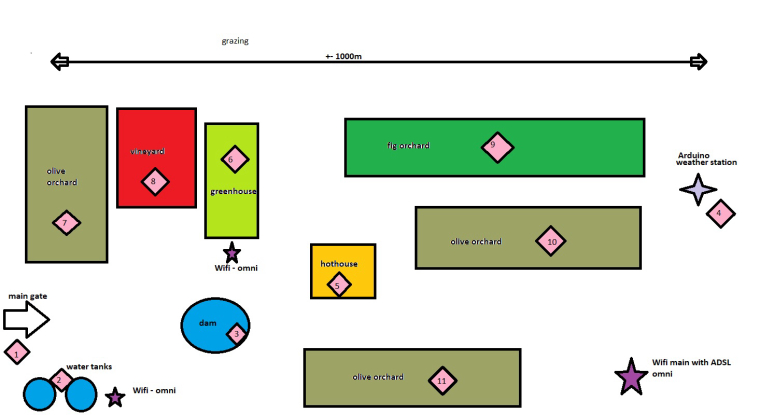
So if this was your farm, what would you do?
Thus 11 Arduino projects currently and I would like to turn them into nodes. I have a Raspberry Pi to use that I can place of at any one of the Wifi AP's.1 sensing when the gate opens
2 irrigation controller
3 water level sensor
4 weather station
5 hothouse controller
6 greenhouse controller
7 - 11 soil and environment sensors- all above is Arduinio
-
So if this was your farm, what would you do?
Thus 11 Arduino projects currently and I would like to turn them into nodes. I have a Raspberry Pi to use that I can place of at any one of the Wifi AP's.1 sensing when the gate opens
2 irrigation controller
3 water level sensor
4 weather station
5 hothouse controller
6 greenhouse controller
7 - 11 soil and environment sensors- all above is Arduinio
@peterrr Now that is more interesting but missing one essential, power distribution v battery power... If you can bridge the range with a power supply (with backup) you could relay your nodes to a gateway at that central point, and collate and re-transmit to your controller possibly? 500m is way easier than 1000m... If you have a sheet metal facing to a building at HQ facing the direction of the nodes or can make a reflective facade, perhaps you could dispense with the remote gateway and combine at the receive end ?
Thoughts ?