
How is this receiver able to continuously Rx but consume only 90ua?
-
The AS3930 is designed to be used with inductive coupled antennas, as in RF-ID devices, where it can feed on the energy generated in the magnetic loop..
It's stated on page 12 in the datasheet (detailed description)
The AS3930 is capable of detecting the presence of an inductive coupled carrier and extract the envelope of the ON-OFF-Keying (OOK) modulated carrier
So unless you want to make a gigantic coil, covering the whole house, it's not usable for waking up low power (my)sensors devices.
-
The AS3930 is designed to be used with inductive coupled antennas, as in RF-ID devices, where it can feed on the energy generated in the magnetic loop..
It's stated on page 12 in the datasheet (detailed description)
The AS3930 is capable of detecting the presence of an inductive coupled carrier and extract the envelope of the ON-OFF-Keying (OOK) modulated carrier
So unless you want to make a gigantic coil, covering the whole house, it's not usable for waking up low power (my)sensors devices.
@tbowmo Good catch! That removes it from consideration, at least for me.
The nRF52810 may be "good enough," using an average 27 microamps as a Bluetooth Tile receiver: https://www.nordicsemi.com/News/2019/10/Tile-employs-nRF52810-to-provide-ultra-low-power-connectivity
Here's my math:
Assume 0.235amp-hour useable capacity for a CR2032. The article says it lasts 1 year. Then 0.235/365/24=27uaIt has me curious now as to just how frequently the new Tile goes into Rx mode. If it's 10 times a second, then that would be ideal (at least the potential for no perceptable lag). I'd be curious as to whether it uses synchronized clocks to cut down on the Tx window. If not, it might be rather laggy if the transmitter is shooting out packets blindly but not continuously during a tile-finding sequence. i.e. it might be good enough for a Tile, but it would exclude things that need more responsiveness (like, say, remote controlling a toy).
-
The AS3930 is designed to be used with inductive coupled antennas, as in RF-ID devices, where it can feed on the energy generated in the magnetic loop..
It's stated on page 12 in the datasheet (detailed description)
The AS3930 is capable of detecting the presence of an inductive coupled carrier and extract the envelope of the ON-OFF-Keying (OOK) modulated carrier
So unless you want to make a gigantic coil, covering the whole house, it's not usable for waking up low power (my)sensors devices.
-
@surgetransient cool. That’s from my home town :)
Abstract:
The proposed system has a current consumption of 42.74μA including the current consumption of the components deployed in the demo board. In an ideal case, wake-up radio can be constructed without using AS3933 demo board by using only AS3933 IC that gives current consumption of 2.8μA. The developed prototype has a sensitivity of -40 dBm which resulted in a wake-up distance of 20 meters at an output power of -5 dBm from the transmitting antenna.
-
@surgetransient cool. That’s from my home town :)
Abstract:
The proposed system has a current consumption of 42.74μA including the current consumption of the components deployed in the demo board. In an ideal case, wake-up radio can be constructed without using AS3933 demo board by using only AS3933 IC that gives current consumption of 2.8μA. The developed prototype has a sensitivity of -40 dBm which resulted in a wake-up distance of 20 meters at an output power of -5 dBm from the transmitting antenna.
@mfalkvidd Something doesn't make sense here. If the Rx current consumption is a mere 2.8uA, then why does the rest of his system add up to 42.7uA? At least on its face, that sounds much less good than the "duty-cycled" systems, like the nRF52, that he claims his system is better than. Unless maybe it's just a hacked together POC system. But then his masters thesis is just proving that a commerical chip isn't lying when it says its current consumption is 2.8uA.
I guess I'll have to read the thesis to find out why, but his summary should have addressed this rather glaring issue with at least a sentence or two.
-
@mfalkvidd Something doesn't make sense here. If the Rx current consumption is a mere 2.8uA, then why does the rest of his system add up to 42.7uA? At least on its face, that sounds much less good than the "duty-cycled" systems, like the nRF52, that he claims his system is better than. Unless maybe it's just a hacked together POC system. But then his masters thesis is just proving that a commerical chip isn't lying when it says its current consumption is 2.8uA.
I guess I'll have to read the thesis to find out why, but his summary should have addressed this rather glaring issue with at least a sentence or two.
-
@neverdie sorry, that was only a section of the abstract (the most interesting part imho)
@mfalkvidd Yes, I agree you quoted the most interesting passage of the abstract. Re-reading it, I'm guessing he's saying that the system consumption is high because of inefficient components on the demo board, but that a properly developed system would be much closer to the 2.8uA.
If such a system could also be duty cycled, just imagine how low the average Rx current would be. I look forward to seeing whether he analyzes that in his thesis or not. Or, maybe it already is being duty cycled in addition to using the low current receiver. The abstract seems to imply it's not duty cycled, but it's worded a bit too hazily to be sure.
-
As near as I can tell, it does receive continuously, and the reason why the current draw is so low is that it works essentially like a crystal radio. Instead of your ear listening to an earpiece, the AS3933 looks for a signal pattern that you program into it, and that is what consumes the 2.8ua of current. If it finds a match, it issues a wake-up.
Therefore, answering my own question, it would appear that AS3933 could be duty cycled to use even less current.
Range is a bit unclear, but looks encouraging. Unfortunately, the guy who wrote the thesis couldn't be bothered to do any range tests outside of just his lab, so he only tested low transmission powers at fairly short range. Indeed, Table 4 contains a total of only 3 such measurements, one at -10dbm and two at -5dbm. He wrote that he had planned to test over a wider range (from -10dbm to +10dbm), but he literally stopped testing when the range would have gone beyond the door of his lab.
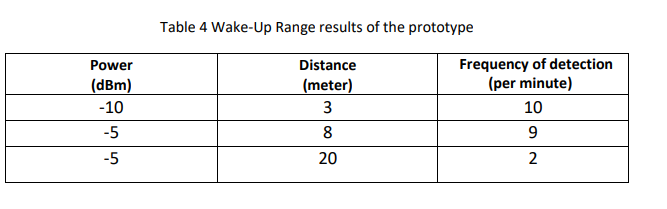
I'd be interested in giving it a try. The official demo boaard is $250 though. Anyone know of a cheaper alternative for giving AS3933 or AS3932 a test-drive?
-
-
A different link to the same thesis as previoiusly where he claims a wake-up distance of 20 meters: https://hh.diva-portal.org/smash/get/diva2:1187369/FULLTEXT02.pdf
Well, it looks not difficult to construct. The AS3933 chips are available for around $1.30 on aliexpress, so cheaper than nRF5x chips. Perhaps cheapest of all would be be a tightly controlled nRF24L01, but it would surely draw more current listening than an AS3933.




Hello! It looks like you're interested in this conversation, but you don't have an account yet.
Getting fed up of having to scroll through the same posts each visit? When you register for an account, you'll always come back to exactly where you were before, and choose to be notified of new replies (either via email, or push notification). You'll also be able to save bookmarks and upvote posts to show your appreciation to other community members.
With your input, this post could be even better 💗
Register Login