
Support for CC1101 radios
-
I wanted 433MHz support to improve performance in an environment challenging to 2.4GHz, so I bought a bunch of cheap CC1101 radio modules and set about writing a HAL driver for this chipset. I probably should have bought some RFM69 modules, but I wanted the challenge of supporting another popular radio.
I took inspiration from some of the other radio drivers, and now have a fully featured driver that is very stable and I have a small network of nodes running nicely now. Nodes are AVR and the gateway is ESP32.
Power consumption is very similar to the RF24 radios (~20mA on full power xmit and a couple of uA in sleep). It also includes adaptive power control to automatically set TX power to just the necessary level.
My fork with cc1101 branch are in my repo, I have also added some documentation (some AI assistance here as I got lazy) . I've gotten the code pretty clean but probably still has a little development cruft left in it.
Would there be any interest in merging into the core?
Happy to take feedback, PRs, etc.
-
Nice. I know there are RFM69's, but I've seen quite a few requests for the CC1101. Always good to have options.
I did something similar with the WIO-E5 chips in my repo. The E5 is not quite ready for prime time, but the basics are working.
I have many MySensors nodes, and still adding more. Good to see some new code for it. -
I wanted 433MHz support to improve performance in an environment challenging to 2.4GHz, so I bought a bunch of cheap CC1101 radio modules and set about writing a HAL driver for this chipset. I probably should have bought some RFM69 modules, but I wanted the challenge of supporting another popular radio.
I took inspiration from some of the other radio drivers, and now have a fully featured driver that is very stable and I have a small network of nodes running nicely now. Nodes are AVR and the gateway is ESP32.
Power consumption is very similar to the RF24 radios (~20mA on full power xmit and a couple of uA in sleep). It also includes adaptive power control to automatically set TX power to just the necessary level.
My fork with cc1101 branch are in my repo, I have also added some documentation (some AI assistance here as I got lazy) . I've gotten the code pretty clean but probably still has a little development cruft left in it.
Would there be any interest in merging into the core?
Happy to take feedback, PRs, etc.
@buxtronix thanks for the effort! Why not make a PR? 433MHz is a quite unique value proposition of MySensors. I'd recommend a quick search through the open issues on MySensors github, maybe some CC1101 support was requested already. In any way, I'd encourage to raise a PR to the development branch. Who knows, if we get some people engaged, maybe we can release a new official version of MySensors with improved hardware support.
Thx, Dirk. -
I finally got around to creating a PR into the official repo, as it's been running reliably for some time so I believe it's ready.
-
So almost time to create a 3rd gateway? :) I'm switching over to RFM69 for now, due to it's high range. Although it's significantly slower than NRF. So Curious about the performance of CC1101 any stats on power consumption?
-
The CL got accepted and merged, so now MySensors officially supports CC1101!
Yes CC1101 is slower than NRF (the bitrate tops out at 250k, NRF starts at 250k), so I imagine this would increase
power consumption a little simply due to the longer airtime. However idle power consumption is comparable.Penetration is certainly better, I have been running an NRF network for nearly a decade, but wanted to add a 433MHz network due to wall penetration issues, hence this feature.
-
Thank you Buxtronix
-
I finally got around to measuring power consumption, with some good results. I made two nodes that were identical except one with a CC1101 and the other on an RF24 network. The nodes had a single SHT31 temp/humidity sensor and woke up every 10s to transmit a single temperature value.
I measured power consumption with an oscilloscope across a 10 ohm shunt on the battery line, so current is v/10. For both nodes, sleep current was near identical, around 4.5uA.
Values for TX over a 60mS window:
- On the CC1101 without MY_PASSIVE_NODE, average current draw during TX was 9.7mA.
- When I enabled MY_PASSIVE_NODE, this dropped considerably down to 3.3mA.
- For RF24 both with and without MY_PASSIVE_NODE, current was 2.2mA.
When averaging for a node transmitting once per minute, this would provide a long lifetime on both radios. With a 180mAh CR2032, I'd calculate a lifetime of:
- 1150 days on a RF24
- 540 days for CC1101 without MY_PASSIVE_NODE
- 975 days for CC1101 with MY_PASSIVE_NODE
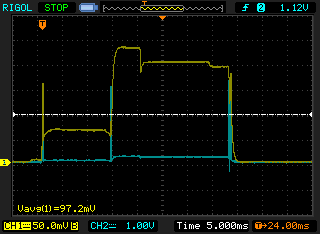
The use of MY_PASSIVE_NODE helps on CC1101, as the node does a 'fire-and-forget' on TX. Without this, it listens for an ack from the gateway, drawing RX current. For RF24, the ack is handled in hardware which is considerably quicker.
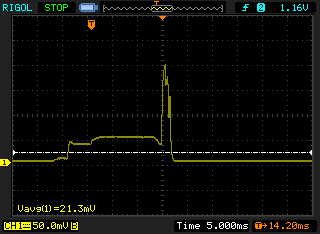
Some graphs! The ~12mS hump before TX is the SHT31 acquisition.
RF24 transmit (not sure what the initial 4ms bump is, radio coming out of sleep maybe?):
CC1101 active mode (blue curve is CC1101 CLK line):
CC1101 passive node:
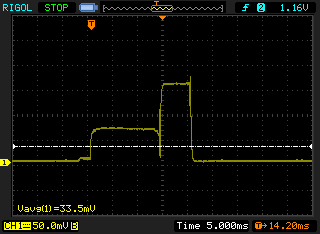
So yeah, interesting results, in summary the CC1101 is a bit more power hungry than the RF24, but results in only around 10% drop in battery life if used in passive mode (or 50% in active mode).
-
nice! I'm happy that there is another radio to use




Hello! It looks like you're interested in this conversation, but you don't have an account yet.
Getting fed up of having to scroll through the same posts each visit? When you register for an account, you'll always come back to exactly where you were before, and choose to be notified of new replies (either via email, or push notification). You'll also be able to save bookmarks and upvote posts to show your appreciation to other community members.
With your input, this post could be even better 💗
Register Login