
Arduino Pro Mini adapter card and nice box from "biltema"
-
-
-
-
-
-
Yes, I'm using 2x1.5V and it seams to work well..
The card uses around 30uA (+- the precision of my multimeter) in idle/sleep and that should give a pretty long run time on batteries.
I have nodes that has been online since before Christmas and still going strong.
/Magnus
@fot said:
Yes, I'm using 2x1.5V and it seams to work well..
The card uses around 30uA (+- the precision of my multimeter) in idle/sleep and that should give a pretty long run time on batteries.
I have nodes that has been online since before Christmas and still going strong.
/Magnus
Have you something else connected than Arduino and NRF? Any Sensors or Powersupply? I got down to below 4uA with Atmega and NRF sleeping, measured with Agilent precision desktop multimeter. (Nothing else connected because it was a remote with only buttons). If you have your ATMega in deepsleep you should have less than 10uA (datasheet says so). Just seeing that you use the Arduino Pro Mini. I used dedicated ATMega w/o Arduino HW... Anyways 30uA is also quiet good I think. it should give you more than a year stand by time (theoretical).
(800mAh Battery / (30uA circuit + 30uA self discharge) /24h = 555 days) -
-
-
@fot said:
Yes, I'm using 2x1.5V and it seams to work well..
The card uses around 30uA (+- the precision of my multimeter) in idle/sleep and that should give a pretty long run time on batteries.
I have nodes that has been online since before Christmas and still going strong.
/Magnus
Have you something else connected than Arduino and NRF? Any Sensors or Powersupply? I got down to below 4uA with Atmega and NRF sleeping, measured with Agilent precision desktop multimeter. (Nothing else connected because it was a remote with only buttons). If you have your ATMega in deepsleep you should have less than 10uA (datasheet says so). Just seeing that you use the Arduino Pro Mini. I used dedicated ATMega w/o Arduino HW... Anyways 30uA is also quiet good I think. it should give you more than a year stand by time (theoretical).
(800mAh Battery / (30uA circuit + 30uA self discharge) /24h = 555 days)@Dirk_H said:
@fot said:
Yes, I'm using 2x1.5V and it seams to work well..
The card uses around 30uA (+- the precision of my multimeter) in idle/sleep and that should give a pretty long run time on batteries.
I have nodes that has been online since before Christmas and still going strong.
/Magnus
Have you something else connected than Arduino and NRF? Any Sensors or Powersupply? I got down to below 4uA with Atmega and NRF sleeping, measured with Agilent precision desktop multimeter. (Nothing else connected because it was a remote with only buttons). If you have your ATMega in deepsleep you should have less than 10uA (datasheet says so). Just seeing that you use the Arduino Pro Mini. I used dedicated ATMega w/o Arduino HW... Anyways 30uA is also quiet good I think. it should give you more than a year stand by time (theoretical).
(800mAh Battery / (30uA circuit + 30uA self discharge) /24h = 555 days)The regulator on the pro mini is still connected it might drain some uA still.
I just removed the power led from the board.
I had one DS18b20 connected at the time of measuring.When i hit 30uA I did not dig any further into it.
I have > 800mAh batteries so I will get > 2 years of operation.
Might do some more analysis of it later on.
/Magnus
-
Hi,
would u share / show the schematic? I actually do the same: A small battery-powered "Baseplate" for the pro mini and a NRF24l01. But i wanted to use a HT7733 instead of HT7133 and definitivly NO SMD parts :)
greetings
Andreas
-
Hi,
would u share / show the schematic? I actually do the same: A small battery-powered "Baseplate" for the pro mini and a NRF24l01. But i wanted to use a HT7733 instead of HT7133 and definitivly NO SMD parts :)
greetings
Andreas
@ahhk said:
Hi,
would u share / show the schematic? I actually do the same: A small battery-powered "Baseplate" for the pro mini and a NRF24l01. But i wanted to use a HT7733 instead of HT7133 and definitivly NO SMD parts :)
As I wrote before. I have some modifications I like to do before but after that I will probably release the card to the public including Eagle files.
/Magnus
-
I went and picked up one of these boxes. As suggested, the box fits perfectly, has clips (no screws), removable terminal blocks and has a nice stylish front that would probably work in most homes.
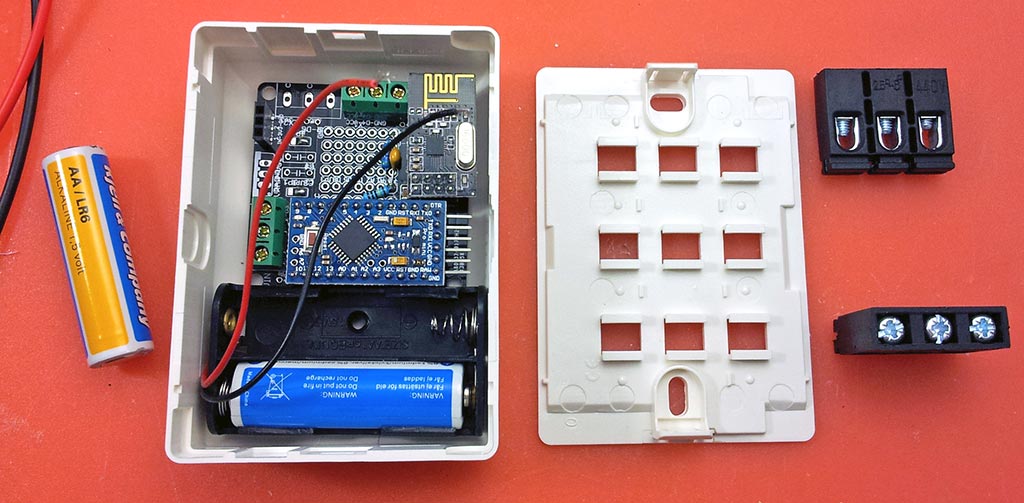
Thanks again for the tip! At 20 SEK ($2.3) it is quite affordable also. Makes me question 3D printing and CNC routing. -
I picked up the smaller variant (http://www.biltema.dk/da/Byggeri/El/Elektrikervarktoj/El-dase-35209/?artId=35209)
If it wasn't for that darn screw in the middle, it would be a perfect fit for the Mysensor micro.
I'm thinking about modifying the box, and remove the screw. But then nothing is holding the box together.
/ Thomas
-
-
I am wondering if you have done improvements and published this schematic or eagle files? These are exactly as I have been thinking about to make the package better than simply using jumper wires to build my desired sensors. If you published them to OshPark or similar I would definitely buy several.
Regards,
Bruce
-
I am wondering if you have done improvements and published this schematic or eagle files? These are exactly as I have been thinking about to make the package better than simply using jumper wires to build my desired sensors. If you published them to OshPark or similar I would definitely buy several.
Regards,
Bruce



Hello! It looks like you're interested in this conversation, but you don't have an account yet.
Getting fed up of having to scroll through the same posts each visit? When you register for an account, you'll always come back to exactly where you were before, and choose to be notified of new replies (either via email, or push notification). You'll also be able to save bookmarks and upvote posts to show your appreciation to other community members.
With your input, this post could be even better 💗
Register Login