
VEML6070 and VEML6075 UV sensors
-
@korttoma what do you need exactly?? I can share some example, but there is nothing fancy for veml6075. On my side i'm using this lib for the moment https://github.com/schizobovine/VEML6075 , not digged much yet but it's working with MySensors of course. You simply need the same cooking in your sketch, as usual ;)
-
Well, I'm looking to replace my Oregon Scientific UV Sensor UVN800 (that finally stopped reporting any values) by using a VEML6075 and a Sensebender Micro.
I can probably work out the code for the sketch myself but I'm not a fan of reinventing the wheel so if someone already created a sketch it would simply save me the time.
I would expect the sensor to report a UV Index value between 0 and 10 like the Oregon sensor did according to this -> https://www.epa.gov/sunsafety/uv-index-scale-1
The example in the Lib you mentioned @scalz seems to have the UV Index posibility
- Tomas
-
Well, I'm looking to replace my Oregon Scientific UV Sensor UVN800 (that finally stopped reporting any values) by using a VEML6075 and a Sensebender Micro.
I can probably work out the code for the sketch myself but I'm not a fan of reinventing the wheel so if someone already created a sketch it would simply save me the time.
I would expect the sensor to report a UV Index value between 0 and 10 like the Oregon sensor did according to this -> https://www.epa.gov/sunsafety/uv-index-scale-1
The example in the Lib you mentioned @scalz seems to have the UV Index posibility
@korttoma this thread is about VEML6075 :-)
However, VEML6075 is more complex - it does report uv-a and uv-b. I do not think you'd get UVI from this sensor straight away, you'd need to do it in the sketch.I can share the sketch after I get the sensor, write a code and convert it into MySensors
-
@korttoma oki, i agree with you about reinventing the wheel, but for big job. I think it's always better to know how to use the lib, so that's not a waste imho ;)
No time for the moment to check my bigger sketch and extract everything.
But in case you would like to try your new sensor, here a quick 5-10min conversion and mix of the lib example to mysensors uv. I wouldn't release it like this, not optimized, and untested version. But it's compiling, it should work :)
// Enable debug prints to serial monitor
#define MY_DEBUG

// Enable and select radio type attached
#define MY_RADIO_NRF24
//#define MY_RADIO_RFM69

//#define MY_NODE_ID 10

#include <MySensors.h>

#include <VEML6075.h>


VEML6075 veml6075 = VEML6075();
bool sensorFound = false;

#define CHILD_ID_UVI 0
#define CHILD_ID_UVA 0
#define CHILD_ID_UVB 0

uint32_t SLEEP_TIME = 30*1000; // Sleep time between reads (in milliseconds)

MyMessage uviMsg(CHILD_ID_UVI, V_UV);
MyMessage uvaMsg(CHILD_ID_UVA, V_UV);
MyMessage uvbMsg(CHILD_ID_UVB, V_UV);


void presentation()
{
    // Send the sketch version information to the gateway and Controller
    sendSketchInfo("UV Sensor", "1.3");

    // Register all sensors to gateway (they will be created as child devices)
    present(CHILD_ID_UVI, S_UV);
    present(CHILD_ID_UVA, S_UV);
    present(CHILD_ID_UVB, S_UV);
}

void setup()
{
  if (!veml6075.begin()) {
    Serial.println(F("VEML6075 not found!"));
  } else
    sensorFound = true;

}

void loop()
{
  if (sensorFound) {
    unsigned long lastSend =0;
    float uvi;
    float uva;
    float uvb;
    static float uviOld = -1;
    static float uvaOld = -1;
    static float uvbOld = -1;

    // Poll sensor
    veml6075.poll();

    uva = veml6075.getUVA();
    Serial.print(F("UVA = "));
    Serial.println(uva, 2);

    uvb = veml6075.getUVB();
    Serial.print(F("UVB = "));
    Serial.println(uvb, 2);

    uvi = veml6075.getUVIndex();
    Serial.print(F("UV Index = "));
    Serial.println(uvi, 1);

    uint16_t devid = veml6075.getDevID();
    Serial.print(F("Device ID = "));
    Serial.println(devid, HEX);

    Serial.println(F("----------------"));

    if (uvi != uviOld) {
        send(uviMsg.set(uvi,2));
        uviOld = uvi;
    }
    if (uva != uvaOld) {
        send(uvaMsg.set(uva,2));
        uvaOld = uva;
    }
    if (uvb != uvbOld) {
        send(uvbMsg.set(uvb,2));
        uvbOld = uvb;
    }
  }

  sleep(SLEEP_TIME);
}
It simply read sensor, send messages, and sleep.
As you can see, it's possible to get the three values from the lib.
-
@korttoma oki, i agree with you about reinventing the wheel, but for big job. I think it's always better to know how to use the lib, so that's not a waste imho ;)
No time for the moment to check my bigger sketch and extract everything.
But in case you would like to try your new sensor, here a quick 5-10min conversion and mix of the lib example to mysensors uv. I wouldn't release it like this, not optimized, and untested version. But it's compiling, it should work :)
// Enable debug prints to serial monitor
#define MY_DEBUG

// Enable and select radio type attached
#define MY_RADIO_NRF24
//#define MY_RADIO_RFM69

//#define MY_NODE_ID 10

#include <MySensors.h>

#include <VEML6075.h>


VEML6075 veml6075 = VEML6075();
bool sensorFound = false;

#define CHILD_ID_UVI 0
#define CHILD_ID_UVA 0
#define CHILD_ID_UVB 0

uint32_t SLEEP_TIME = 30*1000; // Sleep time between reads (in milliseconds)

MyMessage uviMsg(CHILD_ID_UVI, V_UV);
MyMessage uvaMsg(CHILD_ID_UVA, V_UV);
MyMessage uvbMsg(CHILD_ID_UVB, V_UV);


void presentation()
{
    // Send the sketch version information to the gateway and Controller
    sendSketchInfo("UV Sensor", "1.3");

    // Register all sensors to gateway (they will be created as child devices)
    present(CHILD_ID_UVI, S_UV);
    present(CHILD_ID_UVA, S_UV);
    present(CHILD_ID_UVB, S_UV);
}

void setup()
{
  if (!veml6075.begin()) {
    Serial.println(F("VEML6075 not found!"));
  } else
    sensorFound = true;

}

void loop()
{
  if (sensorFound) {
    unsigned long lastSend =0;
    float uvi;
    float uva;
    float uvb;
    static float uviOld = -1;
    static float uvaOld = -1;
    static float uvbOld = -1;

    // Poll sensor
    veml6075.poll();

    uva = veml6075.getUVA();
    Serial.print(F("UVA = "));
    Serial.println(uva, 2);

    uvb = veml6075.getUVB();
    Serial.print(F("UVB = "));
    Serial.println(uvb, 2);

    uvi = veml6075.getUVIndex();
    Serial.print(F("UV Index = "));
    Serial.println(uvi, 1);

    uint16_t devid = veml6075.getDevID();
    Serial.print(F("Device ID = "));
    Serial.println(devid, HEX);

    Serial.println(F("----------------"));

    if (uvi != uviOld) {
        send(uviMsg.set(uvi,2));
        uviOld = uvi;
    }
    if (uva != uvaOld) {
        send(uvaMsg.set(uva,2));
        uvaOld = uva;
    }
    if (uvb != uvbOld) {
        send(uvbMsg.set(uvb,2));
        uvbOld = uvb;
    }
  }

  sleep(SLEEP_TIME);
}
It simply read sensor, send messages, and sleep.
As you can see, it's possible to get the three values from the lib.
Thanks for the sketch @scalz , I made an attempt at it myself also. I was not avare that V_UV and S_UV could be used so I had V/S_LIGHT_LEVEL but I changed it now. Seems to compile just fine. Just need to get it tested.
SensebenderMicroWithUVIndex:
/** * The MySensors Arduino library handles the wireless radio link and protocol * between your home built sensors/actuators and HA controller of choice. * The sensors forms a self healing radio network with optional repeaters. Each * repeater and gateway builds a routing tables in EEPROM which keeps track of the * network topology allowing messages to be routed to nodes. * * Created by Henrik Ekblad <henrik.ekblad@mysensors.org> * Copyright (C) 2013-2015 Sensnology AB * Full contributor list: https://github.com/mysensors/Arduino/graphs/contributors * * Documentation: http://www.mysensors.org * Support Forum: http://forum.mysensors.org * * This program is free software; you can redistribute it and/or * modify it under the terms of the GNU General Public License * version 2 as published by the Free Software Foundation. * ******************************* * * REVISION HISTORY * Version 1.0 - Thomas Bowman Mørch * * DESCRIPTION * Default sensor sketch for Sensebender Micro module * Act as a temperature / humidity sensor by default. * * If A0 is held low while powering on, it will enter testmode, which verifies all on-board peripherals * * Battery voltage is as battery percentage (Internal message), and optionally as a sensor value (See defines below) * * * Version 1.3 - Thomas Bowman Mørch * Improved transmission logic, eliminating spurious transmissions (when temperatuere / humidity fluctuates 1 up and down between measurements) * Added OTA boot mode, need to hold A1 low while applying power. (uses slightly more power as it's waiting for bootloader messages) * * Version 1.4 - Thomas Bowman Mørch * * Corrected division in the code deciding whether to transmit or not, that resulted in generating an integer. Now it's generating floats as expected. * Simplified detection for OTA bootloader, now detecting if MY_OTA_FIRMWARE_FEATURE is defined. If this is defined sensebender automaticly waits 300mS after each transmission * Moved Battery status messages, so they are transmitted together with normal sensor updates (but only every 60th minute) * */ // Enable debug prints to serial monitor //#define MY_DEBUG // Define a static node address, remove if you want auto address assignment #define MY_NODE_ID 27 // Enable and select radio type attached #define MY_RADIO_NRF24 //#define MY_RADIO_RFM69 // Enable to support OTA for this node (needs DualOptiBoot boot-loader to fully work) //#define MY_OTA_FIRMWARE_FEATURE #include <SPI.h> #include <MySensors.h> #include <Wire.h> #include <SI7021.h> #ifndef MY_OTA_FIRMWARE_FEATURE #include "drivers/SPIFlash/SPIFlash.cpp" #endif #include <EEPROM.h> #include <sha204_lib_return_codes.h> #include <sha204_library.h> #include <RunningAverage.h> #include <VEML6075.h> //#include <avr/power.h> // Uncomment the line below, to transmit battery voltage as a normal sensor value //#define BATT_SENSOR 199 #define RELEASE "1.4" #define AVERAGES 2 // Child sensor ID's #define CHILD_ID_UVI 1 #define CHILD_ID_TEMP 2 #define CHILD_ID_HUM 3 // How many milli seconds between each measurement #define MEASURE_INTERVAL 60000 // How many milli seconds should we wait for OTA? #define OTA_WAIT_PERIOD 300 // FORCE_TRANSMIT_INTERVAL, this number of times of wakeup, the sensor is forced to report all values to the controller #define FORCE_TRANSMIT_INTERVAL 30 // When MEASURE_INTERVAL is 60000 and FORCE_TRANSMIT_INTERVAL is 30, we force a transmission every 30 minutes. // Between the forced transmissions a tranmission will only occur if the measured value differs from the previous measurement // HUMI_TRANSMIT_THRESHOLD tells how much the humidity should have changed since last time it was transmitted. Likewise with // TEMP_TRANSMIT_THRESHOLD for temperature threshold. #define HUMI_TRANSMIT_THRESHOLD 0.5 #define TEMP_TRANSMIT_THRESHOLD 0.5 #define UVI_TRANSMIT_THRESHOLD 0.1 // Pin definitions #define TEST_PIN A0 #define LED_PIN A2 #define ATSHA204_PIN 17 // A3 VEML6075 veml6075 = VEML6075(); const int sha204Pin = ATSHA204_PIN; atsha204Class sha204(sha204Pin); SI7021 humiditySensor; SPIFlash flash(8, 0x1F65); // Sensor messages MyMessage msgHum(CHILD_ID_HUM, V_HUM); MyMessage msgTemp(CHILD_ID_TEMP, V_TEMP); MyMessage msgUVI(CHILD_ID_UVI, V_UV); #ifdef BATT_SENSOR MyMessage msgBatt(BATT_SENSOR, V_VOLTAGE); #endif // Global settings int measureCount = 0; int sendBattery = 0; boolean isMetric = true; boolean highfreq = true; boolean transmission_occured = false; // Storage of old measurements float lastTemperature = -100; int lastHumidity = -100; long lastBattery = -100; int lastUVI = -100; RunningAverage raHum(AVERAGES); /**************************************************** * * Setup code * ****************************************************/ void setup() { pinMode(LED_PIN, OUTPUT); digitalWrite(LED_PIN, LOW); //Serial.begin(115200); //Serial.print(F("Sensebender Micro FW ")); //Serial.print(RELEASE); //Serial.flush(); // First check if we should boot into test mode pinMode(TEST_PIN,INPUT); digitalWrite(TEST_PIN, HIGH); // Enable pullup if (!digitalRead(TEST_PIN)) testMode(); // Make sure that ATSHA204 is not floating pinMode(ATSHA204_PIN, INPUT); digitalWrite(ATSHA204_PIN, HIGH); digitalWrite(TEST_PIN,LOW); digitalWrite(LED_PIN, HIGH); humiditySensor.begin(); veml6075.begin(); digitalWrite(LED_PIN, LOW); //Serial.flush(); //Serial.println(F(" - Online!")); isMetric = getControllerConfig().isMetric; //Serial.print(F("isMetric: ")); Serial.println(isMetric); raHum.clear(); sendTempHumidityMeasurements(false); sendBattLevel(false); #ifdef MY_OTA_FIRMWARE_FEATURE //Serial.println("OTA FW update enabled"); #endif } void presentation() { sendSketchInfo("Sensebender Micro", RELEASE); present(CHILD_ID_UVI,S_UV); present(CHILD_ID_TEMP,S_TEMP); present(CHILD_ID_HUM,S_HUM); #ifdef BATT_SENSOR present(BATT_SENSOR, S_POWER); #endif } /*********************************************** * * Main loop function * ***********************************************/ void loop() { measureCount ++; sendBattery ++; bool forceTransmit = false; transmission_occured = false; #ifndef MY_OTA_FIRMWARE_FEATURE if ((measureCount == 5) && highfreq) { clock_prescale_set(clock_div_8); // Switch to 1Mhz for the reminder of the sketch, save power. highfreq = false; } #endif if (measureCount > FORCE_TRANSMIT_INTERVAL) { // force a transmission forceTransmit = true; measureCount = 0; } sendTempHumidityMeasurements(forceTransmit); /* if (sendBattery > 60) { sendBattLevel(forceTransmit); // Not needed to send battery info that often sendBattery = 0; }*/ #ifdef MY_OTA_FIRMWARE_FEATURE if (transmission_occured) { wait(OTA_WAIT_PERIOD); } #endif sleep(MEASURE_INTERVAL); } /********************************************* * * Sends temperature and humidity from Si7021 sensor * * Parameters * - force : Forces transmission of a value (even if it's the same as previous measurement) * *********************************************/ void sendTempHumidityMeasurements(bool force) { bool tx = force; si7021_env data = humiditySensor.getHumidityAndTemperature(); veml6075.poll(); float UVA = veml6075.getUVA(); //Serial.print(F("UVA = ")); //Serial.println(UVA, 2); float UVB = veml6075.getUVB(); //Serial.print(F("UVB = ")); //Serial.println(UVB, 2); float UVI = veml6075.getUVIndex(); //Serial.print(F("UV Index = ")); //Serial.println(UVI, 1); raHum.addValue(data.humidityPercent); float diffTemp = abs(lastTemperature - (isMetric ? data.celsiusHundredths : data.fahrenheitHundredths)/100.0); float diffHum = abs(lastHumidity - raHum.getAverage()); float diffUVI = abs(lastUVI - UVI); //Serial.print(F("TempDiff :"));Serial.println(diffTemp); //Serial.print(F("HumDiff :"));Serial.println(diffHum); //Serial.print(F("UVIDiff :"));Serial.println(diffUVI); if (isnan(diffHum)) tx = true; if (diffTemp > TEMP_TRANSMIT_THRESHOLD) tx = true; if (diffHum > HUMI_TRANSMIT_THRESHOLD) tx = true; if (diffUVI > UVI_TRANSMIT_THRESHOLD) tx = true; if (tx) { measureCount = 0; float temperature = (isMetric ? data.celsiusHundredths : data.fahrenheitHundredths) / 100.0; int humidity = data.humidityPercent; //Serial.print("T: ");Serial.println(temperature); //Serial.print("H: ");Serial.println(humidity); send(msgTemp.set(temperature,1)); send(msgHum.set(humidity)); send(msgUVI.set(UVI,2)); lastTemperature = temperature; lastHumidity = humidity; lastUVI = UVI; transmission_occured = true; if (sendBattery > 60) { sendBattLevel(true); // Not needed to send battery info that often sendBattery = 0; } } } /******************************************** * * Sends battery information (battery percentage) * * Parameters * - force : Forces transmission of a value * *******************************************/ void sendBattLevel(bool force) { if (force) lastBattery = -1; long vcc = readVcc(); if (vcc != lastBattery) { lastBattery = vcc; #ifdef BATT_SENSOR float send_voltage = float(vcc)/1000.0f; send(msgBatt.set(send_voltage,3)); #endif // Calculate percentage vcc = vcc - 1900; // subtract 1.9V from vcc, as this is the lowest voltage we will operate at long percent = vcc / 14.0; sendBatteryLevel(percent); transmission_occured = true; } } /******************************************* * * Internal battery ADC measuring * *******************************************/ long readVcc() { // Read 1.1V reference against AVcc // set the reference to Vcc and the measurement to the internal 1.1V reference #if defined(__AVR_ATmega32U4__) || defined(__AVR_ATmega1280__) || defined(__AVR_ATmega2560__) ADMUX = _BV(REFS0) | _BV(MUX4) | _BV(MUX3) | _BV(MUX2) | _BV(MUX1); #elif defined (__AVR_ATtiny24__) || defined(__AVR_ATtiny44__) || defined(__AVR_ATtiny84__) ADMUX = _BV(MUX5) | _BV(MUX0); #elif defined (__AVR_ATtiny25__) || defined(__AVR_ATtiny45__) || defined(__AVR_ATtiny85__) ADcdMUX = _BV(MUX3) | _BV(MUX2); #else ADMUX = _BV(REFS0) | _BV(MUX3) | _BV(MUX2) | _BV(MUX1); #endif delay(2); // Wait for Vref to settle ADCSRA |= _BV(ADSC); // Start conversion while (bit_is_set(ADCSRA,ADSC)); // measuring uint8_t low = ADCL; // must read ADCL first - it then locks ADCH uint8_t high = ADCH; // unlocks both long result = (high<<8) | low; result = 1125300L / result; // Calculate Vcc (in mV); 1125300 = 1.1*1023*1000 return result; // Vcc in millivolts } /**************************************************** * * Verify all peripherals, and signal via the LED if any problems. * ****************************************************/ void testMode() { uint8_t rx_buffer[SHA204_RSP_SIZE_MAX]; uint8_t ret_code; byte tests = 0; digitalWrite(LED_PIN, HIGH); // Turn on LED. //Serial.println(F(" - TestMode")); //Serial.println(F("Testing peripherals!")); //Serial.flush(); //Serial.print(F("-> SI7021 : ")); //Serial.flush(); if (humiditySensor.begin()) { //Serial.println(F("ok!")); tests ++; } else { //Serial.println(F("failed!")); } //Serial.flush(); //Serial.print(F("-> Flash : ")); //Serial.flush(); if (flash.initialize()) { //Serial.println(F("ok!")); tests ++; } else { //Serial.println(F("failed!")); } //Serial.flush(); //Serial.print(F("-> SHA204 : ")); ret_code = sha204.sha204c_wakeup(rx_buffer); //Serial.flush(); if (ret_code != SHA204_SUCCESS) { //Serial.print(F("Failed to wake device. Response: ")); Serial.println(ret_code, HEX); } //Serial.flush(); if (ret_code == SHA204_SUCCESS) { ret_code = sha204.getSerialNumber(rx_buffer); if (ret_code != SHA204_SUCCESS) { //Serial.print(F("Failed to obtain device serial number. Response: ")); Serial.println(ret_code, HEX); } else { //Serial.print(F("Ok (serial : ")); for (int i=0; i<9; i++) { if (rx_buffer[i] < 0x10) { //Serial.print('0'); // Because Serial.print does not 0-pad HEX } //Serial.print(rx_buffer[i], HEX); } //Serial.println(")"); tests ++; } } //Serial.flush(); //Serial.println(F("Test finished")); if (tests == 3) { //Serial.println(F("Selftest ok!")); while (1) // Blink OK pattern! { digitalWrite(LED_PIN, HIGH); delay(200); digitalWrite(LED_PIN, LOW); delay(200); } } else { //Serial.println(F("----> Selftest failed!")); while (1) // Blink FAILED pattern! Rappidly blinking.. { } } }- Tomas
-
Thanks for the sketch @scalz , I made an attempt at it myself also. I was not avare that V_UV and S_UV could be used so I had V/S_LIGHT_LEVEL but I changed it now. Seems to compile just fine. Just need to get it tested.
SensebenderMicroWithUVIndex:
/** * The MySensors Arduino library handles the wireless radio link and protocol * between your home built sensors/actuators and HA controller of choice. * The sensors forms a self healing radio network with optional repeaters. Each * repeater and gateway builds a routing tables in EEPROM which keeps track of the * network topology allowing messages to be routed to nodes. * * Created by Henrik Ekblad <henrik.ekblad@mysensors.org> * Copyright (C) 2013-2015 Sensnology AB * Full contributor list: https://github.com/mysensors/Arduino/graphs/contributors * * Documentation: http://www.mysensors.org * Support Forum: http://forum.mysensors.org * * This program is free software; you can redistribute it and/or * modify it under the terms of the GNU General Public License * version 2 as published by the Free Software Foundation. * ******************************* * * REVISION HISTORY * Version 1.0 - Thomas Bowman Mørch * * DESCRIPTION * Default sensor sketch for Sensebender Micro module * Act as a temperature / humidity sensor by default. * * If A0 is held low while powering on, it will enter testmode, which verifies all on-board peripherals * * Battery voltage is as battery percentage (Internal message), and optionally as a sensor value (See defines below) * * * Version 1.3 - Thomas Bowman Mørch * Improved transmission logic, eliminating spurious transmissions (when temperatuere / humidity fluctuates 1 up and down between measurements) * Added OTA boot mode, need to hold A1 low while applying power. (uses slightly more power as it's waiting for bootloader messages) * * Version 1.4 - Thomas Bowman Mørch * * Corrected division in the code deciding whether to transmit or not, that resulted in generating an integer. Now it's generating floats as expected. * Simplified detection for OTA bootloader, now detecting if MY_OTA_FIRMWARE_FEATURE is defined. If this is defined sensebender automaticly waits 300mS after each transmission * Moved Battery status messages, so they are transmitted together with normal sensor updates (but only every 60th minute) * */ // Enable debug prints to serial monitor //#define MY_DEBUG // Define a static node address, remove if you want auto address assignment #define MY_NODE_ID 27 // Enable and select radio type attached #define MY_RADIO_NRF24 //#define MY_RADIO_RFM69 // Enable to support OTA for this node (needs DualOptiBoot boot-loader to fully work) //#define MY_OTA_FIRMWARE_FEATURE #include <SPI.h> #include <MySensors.h> #include <Wire.h> #include <SI7021.h> #ifndef MY_OTA_FIRMWARE_FEATURE #include "drivers/SPIFlash/SPIFlash.cpp" #endif #include <EEPROM.h> #include <sha204_lib_return_codes.h> #include <sha204_library.h> #include <RunningAverage.h> #include <VEML6075.h> //#include <avr/power.h> // Uncomment the line below, to transmit battery voltage as a normal sensor value //#define BATT_SENSOR 199 #define RELEASE "1.4" #define AVERAGES 2 // Child sensor ID's #define CHILD_ID_UVI 1 #define CHILD_ID_TEMP 2 #define CHILD_ID_HUM 3 // How many milli seconds between each measurement #define MEASURE_INTERVAL 60000 // How many milli seconds should we wait for OTA? #define OTA_WAIT_PERIOD 300 // FORCE_TRANSMIT_INTERVAL, this number of times of wakeup, the sensor is forced to report all values to the controller #define FORCE_TRANSMIT_INTERVAL 30 // When MEASURE_INTERVAL is 60000 and FORCE_TRANSMIT_INTERVAL is 30, we force a transmission every 30 minutes. // Between the forced transmissions a tranmission will only occur if the measured value differs from the previous measurement // HUMI_TRANSMIT_THRESHOLD tells how much the humidity should have changed since last time it was transmitted. Likewise with // TEMP_TRANSMIT_THRESHOLD for temperature threshold. #define HUMI_TRANSMIT_THRESHOLD 0.5 #define TEMP_TRANSMIT_THRESHOLD 0.5 #define UVI_TRANSMIT_THRESHOLD 0.1 // Pin definitions #define TEST_PIN A0 #define LED_PIN A2 #define ATSHA204_PIN 17 // A3 VEML6075 veml6075 = VEML6075(); const int sha204Pin = ATSHA204_PIN; atsha204Class sha204(sha204Pin); SI7021 humiditySensor; SPIFlash flash(8, 0x1F65); // Sensor messages MyMessage msgHum(CHILD_ID_HUM, V_HUM); MyMessage msgTemp(CHILD_ID_TEMP, V_TEMP); MyMessage msgUVI(CHILD_ID_UVI, V_UV); #ifdef BATT_SENSOR MyMessage msgBatt(BATT_SENSOR, V_VOLTAGE); #endif // Global settings int measureCount = 0; int sendBattery = 0; boolean isMetric = true; boolean highfreq = true; boolean transmission_occured = false; // Storage of old measurements float lastTemperature = -100; int lastHumidity = -100; long lastBattery = -100; int lastUVI = -100; RunningAverage raHum(AVERAGES); /**************************************************** * * Setup code * ****************************************************/ void setup() { pinMode(LED_PIN, OUTPUT); digitalWrite(LED_PIN, LOW); //Serial.begin(115200); //Serial.print(F("Sensebender Micro FW ")); //Serial.print(RELEASE); //Serial.flush(); // First check if we should boot into test mode pinMode(TEST_PIN,INPUT); digitalWrite(TEST_PIN, HIGH); // Enable pullup if (!digitalRead(TEST_PIN)) testMode(); // Make sure that ATSHA204 is not floating pinMode(ATSHA204_PIN, INPUT); digitalWrite(ATSHA204_PIN, HIGH); digitalWrite(TEST_PIN,LOW); digitalWrite(LED_PIN, HIGH); humiditySensor.begin(); veml6075.begin(); digitalWrite(LED_PIN, LOW); //Serial.flush(); //Serial.println(F(" - Online!")); isMetric = getControllerConfig().isMetric; //Serial.print(F("isMetric: ")); Serial.println(isMetric); raHum.clear(); sendTempHumidityMeasurements(false); sendBattLevel(false); #ifdef MY_OTA_FIRMWARE_FEATURE //Serial.println("OTA FW update enabled"); #endif } void presentation() { sendSketchInfo("Sensebender Micro", RELEASE); present(CHILD_ID_UVI,S_UV); present(CHILD_ID_TEMP,S_TEMP); present(CHILD_ID_HUM,S_HUM); #ifdef BATT_SENSOR present(BATT_SENSOR, S_POWER); #endif } /*********************************************** * * Main loop function * ***********************************************/ void loop() { measureCount ++; sendBattery ++; bool forceTransmit = false; transmission_occured = false; #ifndef MY_OTA_FIRMWARE_FEATURE if ((measureCount == 5) && highfreq) { clock_prescale_set(clock_div_8); // Switch to 1Mhz for the reminder of the sketch, save power. highfreq = false; } #endif if (measureCount > FORCE_TRANSMIT_INTERVAL) { // force a transmission forceTransmit = true; measureCount = 0; } sendTempHumidityMeasurements(forceTransmit); /* if (sendBattery > 60) { sendBattLevel(forceTransmit); // Not needed to send battery info that often sendBattery = 0; }*/ #ifdef MY_OTA_FIRMWARE_FEATURE if (transmission_occured) { wait(OTA_WAIT_PERIOD); } #endif sleep(MEASURE_INTERVAL); } /********************************************* * * Sends temperature and humidity from Si7021 sensor * * Parameters * - force : Forces transmission of a value (even if it's the same as previous measurement) * *********************************************/ void sendTempHumidityMeasurements(bool force) { bool tx = force; si7021_env data = humiditySensor.getHumidityAndTemperature(); veml6075.poll(); float UVA = veml6075.getUVA(); //Serial.print(F("UVA = ")); //Serial.println(UVA, 2); float UVB = veml6075.getUVB(); //Serial.print(F("UVB = ")); //Serial.println(UVB, 2); float UVI = veml6075.getUVIndex(); //Serial.print(F("UV Index = ")); //Serial.println(UVI, 1); raHum.addValue(data.humidityPercent); float diffTemp = abs(lastTemperature - (isMetric ? data.celsiusHundredths : data.fahrenheitHundredths)/100.0); float diffHum = abs(lastHumidity - raHum.getAverage()); float diffUVI = abs(lastUVI - UVI); //Serial.print(F("TempDiff :"));Serial.println(diffTemp); //Serial.print(F("HumDiff :"));Serial.println(diffHum); //Serial.print(F("UVIDiff :"));Serial.println(diffUVI); if (isnan(diffHum)) tx = true; if (diffTemp > TEMP_TRANSMIT_THRESHOLD) tx = true; if (diffHum > HUMI_TRANSMIT_THRESHOLD) tx = true; if (diffUVI > UVI_TRANSMIT_THRESHOLD) tx = true; if (tx) { measureCount = 0; float temperature = (isMetric ? data.celsiusHundredths : data.fahrenheitHundredths) / 100.0; int humidity = data.humidityPercent; //Serial.print("T: ");Serial.println(temperature); //Serial.print("H: ");Serial.println(humidity); send(msgTemp.set(temperature,1)); send(msgHum.set(humidity)); send(msgUVI.set(UVI,2)); lastTemperature = temperature; lastHumidity = humidity; lastUVI = UVI; transmission_occured = true; if (sendBattery > 60) { sendBattLevel(true); // Not needed to send battery info that often sendBattery = 0; } } } /******************************************** * * Sends battery information (battery percentage) * * Parameters * - force : Forces transmission of a value * *******************************************/ void sendBattLevel(bool force) { if (force) lastBattery = -1; long vcc = readVcc(); if (vcc != lastBattery) { lastBattery = vcc; #ifdef BATT_SENSOR float send_voltage = float(vcc)/1000.0f; send(msgBatt.set(send_voltage,3)); #endif // Calculate percentage vcc = vcc - 1900; // subtract 1.9V from vcc, as this is the lowest voltage we will operate at long percent = vcc / 14.0; sendBatteryLevel(percent); transmission_occured = true; } } /******************************************* * * Internal battery ADC measuring * *******************************************/ long readVcc() { // Read 1.1V reference against AVcc // set the reference to Vcc and the measurement to the internal 1.1V reference #if defined(__AVR_ATmega32U4__) || defined(__AVR_ATmega1280__) || defined(__AVR_ATmega2560__) ADMUX = _BV(REFS0) | _BV(MUX4) | _BV(MUX3) | _BV(MUX2) | _BV(MUX1); #elif defined (__AVR_ATtiny24__) || defined(__AVR_ATtiny44__) || defined(__AVR_ATtiny84__) ADMUX = _BV(MUX5) | _BV(MUX0); #elif defined (__AVR_ATtiny25__) || defined(__AVR_ATtiny45__) || defined(__AVR_ATtiny85__) ADcdMUX = _BV(MUX3) | _BV(MUX2); #else ADMUX = _BV(REFS0) | _BV(MUX3) | _BV(MUX2) | _BV(MUX1); #endif delay(2); // Wait for Vref to settle ADCSRA |= _BV(ADSC); // Start conversion while (bit_is_set(ADCSRA,ADSC)); // measuring uint8_t low = ADCL; // must read ADCL first - it then locks ADCH uint8_t high = ADCH; // unlocks both long result = (high<<8) | low; result = 1125300L / result; // Calculate Vcc (in mV); 1125300 = 1.1*1023*1000 return result; // Vcc in millivolts } /**************************************************** * * Verify all peripherals, and signal via the LED if any problems. * ****************************************************/ void testMode() { uint8_t rx_buffer[SHA204_RSP_SIZE_MAX]; uint8_t ret_code; byte tests = 0; digitalWrite(LED_PIN, HIGH); // Turn on LED. //Serial.println(F(" - TestMode")); //Serial.println(F("Testing peripherals!")); //Serial.flush(); //Serial.print(F("-> SI7021 : ")); //Serial.flush(); if (humiditySensor.begin()) { //Serial.println(F("ok!")); tests ++; } else { //Serial.println(F("failed!")); } //Serial.flush(); //Serial.print(F("-> Flash : ")); //Serial.flush(); if (flash.initialize()) { //Serial.println(F("ok!")); tests ++; } else { //Serial.println(F("failed!")); } //Serial.flush(); //Serial.print(F("-> SHA204 : ")); ret_code = sha204.sha204c_wakeup(rx_buffer); //Serial.flush(); if (ret_code != SHA204_SUCCESS) { //Serial.print(F("Failed to wake device. Response: ")); Serial.println(ret_code, HEX); } //Serial.flush(); if (ret_code == SHA204_SUCCESS) { ret_code = sha204.getSerialNumber(rx_buffer); if (ret_code != SHA204_SUCCESS) { //Serial.print(F("Failed to obtain device serial number. Response: ")); Serial.println(ret_code, HEX); } else { //Serial.print(F("Ok (serial : ")); for (int i=0; i<9; i++) { if (rx_buffer[i] < 0x10) { //Serial.print('0'); // Because Serial.print does not 0-pad HEX } //Serial.print(rx_buffer[i], HEX); } //Serial.println(")"); tests ++; } } //Serial.flush(); //Serial.println(F("Test finished")); if (tests == 3) { //Serial.println(F("Selftest ok!")); while (1) // Blink OK pattern! { digitalWrite(LED_PIN, HIGH); delay(200); digitalWrite(LED_PIN, LOW); delay(200); } } else { //Serial.println(F("----> Selftest failed!")); while (1) // Blink FAILED pattern! Rappidly blinking.. { } } } -
-
Did anyone measure the current consumption of these VEML chips?
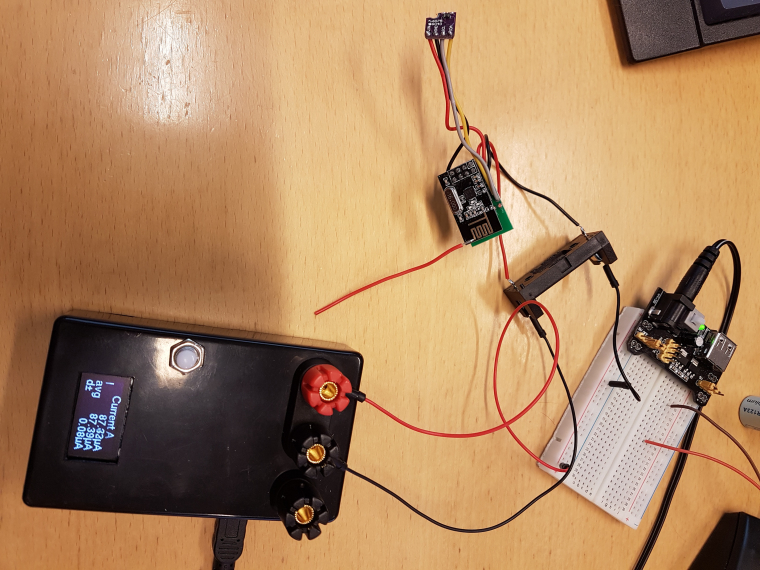
I just compared a Sensebender Micro with the VEML6075 to a standalone Sensebender Micro and the standalone one measured 28uA and the one with the VEML6075 measured 740uA.I just checked the VEML6075 documentation and typical consumption is 480uA but it should also be possible to shut it down and then it should only draw 800nA.
I need to check the Lib if there is some function to shut it down and wake it up. Or else I will try to change the setup so I can power the VEML6075 from an output pin so I can turn it completely off.
- Tomas
-
Did anyone measure the current consumption of these VEML chips?
I just compared a Sensebender Micro with the VEML6075 to a standalone Sensebender Micro and the standalone one measured 28uA and the one with the VEML6075 measured 740uA.I just checked the VEML6075 documentation and typical consumption is 480uA but it should also be possible to shut it down and then it should only draw 800nA.
I need to check the Lib if there is some function to shut it down and wake it up. Or else I will try to change the setup so I can power the VEML6075 from an output pin so I can turn it completely off.
-
@korttoma
if i remember, sleep is not implemented in the veml6075 lib above. I added a sleep function and set the corresponding CONF register. not a big thing ;) -
@korttoma you can try this, and you'll see it's not a big thing :smile:
in your .h, in the public section, add this:
void sleep(bool mode);then in the .cpp, add this:
void VEML6075::sleep(bool mode) {

	if (mode)
		this->config |= 1; // Go to sleep
	else
		this->config &= 254; // Wake up

	this->write16(VEML6075_REG_CONF, this->config);

}
In your sketch, just do this:
veml6075.sleep(true); // power down veml6075Note: i added this because i noticed it wasn't implemented, but i've not checked the power consumption yet. So if you can tell me if it's ok, please!
Enjoy ;)
-
@korttoma you can try this, and you'll see it's not a big thing :smile:
in your .h, in the public section, add this:
void sleep(bool mode);then in the .cpp, add this:
void VEML6075::sleep(bool mode) {

	if (mode)
		this->config |= 1; // Go to sleep
	else
		this->config &= 254; // Wake up

	this->write16(VEML6075_REG_CONF, this->config);

}
In your sketch, just do this:
veml6075.sleep(true); // power down veml6075Note: i added this because i noticed it wasn't implemented, but i've not checked the power consumption yet. So if you can tell me if it's ok, please!
Enjoy ;)
@scalz thanks for the sleep function! The current consumption is now down to 85uA but the problem is that onece it sleeps I cant get it to wake up.
Tried with:
veml6075.sleep(false);Tried allso adding a 500ms sleep after the wakeup to give it time to setle.
But do I need to do something more?- Tomas
-
@scalz thanks for the sleep function! The current consumption is now down to 85uA but the problem is that onece it sleeps I cant get it to wake up.
Tried with:
veml6075.sleep(false);Tried allso adding a 500ms sleep after the wakeup to give it time to setle.
But do I need to do something more? -
@korttoma sorry for the copy/paste mistake :) you can try again, i've updated above. maybe someday i'll measure power consuption of a sensebender, weird that you get 28uA for the standalone..
@scalz seems to be working now :D don´t take my current consumtion figures to sareously since Im using the Micro (nano) ampere meter and I realy have nothing good to calibrate it against.
-
-
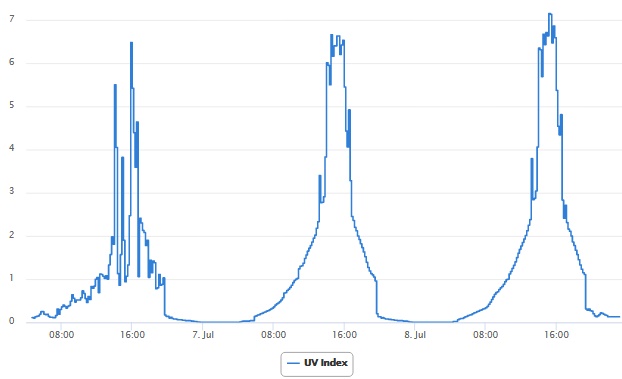
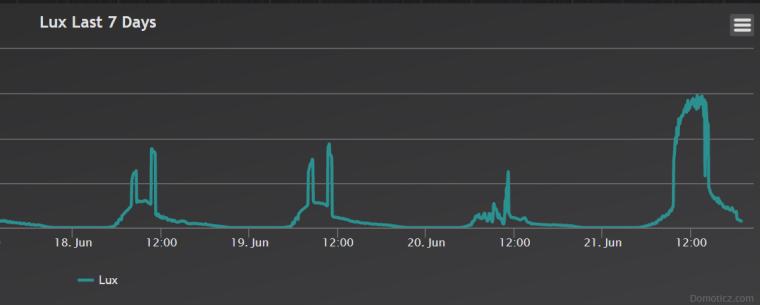
I mounted the Sensebender Micro VEML6075 inside my old broken UVN800 and set it in the roof. Here are graphs of the values I received the last 3 days. Unfortunately I do not have anything to compare with but the values seem reasonable.
-
@korttoma you can try this, and you'll see it's not a big thing :smile:
in your .h, in the public section, add this:
void sleep(bool mode);then in the .cpp, add this:
void VEML6075::sleep(bool mode) {

	if (mode)
		this->config |= 1; // Go to sleep
	else
		this->config &= 254; // Wake up

	this->write16(VEML6075_REG_CONF, this->config);

}
In your sketch, just do this:
veml6075.sleep(true); // power down veml6075Note: i added this because i noticed it wasn't implemented, but i've not checked the power consumption yet. So if you can tell me if it's ok, please!
Enjoy ;)
-
-
OK, I think found what the issue is. VEML 6070 is not providing accurate UV Index. Adafruit is stating the following:
Note that this is not UV index, its just UV light intensity!This is how it can be converted into sort of UV Index according to the datasheet:
RISK_LEVEL convert_to_risk_level(WORD uvs_step) { WORD risk_level_mapping_table[4] = {2241, 4482, 5976, 8217}; } WORD read_uvs_step(void) { BYTE lsb, msb; WORD data; VEML6070_read_byte(VEML6070_ADDR_DATA_MSB, &msb); VEML6070_read_byte(VEML6070_ADDR_DATA_LSB, &lsb); data = ((WORD)msb << 8) | (WORD)lsb; return data; } LEVEL* UV Index ===== ======== LOW 0-2 MODERATE 3-5 HIGH 6-7 VERY HIGH 8-10 EXTREME >=11 -
Yeah, my 6075 device is also still working fine on the 2xAA batteries I put in it a year ago.
@korttoma @scalz FYG I got a new DMM from Dave Jones 121GW and decided to measure a sleep current for VEML6075 and to my surprise:
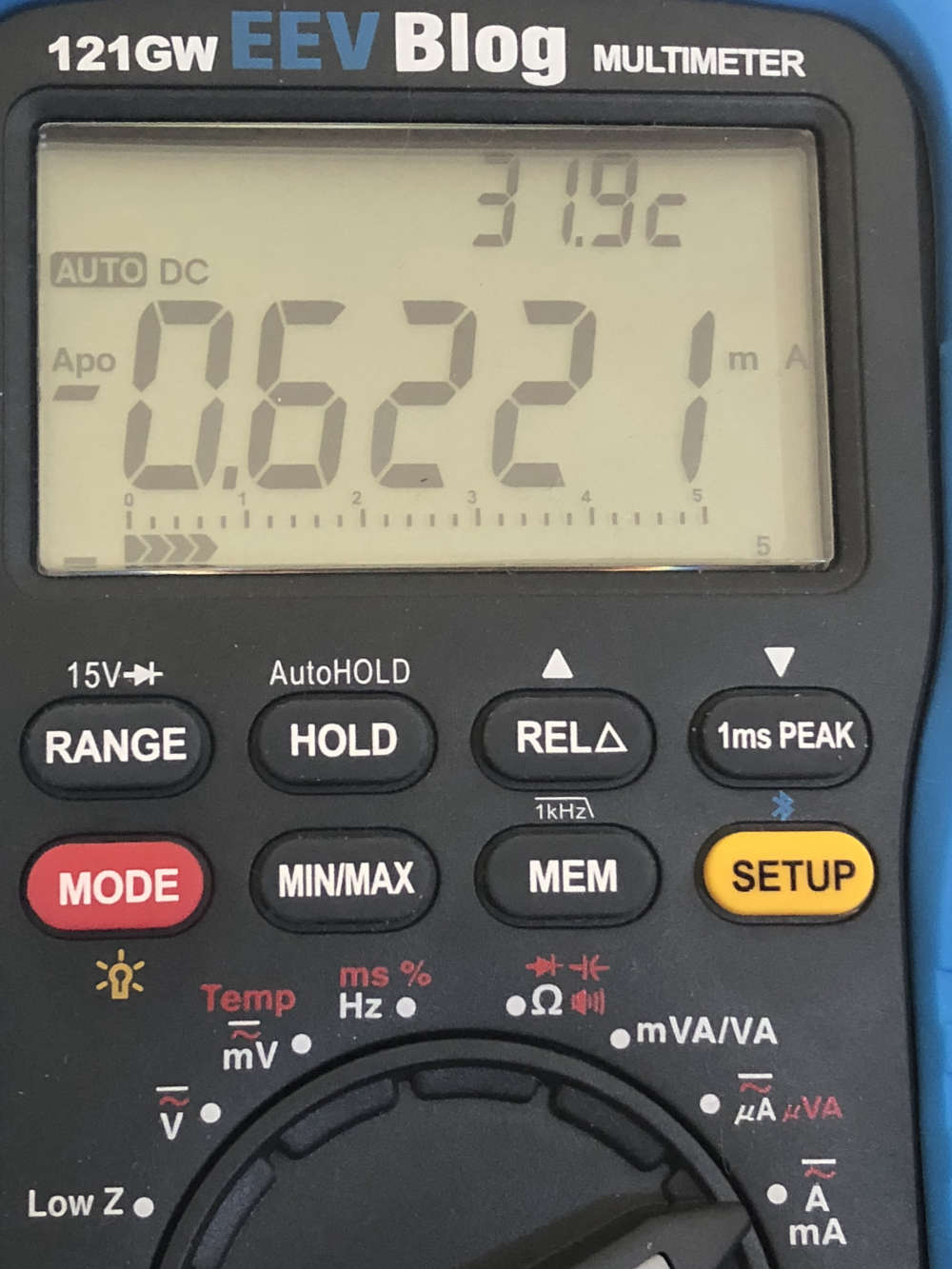
Quickly reading the datasheet I discovered my mistake:
- current supply - 480uA
- shutdown current - 800nA
Therefore, the sensor has to be put to sleep properly.
One can modify the existing lib:uint8_t VEML6075::Shutdown() { //Places device in shutdown low power mode Config = ReadByte(CONF_CMD, 0); //Update global config value return WriteConfig(Config | 0x01); //Set shutdown bit } uint8_t VEML6075::PowerOn() { //Turns device on from shutdown mode Config = ReadByte(CONF_CMD, 0); //Update global config value return WriteConfig(Config & 0xFE); //Clear shutdown bit } Make sure you define #define CONF_CMD 0x00PS Now I understand why I did not change batteries - they are rechargeable. Charing and putting them back made me think that batteries lasted for a long time. :relaxed:


Hello! It looks like you're interested in this conversation, but you don't have an account yet.
Getting fed up of having to scroll through the same posts each visit? When you register for an account, you'll always come back to exactly where you were before, and choose to be notified of new replies (either via email, or push notification). You'll also be able to save bookmarks and upvote posts to show your appreciation to other community members.
With your input, this post could be even better 💗
Register Login