Skip to content
  • MySensors
  • OpenHardware.io
  • Categories
  • Recent
  • Tags
  • Popular
Skins
  • Light
  • Brite
  • Cerulean
  • Cosmo
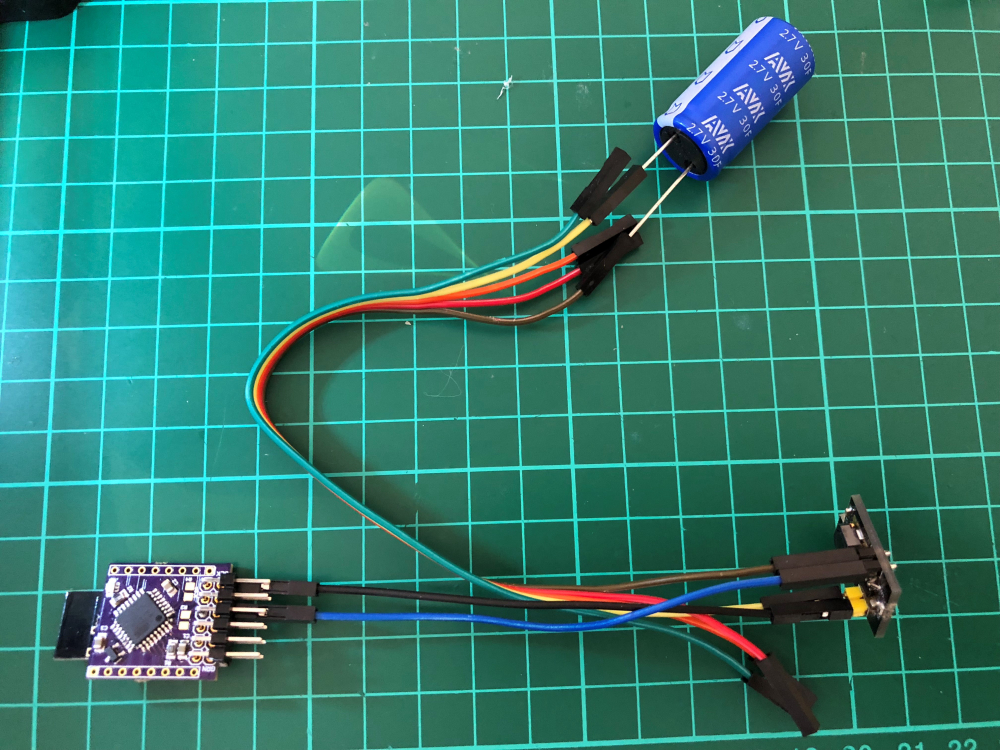
  • Flatly
  • Journal
  • Litera
  • Lumen
  • Lux
  • Materia
  • Minty
  • Morph
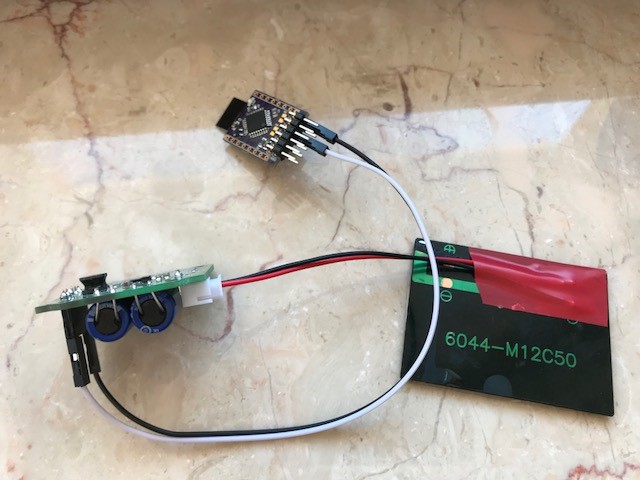
  • Pulse
  • Sandstone
  • Simplex
  • Sketchy
  • Spacelab
  • United
  • Yeti
  • Zephyr
  • Dark
  • Cyborg
  • Darkly
  • Quartz
  • Slate
  • Solar
  • Superhero
  • Vapor

  • Default (No Skin)
  • No Skin
Collapse
Brand Logo
  1. Home
  2. Hardware
  3. Node running on supercaps and a solar panel.

Node running on supercaps and a solar panel.
Scheduled Pinned Locked Moved Hardware
59 Posts 5 Posters 6.0k Views 6 Watching
  • Oldest to Newest
  • Newest to Oldest
  • Most Votes
Reply
  • Reply as topic
Log in to reply
This topic has been deleted. Only users with topic management privileges can see it.
  • alexsh1A Offline
    alexsh1A Offline
    alexsh1
    wrote on last edited by
    #1

    Hi,

    I'd like to share my experience of running a small sensor, which currently only reports voltage every 5 minutes on supercaps with the tiny solar panel.

    My setup:

    1. A stamp size atmega328p sensor with ATSHA204A. Sleeping consumption is around 5 uA.

    2. The harvesting board by @ceech with two 10F supercaps.
      https://www.ebay.co.uk/itm/BQ25570-thermal-solar-energy-harvester/332071662285?hash=item4d510372cd:g:yG8AAOSwJ7RYXkVQ

    3. a small solar panel.

    The harvester is done on BQ25570 with 3.3v converter for sensors. It is harvesting as low as 100mV which is excellent - no need for a the sun to charge supercaps. Can also charge supercaps indoors.

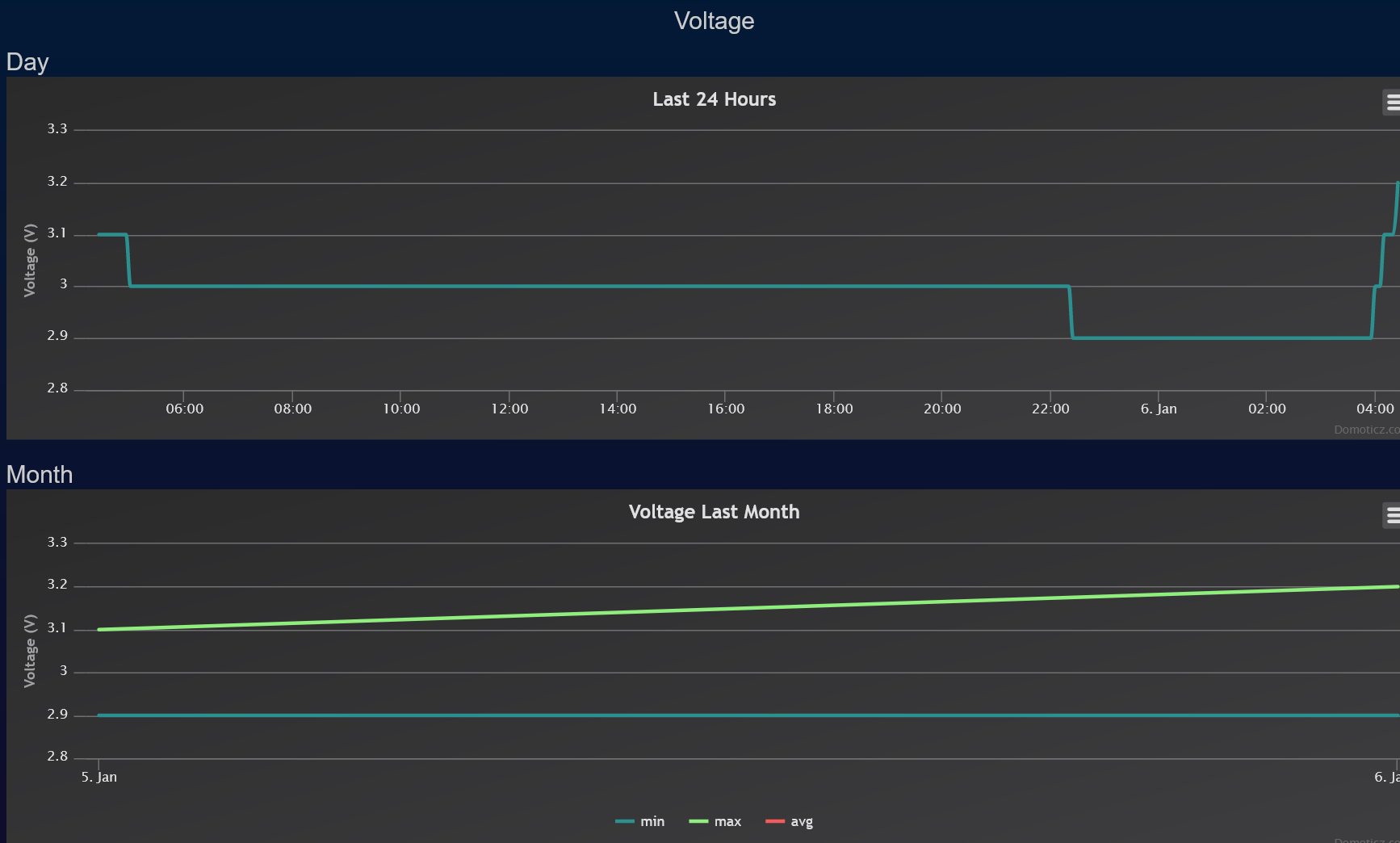
    In the beginning I fully charged supercaps to 5V and then disconnected the solar panel. Voltage was slowly dropping though my sensor did not sense it as it is connected to 3.3V converter. However, as soon as voltage dropped below 3.3V, the the sensor could see it dropping. The drop is around 0.2V a day, which means that from 5V to 2.9V without the solar panel disconnected, the sensor was sending voltage to controller every 5 minutes for more than 10 days!!! 10 days without a single change! Then as soon as I connected the solar panel, voltage recovered literally in minutes. See the graph below
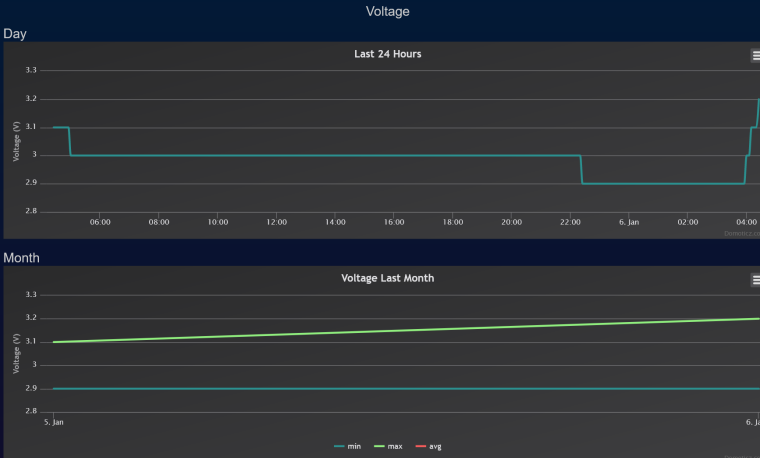
    0_1515214422979_Screenshot (38).png

    Very impressive in my view. TO DO - I'll try to assemble a more complex weather node reporting 6-8 parameters to the controller with 10-15 minutes sleeping time to test this setup.

    AnticimexA 1 Reply Last reply
    1
    • alexsh1A Offline
      alexsh1A Offline
      alexsh1
      wrote on last edited by alexsh1
      #2

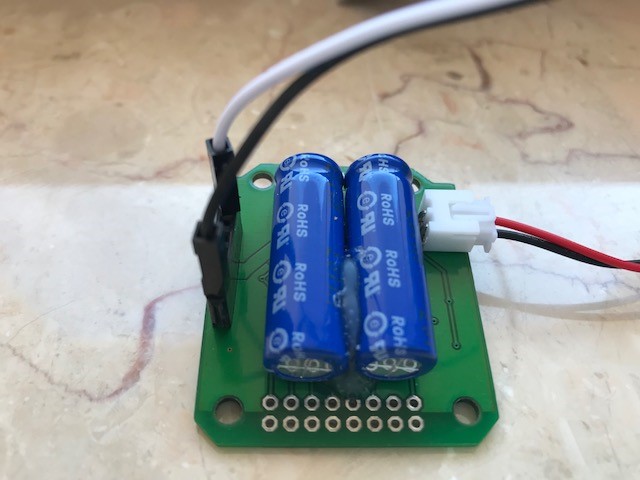
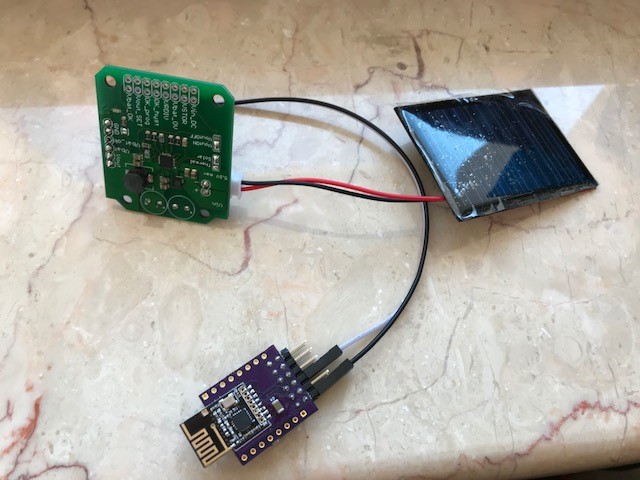
      a few photos

      1_1515215337965_2.jpg 0_1515215337965_1.jpg
      0_1515215501163_3.jpg

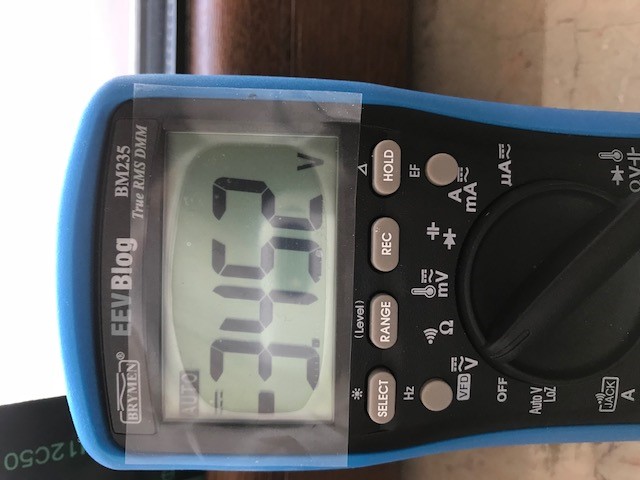
      It took 10-15 minutes in a bright room to charge supercaps with 0.5V (2 x 2.7V 10F caps in series)

      0_1515215522138_4.jpg

      1 Reply Last reply
      1
      • gohanG Offline
        gohanG Offline
        gohan
        Mod
        wrote on last edited by
        #3

        What supercap where you using?

        alexsh1A 1 Reply Last reply
        0
        • alexsh1A alexsh1

          Hi,

          I'd like to share my experience of running a small sensor, which currently only reports voltage every 5 minutes on supercaps with the tiny solar panel.

          My setup:

          1. A stamp size atmega328p sensor with ATSHA204A. Sleeping consumption is around 5 uA.

          2. The harvesting board by @ceech with two 10F supercaps.
            https://www.ebay.co.uk/itm/BQ25570-thermal-solar-energy-harvester/332071662285?hash=item4d510372cd:g:yG8AAOSwJ7RYXkVQ

          3. a small solar panel.

          The harvester is done on BQ25570 with 3.3v converter for sensors. It is harvesting as low as 100mV which is excellent - no need for a the sun to charge supercaps. Can also charge supercaps indoors.

          In the beginning I fully charged supercaps to 5V and then disconnected the solar panel. Voltage was slowly dropping though my sensor did not sense it as it is connected to 3.3V converter. However, as soon as voltage dropped below 3.3V, the the sensor could see it dropping. The drop is around 0.2V a day, which means that from 5V to 2.9V without the solar panel disconnected, the sensor was sending voltage to controller every 5 minutes for more than 10 days!!! 10 days without a single change! Then as soon as I connected the solar panel, voltage recovered literally in minutes. See the graph below

          0_1515214422979_Screenshot (38).png

          Very impressive in my view. TO DO - I'll try to assemble a more complex weather node reporting 6-8 parameters to the controller with 10-15 minutes sleeping time to test this setup.

          AnticimexA Offline
          AnticimexA Offline
          Anticimex
          Contest Winner
          wrote on last edited by
          #4

          @alexsh1 that is awesome! Was this with signing enabled and with the receiver of your messages requesting signatures? Would be interesting to see what effect the atsha and signing algorithms would have on the consumption. The atsha is kept in dormant state unless it is needed.

          Do you feel secure today? No? Start requiring some signatures and feel better tomorrow ;)

          alexsh1A 1 Reply Last reply
          0
          • gohanG gohan

            What supercap where you using?

            alexsh1A Offline
            alexsh1A Offline
            alexsh1
            wrote on last edited by
            #5

            @gohan 2 caps in series 10F x 2.7V

            gohanG 1 Reply Last reply
            0
            • AnticimexA Anticimex

              @alexsh1 that is awesome! Was this with signing enabled and with the receiver of your messages requesting signatures? Would be interesting to see what effect the atsha and signing algorithms would have on the consumption. The atsha is kept in dormant state unless it is needed.

              alexsh1A Offline
              alexsh1A Offline
              alexsh1
              wrote on last edited by
              #6

              @anticimex No, this time I have use Sensebender GW Serial and have had a few issues with the computer going into a sleep mode. Therefore, I disabled signing for now. Testing signing would be the next step.

              1 Reply Last reply
              1
              • alexsh1A alexsh1

                @gohan 2 caps in series 10F x 2.7V

                gohanG Offline
                gohanG Offline
                gohan
                Mod
                wrote on last edited by
                #7

                @alexsh1 what brand and where did you get them? I am running too a solar node but even with more capacitance than yours I am not getting that much runtime, probably because I am sending every 10 minutes temperature, humidity, tx pwr percentage, tx and rx rssi, battery % and supercap voltage

                alexsh1A 1 Reply Last reply
                0
                • gohanG gohan

                  @alexsh1 what brand and where did you get them? I am running too a solar node but even with more capacitance than yours I am not getting that much runtime, probably because I am sending every 10 minutes temperature, humidity, tx pwr percentage, tx and rx rssi, battery % and supercap voltage

                  alexsh1A Offline
                  alexsh1A Offline
                  alexsh1
                  wrote on last edited by
                  #8

                  @gohan I cannot tell you about the brand. @ceech soldered those for me. I am going to test it with another node and see how much run time I'll get. I must also admit that the node is very-very low power.

                  1 Reply Last reply
                  0
                  • gohanG Offline
                    gohanG Offline
                    gohan
                    Mod
                    wrote on last edited by
                    #9

                    I noticed there isn't much attached to it, so a real case scenario with a temp hum sensor could be more useful

                    alexsh1A 1 Reply Last reply
                    0
                    • gohanG gohan

                      I noticed there isn't much attached to it, so a real case scenario with a temp hum sensor could be more useful

                      alexsh1A Offline
                      alexsh1A Offline
                      alexsh1
                      wrote on last edited by
                      #10

                      @gohan I have a node with temp/hum/pressure/light/lightning sensor - I'll try this one.

                      Yes so far I have only tried reporting voltage. Let's see how other sensors can impact the run time.

                      1 Reply Last reply
                      0
                      • gohanG Offline
                        gohanG Offline
                        gohan
                        Mod
                        wrote on last edited by
                        #11

                        I bet you will see a proportional drop according to the number of values you want to report. I am still stressing it a bit, so I think there may be margin to save some power by sending less important values with a lower frequency

                        alexsh1A 1 Reply Last reply
                        0
                        • alexsh1A Offline
                          alexsh1A Offline
                          alexsh1
                          wrote on last edited by
                          #12

                          I have got my hands on 30F 2.7V supercapacitor.
                          0_1523113648078_30FSupercap.jpg

                          With it was charged for the first time, it only lasted sending 2583 times (1 time a minute voltage and an 20ms LED pulse and then sleeping; sleeping consumption is 4-5uA). The number is a bit disappointing. It is however connected via boost MCP1640 to provide the node with a stable 3.3V. I may try to get the supercapacitor connected directly to the node to see if I can extract more packets.

                          YveauxY NeverDieN alexsh1A 3 Replies Last reply
                          1
                          • alexsh1A alexsh1

                            I have got my hands on 30F 2.7V supercapacitor.

                            0_1523113648078_30FSupercap.jpg

                            With it was charged for the first time, it only lasted sending 2583 times (1 time a minute voltage and an 20ms LED pulse and then sleeping; sleeping consumption is 4-5uA). The number is a bit disappointing. It is however connected via boost MCP1640 to provide the node with a stable 3.3V. I may try to get the supercapacitor connected directly to the node to see if I can extract more packets.

                            YveauxY Offline
                            YveauxY Offline
                            Yveaux
                            Mod
                            wrote on last edited by
                            #13

                            @alexsh1 Nice experiment :+1:
                            Thanks for reporting!

                            http://yveaux.blogspot.nl

                            1 Reply Last reply
                            0
                            • alexsh1A alexsh1

                              I have got my hands on 30F 2.7V supercapacitor.

                              0_1523113648078_30FSupercap.jpg

                              With it was charged for the first time, it only lasted sending 2583 times (1 time a minute voltage and an 20ms LED pulse and then sleeping; sleeping consumption is 4-5uA). The number is a bit disappointing. It is however connected via boost MCP1640 to provide the node with a stable 3.3V. I may try to get the supercapacitor connected directly to the node to see if I can extract more packets.

                              NeverDieN Offline
                              NeverDieN Offline
                              NeverDie
                              Hero Member
                              wrote on last edited by
                              #14

                              @alexsh1 said in Node running on supercaps and a solar panel.:

                              I may try to get the supercapacitor connected directly to the node to see if I can extract more packets.

                              That's your best choice, unless you're also running a PIR or something that requires a higher minimum voltage. In that case, you could switch to this boost converter, which has only 7ua quiescent current:
                              https://www.openhardware.io/view/285/33v-Boost-Converter-with-Pass-Through

                              alexsh1A 1 Reply Last reply
                              0
                              • NeverDieN NeverDie

                                @alexsh1 said in Node running on supercaps and a solar panel.:

                                I may try to get the supercapacitor connected directly to the node to see if I can extract more packets.

                                That's your best choice, unless you're also running a PIR or something that requires a higher minimum voltage. In that case, you could switch to this boost converter, which has only 7ua quiescent current:
                                https://www.openhardware.io/view/285/33v-Boost-Converter-with-Pass-Through

                                alexsh1A Offline
                                alexsh1A Offline
                                alexsh1
                                wrote on last edited by
                                #15

                                @neverdie I think you are right. I have tinkered with your other boost converter - https://www.openhardware.io/view/279/Adjustable-Boost-Converter-with-Pass-Through

                                MCP1640's quiescent current is much higher 19uA.

                                Now, I'll try to run it from the supercapacitor directly. Pity that anything below 1.9V is going to be wasted (nrf24l01+ is unstable around 1.9V)

                                NeverDieN 1 Reply Last reply
                                0
                                • gohanG gohan

                                  I bet you will see a proportional drop according to the number of values you want to report. I am still stressing it a bit, so I think there may be margin to save some power by sending less important values with a lower frequency

                                  alexsh1A Offline
                                  alexsh1A Offline
                                  alexsh1
                                  wrote on last edited by
                                  #16

                                  @gohan Just to let you know. I have been running this node with Si1132 + Si7021 + another sensor (reporting more than 6 values every 5-10 mins) for weeks now. I have just measured the caps = 4.8V (peak is around 5.2V) - it is late at night. In the morning the voltage will go up. I managed to find a very small, but efficient solar cell smaller than in the photo.

                                  The key is to have a low sleeping consumption, i.e. all sensors must sleep properly. In this case you get 4-8uA sleeping current and can live on supercaps for days without recharge.

                                  NeverDieN 1 Reply Last reply
                                  0
                                  • alexsh1A alexsh1

                                    @gohan Just to let you know. I have been running this node with Si1132 + Si7021 + another sensor (reporting more than 6 values every 5-10 mins) for weeks now. I have just measured the caps = 4.8V (peak is around 5.2V) - it is late at night. In the morning the voltage will go up. I managed to find a very small, but efficient solar cell smaller than in the photo.

                                    The key is to have a low sleeping consumption, i.e. all sensors must sleep properly. In this case you get 4-8uA sleeping current and can live on supercaps for days without recharge.

                                    NeverDieN Offline
                                    NeverDieN Offline
                                    NeverDie
                                    Hero Member
                                    wrote on last edited by
                                    #17

                                    @alexsh1 said in Node running on supercaps and a solar panel.:

                                    I managed to find a very small, but efficient solar cell smaller than in the photo.

                                    Please do tell: what did you find? And where?

                                    alexsh1A 1 Reply Last reply
                                    0
                                    • alexsh1A alexsh1

                                      @neverdie I think you are right. I have tinkered with your other boost converter - https://www.openhardware.io/view/279/Adjustable-Boost-Converter-with-Pass-Through

                                      MCP1640's quiescent current is much higher 19uA.

                                      Now, I'll try to run it from the supercapacitor directly. Pity that anything below 1.9V is going to be wasted (nrf24l01+ is unstable around 1.9V)

                                      NeverDieN Offline
                                      NeverDieN Offline
                                      NeverDie
                                      Hero Member
                                      wrote on last edited by
                                      #18

                                      @alexsh1 said in Node running on supercaps and a solar panel.:

                                      MCP1640's quiescent current is much higher 19uA.

                                      Or, better yet, just turn it on prior to your sensor readings, and then turn it off.

                                      alexsh1A 1 Reply Last reply
                                      0
                                      • NeverDieN NeverDie

                                        @alexsh1 said in Node running on supercaps and a solar panel.:

                                        MCP1640's quiescent current is much higher 19uA.

                                        Or, better yet, just turn it on prior to your sensor readings, and then turn it off.

                                        alexsh1A Offline
                                        alexsh1A Offline
                                        alexsh1
                                        wrote on last edited by
                                        #19

                                        @neverdie you mean like using a mosfet or something?
                                        It is used to supply 3.3v to atmega328p, I do not think I can just turn it off.

                                        NeverDieN 1 Reply Last reply
                                        0
                                        • NeverDieN NeverDie

                                          @alexsh1 said in Node running on supercaps and a solar panel.:

                                          I managed to find a very small, but efficient solar cell smaller than in the photo.

                                          Please do tell: what did you find? And where?

                                          alexsh1A Offline
                                          alexsh1A Offline
                                          alexsh1
                                          wrote on last edited by
                                          #20

                                          @neverdie sure - this is the one i am very much happy with. Previous one was not supplying enough juice to charge fully supercaps.
                                          https://www.ebay.co.uk/itm/Polycrystalline-Solar-Panel-Cell-5v-30mA-0-15w-53mm-x-30mm-DIY-LED-Garden-Light/362000885812?ssPageName=STRK%3AMEBIDX%3AIT&_trksid=p2057872.m2749.l2649

                                          1 Reply Last reply
                                          0
                                          Reply
                                          • Reply as topic
                                          Log in to reply
                                          • Oldest to Newest
                                          • Newest to Oldest
                                          • Most Votes


                                          15

                                          Online

                                          11.7k

                                          Users

                                          11.2k

                                          Topics

                                          113.1k

                                          Posts


                                          Copyright 2025 TBD   |   Forum Guidelines   |   Privacy Policy   |   Terms of Service
                                          • Login

                                          • Don't have an account? Register

                                          • Login or register to search.
                                          • First post
                                            Last post
                                          0
                                          • MySensors
                                          • OpenHardware.io
                                          • Categories
                                          • Recent
                                          • Tags
                                          • Popular