Skip to content
  • MySensors
  • OpenHardware.io
  • Categories
  • Recent
  • Tags
  • Popular
Skins
  • Light
  • Brite
  • Cerulean
  • Cosmo
  • Flatly
  • Journal
  • Litera
  • Lumen
  • Lux
  • Materia
  • Minty
  • Morph
  • Pulse
  • Sandstone
  • Simplex
  • Sketchy
  • Spacelab
  • United
  • Yeti
  • Zephyr
  • Dark
  • Cyborg
  • Darkly
  • Quartz
  • Slate
  • Solar
  • Superhero
  • Vapor

  • Default (No Skin)
  • No Skin
Collapse
Brand Logo
  1. Home
  2. General Discussion
  3. Over the air (OTA) bootloading update tutorial?

Over the air (OTA) bootloading update tutorial?

Scheduled Pinned Locked Moved General Discussion
97 Posts 19 Posters 60.0k Views 22 Watching
  • Oldest to Newest
  • Newest to Oldest
  • Most Votes
Reply
  • Reply as topic
Log in to reply
This topic has been deleted. Only users with topic management privileges can see it.
  • mfalkviddM Offline
    mfalkviddM Offline
    mfalkvidd
    Mod
    wrote on last edited by
    #39

    Does a signed crc really provide sufficient security? Modifying a firmware in a way that results in the same crc should be fairly easy, since crc is very predictable.

    AnticimexA 1 Reply Last reply
    0
    • mfalkviddM mfalkvidd

      Does a signed crc really provide sufficient security? Modifying a firmware in a way that results in the same crc should be fairly easy, since crc is very predictable.

      AnticimexA Offline
      AnticimexA Offline
      Anticimex
      Contest Winner
      wrote on last edited by
      #40

      @mfalkvidd if so, the choice of crc algorithm is bad. And a hash should be used instead.

      Do you feel secure today? No? Start requiring some signatures and feel better tomorrow ;)

      1 Reply Last reply
      0
      • mfalkviddM Offline
        mfalkviddM Offline
        mfalkvidd
        Mod
        wrote on last edited by
        #41

        Yes. A cryptographic hash function to be specific.

        AnticimexA 1 Reply Last reply
        0
        • AnticimexA Offline
          AnticimexA Offline
          Anticimex
          Contest Winner
          wrote on last edited by
          #42

          Well, obviously. We already have sha256 capability. But not publicly available.

          Do you feel secure today? No? Start requiring some signatures and feel better tomorrow ;)

          1 Reply Last reply
          0
          • mfalkviddM mfalkvidd

            Yes. A cryptographic hash function to be specific.

            AnticimexA Offline
            AnticimexA Offline
            Anticimex
            Contest Winner
            wrote on last edited by
            #43

            @mfalkvidd even if crc can be predictable, the signing mechanism is not. So let's assume you can fabricate a firmware with a desirable crc, you still need to provide a valid signature for that crc. And that would not be so easy given the use of a random nonce and a PSK.

            Do you feel secure today? No? Start requiring some signatures and feel better tomorrow ;)

            1 Reply Last reply
            0
            • mfalkviddM Offline
              mfalkviddM Offline
              mfalkvidd
              Mod
              wrote on last edited by
              #44

              Good point. Using a nonce should be enough even if a predictable compression function is used. The signing would then verify the entire conversation, not just the binary blob.

              1 Reply Last reply
              0
              • AnticimexA Offline
                AnticimexA Offline
                Anticimex
                Contest Winner
                wrote on last edited by
                #45

                The use of random nonce ensures (at least to a significant extent) that two signatures will never look the same even with the same payload. So replaying signed messages won't work. Based on that, it won't be possible for an attacker to provide a trusted crc of any form after it has sent the forged FW that yield the same crc as a valid firmware would.
                The only way I see that this could be exploited is if the attacker managed to predict the resulting crc and black out the valid FW as it is sent OTA and instead inject the forged FW. And then it let the valid senders signed crc pass though.
                But that require the attacker to know the resulting crc of the real FW. And if the OTA solution include a random component with the firmware that is covered by crc that also becomes a tricky task. @tekka might be interested in that.

                Do you feel secure today? No? Start requiring some signatures and feel better tomorrow ;)

                tekkaT 1 Reply Last reply
                1
                • AnticimexA Anticimex

                  The use of random nonce ensures (at least to a significant extent) that two signatures will never look the same even with the same payload. So replaying signed messages won't work. Based on that, it won't be possible for an attacker to provide a trusted crc of any form after it has sent the forged FW that yield the same crc as a valid firmware would.
                  The only way I see that this could be exploited is if the attacker managed to predict the resulting crc and black out the valid FW as it is sent OTA and instead inject the forged FW. And then it let the valid senders signed crc pass though.
                  But that require the attacker to know the resulting crc of the real FW. And if the OTA solution include a random component with the firmware that is covered by crc that also becomes a tricky task. @tekka might be interested in that.

                  tekkaT Offline
                  tekkaT Offline
                  tekka
                  Admin
                  wrote on last edited by tekka
                  #46

                  In it's current stage, the OTA FW update is initiated by a FIRMWARE_CONFIG_RESPONSE message consisting of FW type, FW version, and FW CRC. If any of these parameters mismatches, the node will request a new FW. The CRC is validated at the end of the OTA update process against the transmitted FW and written in the EEPROM. This opens ways to forge the OTA update process, as described by @Anticimex

                  In order to make the OTA update process more secure, adding a random byte to every FW block transmitted and computing the CRC over all sent bytes makes the process more secure and the CRC less predictable. This also implies that the signed CRC is transmitted at the end of the update process and validated against the received FW + random bytes. If any component of the transmitted FW is altered, the CRC will fail and the new FW discarded.

                  1 Reply Last reply
                  1
                  • mfalkviddM Offline
                    mfalkviddM Offline
                    mfalkvidd
                    Mod
                    wrote on last edited by
                    #47

                    I'm not sure a random byte would be sufficient. How do we verify that the correct random byte is used? If the attacker can choose the random number in their firmware, getting a crc that matches the original firmware is trivial. Or do you suggest that a nonce is used for each FW packet? If so, how is that nonce verified?

                    1 Reply Last reply
                    0
                    • AnticimexA Offline
                      AnticimexA Offline
                      Anticimex
                      Contest Winner
                      wrote on last edited by
                      #48

                      Why would a random byte not be sufficient? The only problem to solve is to make the crc unpredictable. Also, making sure a OTA process is started and finalized by a signed message, and those messages are a function of the OTA firmware, I don't see any security implications.

                      Do you feel secure today? No? Start requiring some signatures and feel better tomorrow ;)

                      1 Reply Last reply
                      0
                      • mfalkviddM Offline
                        mfalkviddM Offline
                        mfalkvidd
                        Mod
                        wrote on last edited by
                        #49

                        My point is that a crc is, by definition, never unpredictable. If an attacker records one firmware update, the attacker can easily replace the firmware and adjust the random bytes to arrive at the same crc. Then the attacker can simply re-use the signature, since it will still be valid. Or am I missing something?

                        1 Reply Last reply
                        0
                        • AnticimexA Offline
                          AnticimexA Offline
                          Anticimex
                          Contest Winner
                          wrote on last edited by
                          #50

                          @mfalkvidd how can an attacker reuse a signature? Nonce used is discarded when a message is signed/verified. If the crc is sent last and based on a unpredictable blob, crc is also unpredictable and only the true source can put a valid signature on a crc that will unlikely be the same two times in a row. On top of that, throw in some AES encryption and I'd say the attacker would be better off with doing a smash & grab on the node to do what he wants.

                          Do you feel secure today? No? Start requiring some signatures and feel better tomorrow ;)

                          1 Reply Last reply
                          0
                          • mfalkviddM Offline
                            mfalkviddM Offline
                            mfalkvidd
                            Mod
                            wrote on last edited by
                            #51

                            I agree. I guess what's confusing me is that you're talking about validating the conversation, while tekka is talking about validating the crc. Just validating the crc will be insufficient, but that's not what you're talking about.

                            AnticimexA 1 Reply Last reply
                            0
                            • mfalkviddM mfalkvidd

                              I agree. I guess what's confusing me is that you're talking about validating the conversation, while tekka is talking about validating the crc. Just validating the crc will be insufficient, but that's not what you're talking about.

                              AnticimexA Offline
                              AnticimexA Offline
                              Anticimex
                              Contest Winner
                              wrote on last edited by Anticimex
                              #52

                              @mfalkvidd well, that is what I'm talking about. My point being, that you can't forge a valid signature. So you can't record a signed message of a crc, make your own firmware that happens to result in the same crc, transmit that, and then send the same signed crc. The receiver won't accept it since a new nonce is used every time. And the PSK is needed to calculate a new signature with a new nonce.

                              Do you feel secure today? No? Start requiring some signatures and feel better tomorrow ;)

                              1 Reply Last reply
                              0
                              • mfalkviddM Offline
                                mfalkviddM Offline
                                mfalkvidd
                                Mod
                                wrote on last edited by
                                #53

                                Agreed.
                                Will adding a random number to each FW packet (as suggested by tekka) add any security? A single nonce somewhere in the conversation should be sufficient I think. Adding random bytes to each packet would add complexity but not security, as the protection would come from the nonce anyway, right?

                                tekkaT 1 Reply Last reply
                                0
                                • mfalkviddM mfalkvidd

                                  Agreed.
                                  Will adding a random number to each FW packet (as suggested by tekka) add any security? A single nonce somewhere in the conversation should be sufficient I think. Adding random bytes to each packet would add complexity but not security, as the protection would come from the nonce anyway, right?

                                  tekkaT Offline
                                  tekkaT Offline
                                  tekka
                                  Admin
                                  wrote on last edited by tekka
                                  #54

                                  @mfalkvidd Both result in the same - making the CRC "unpredictable", which is what we need. You can see the added random bytes as a nonce streching over the entire OTA update process.

                                  1 Reply Last reply
                                  0
                                  • AnticimexA Offline
                                    AnticimexA Offline
                                    Anticimex
                                    Contest Winner
                                    wrote on last edited by
                                    #55

                                    Nonce provide security for a single message. The signed message is secure in the sense that it is authenticated. This means that the signed message could only be made from a trusted sender. Securing OTA is therefore a matter of crafting a solution where the signed messages cover data that is a function of the OTA firmware. Preferably a function which is difficult to reverse-engineer (like a cryptographic hash function). So, if there is a signed message with some form of checksum of the firmware that is enough to guarantee authenticity of the firmware. In this case, assuming the signing paradigm is ideally secure, the signature is good enough but the security will always be limited to the strength of the checksum. Injecting signed messages in the OTA flow at some intervals to continuously "monitor" the procedure could also help increasing the security.

                                    Do you feel secure today? No? Start requiring some signatures and feel better tomorrow ;)

                                    1 Reply Last reply
                                    0
                                    • AnticimexA Offline
                                      AnticimexA Offline
                                      Anticimex
                                      Contest Winner
                                      wrote on last edited by
                                      #56

                                      and yes, I agree with @tekka, in that making an "unpredictable" crc and signing that crc would make it really hard for an attacker to temporarily block the senders firmware and inject a bad firmware and then let through the senders signed crc since the attacker would not know in "runtime" what the crc will be. Especially if the last random bit is provided in the signed crc message. That makes a secure chain where the last link is signed, and unpredictable.

                                      Do you feel secure today? No? Start requiring some signatures and feel better tomorrow ;)

                                      1 Reply Last reply
                                      0
                                      • mfalkviddM Offline
                                        mfalkviddM Offline
                                        mfalkvidd
                                        Mod
                                        wrote on last edited by
                                        #57

                                        Looks like I'll need to make some drawings to understand what is signed. Adding random bytes to the FW packets will not make the crc unpredictable, since the attacker can calcullate the real crc continuously and just needs to modify the last bytes to get the same crc.

                                        I'll try to make some drawings of my impression of what you are saying when I get to a computer (probably tomorrow). From there you'll probably be able to tell me where I have gotten things wrong.

                                        1 Reply Last reply
                                        0
                                        • mfalkviddM Offline
                                          mfalkviddM Offline
                                          mfalkvidd
                                          Mod
                                          wrote on last edited by
                                          #58

                                          Alright. I've spent some time to draw my understanding of what Anticimex is suggesting, and described two attack scenarios.
                                          I've probably misunderstood something along the way, so feel free to correct me if the method is wrong.

                                          Attack scenario 2 gives immense power to the attacker. I'm not sure if that is a realistic attack scenario, as Anticimex mentioned before it might be easier to do a smash and grab to get the physical sensor. I'm fine with that, if someone is able to argue that it is a scenario we don't want to protect from.

                                          Text in purple is authenticated. Text in black is not.
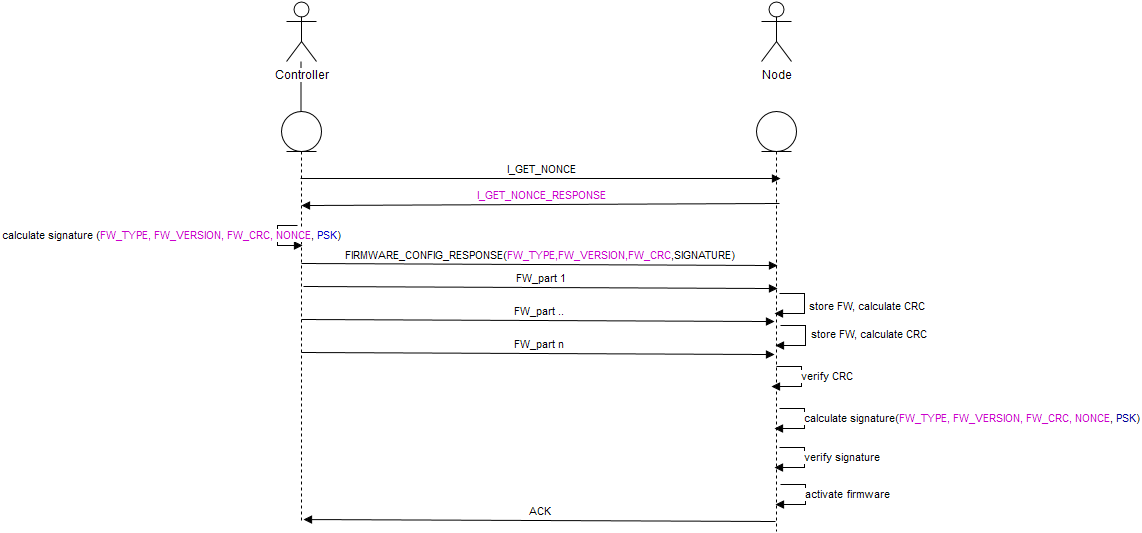
                                          MySensors OTA.png

                                          I'm attaching the xml file from https://www.draw.io/ - feel free to correct if I have misunderstood something. (Or use whatever neat tool Anticimex used when describing the message signing process.)
                                          MySensors OTA.xml

                                          Base fact: A CRC is, by definition, redundant. That means that the CRC does not add any information to the conversation. The CRC can be computed on-the-fly by anyone. To get a selected CRC, an attacker can flip the corresponding bit(s) anywhere in the message (mod 16 bits).

                                          Attack scenario 1: The attacker is able to read anything and send their own packets, but is unable to block or modify legitimate traffic.
                                          In this case, the attacker is unable to create a valid signature since a new nonce will be generated by the node for every firmware update, and the life time of the nonce is limited (just as described by Anticimex in the signing thread. The only viable attack is for the attacker to ask the Node for new nonces repeatedly until a nonce is re-used.

                                          Attack scenario 2: The attacker is able to modify, block and inject traffic in an ongoing conversation.
                                          In this case, if the above OTA method is used, the attacker can simply replace the firmware on-the-fly, calculate the CRC on-the-fly and replace the last two bytes (assuming a CRC16) to arrive at the original CRC. The signature created by the Controller will still be valid.


                                          1 Reply Last reply
                                          0
                                          Reply
                                          • Reply as topic
                                          Log in to reply
                                          • Oldest to Newest
                                          • Newest to Oldest
                                          • Most Votes


                                          25

                                          Online

                                          11.7k

                                          Users

                                          11.2k

                                          Topics

                                          113.1k

                                          Posts


                                          Copyright 2025 TBD   |   Forum Guidelines   |   Privacy Policy   |   Terms of Service
                                          • Login

                                          • Don't have an account? Register

                                          • Login or register to search.
                                          • First post
                                            Last post
                                          0
                                          • MySensors
                                          • OpenHardware.io
                                          • Categories
                                          • Recent
                                          • Tags
                                          • Popular