Skip to content
  • MySensors
  • OpenHardware.io
  • Categories
  • Recent
  • Tags
  • Popular
Skins
  • Light
  • Brite
  • Cerulean
  • Cosmo
  • Flatly
  • Journal
  • Litera
  • Lumen
  • Lux
  • Materia
  • Minty
  • Morph
  • Pulse
  • Sandstone
  • Simplex
  • Sketchy
  • Spacelab
  • United
  • Yeti
  • Zephyr
  • Dark
  • Cyborg
  • Darkly
  • Quartz
  • Slate
  • Solar
  • Superhero
  • Vapor

  • Default (No Skin)
  • No Skin
Collapse
Brand Logo
  1. Home
  2. Hardware
  3. How can i detect 230V (pump active)?

How can i detect 230V (pump active)?

Scheduled Pinned Locked Moved Hardware
10 Posts 5 Posters 8.0k Views 3 Watching
  • Oldest to Newest
  • Newest to Oldest
  • Most Votes
Reply
  • Reply as topic
Log in to reply
This topic has been deleted. Only users with topic management privileges can see it.
  • A Offline
    A Offline
    ahhk
    Hardware Contributor
    wrote on last edited by
    #1

    Hi all,

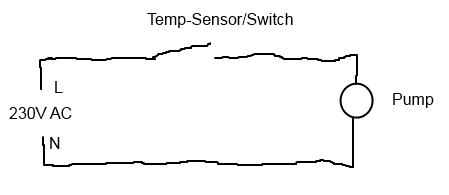
    i hope you have an idea. The situation: I have a water-bearing fireplace which is integrated into the heating system of my house. There is a temperature-sensor, which switches at 70°C so that the heatingpump gets 230V and starts
    Unbenannt.png

    My challenge is now, to detect when the sensor closes and opens (pump on / off) without cutting the direct connection (the direct wire) between 230V, Sensor and Pump (legal requirement).

    My first thought was to install a relay in parallel to the pump. But this draws 1W - a bit too much for me.

    My question is now: How can i easily detect, when the pump is on and off? Any Ideas?

    1 Reply Last reply
    0
    • M Offline
      M Offline
      mvdarend
      wrote on last edited by
      #2

      A non-invasive current sensor?

      http://www.aliexpress.com/item/Free-Shipping-New-Non-invasive-0-100A-AC-Sensor-Split-Core-Current-Transformer-SCT-013-000/32280304935.html

      1 Reply Last reply
      0
      • J Offline
        J Offline
        jkandasa
        Plugin Developer
        wrote on last edited by
        #3

        @ahhk you can use something like "Electric Field Detector", example: http://forum.arduino.cc/index.php?topic=85752.0

        1 Reply Last reply
        0
        • A Offline
          A Offline
          ahhk
          Hardware Contributor
          wrote on last edited by
          #4

          Hi,

          sry guys, i withdraw my question. I just found a simple and unbelievable easy solution: 230v small signal lamp + LDR.

          It could not be cheaper and easier.....LOL

          Thx for your proposals!
          Greetings

          Andreas

          1 Reply Last reply
          0
          • M Offline
            M Offline
            MikeF
            wrote on last edited by
            #5

            What's a 'small signal lamp', and how much power does it draw?

            I'm looking for a similar solution - I want to monitor my central heating and hot water system. I've got a UK 'Y-plan' system, with a mid-position valve. One wire to the valve is energised (i.e., 230V) when heating is on, while another is energised when hot water is off.

            1 Reply Last reply
            0
            • A Offline
              A Offline
              ahhk
              Hardware Contributor
              wrote on last edited by
              #6

              Hi,

              something like this: http://www.ebay.com/itm/Signalleuchten-mit-Lampe-Max-230-V-Rot-transparent-RAFI-Inhalt-1-St-/400562275133?hash=item5d435f433d

              On the arduino-side, just use an LDR (http://www.ebay.com/itm/20PCS-Photoresistor-LDR-CDS-5mm-Light-Dependent-Resistor-Sensor-GL5516-Arduino-/311050784623?hash=item486c124f6f)

              The LDR triggers an interrupt and the arduino wakes up to send "on" or "off" signal ;)

              Greetings

              Andreas

              1 Reply Last reply
              0
              • M Offline
                M Offline
                MikeF
                wrote on last edited by
                #7

                I'm trying to detect mains voltage as suggested above, using a miniature mains neon indicator and photodiode sensor module (digital output):
                (http://www.ebay.co.uk/itm/301337737695?_trksid=p2060353.m2749.l2649&ssPageName=STRK%3AMEBIDX%3AIT)
                (http://www.ebay.co.uk/itm/161785822980?_trksid=p2060353.m2749.l2649&ssPageName=STRK%3AMEBIDX%3AIT)

                I'm using the MySensors Door / Windows / Button example sketch, however in serial monitor I'm getting rapidly alternating fail messages:

                send: 1-1-0-0 s=3,c=1,t=16,pt=2,l=2,st=fail:0
                send: 1-1-0-0 s=3,c=1,t=16,pt=2,l=2,st=fail:1
                send: 1-1-0-0 s=3,c=1,t=16,pt=2,l=2,st=fail:0
                send: 1-1-0-0 s=3,c=1,t=16,pt=2,l=2,st=fail:1
                send: 1-1-0-0 s=3,c=1,t=16,pt=2,l=2,st=fail:0
                send: 1-1-0-0 s=3,c=1,t=16,pt=2,l=2,st=fail:1
                

                Is this because the input is changing at 50Hz? (it works OK on a battery-powered torch).

                Is there anything I can do to overcome this?

                A 1 Reply Last reply
                0
                • M MikeF

                  I'm trying to detect mains voltage as suggested above, using a miniature mains neon indicator and photodiode sensor module (digital output):
                  (http://www.ebay.co.uk/itm/301337737695?_trksid=p2060353.m2749.l2649&ssPageName=STRK%3AMEBIDX%3AIT)
                  (http://www.ebay.co.uk/itm/161785822980?_trksid=p2060353.m2749.l2649&ssPageName=STRK%3AMEBIDX%3AIT)

                  I'm using the MySensors Door / Windows / Button example sketch, however in serial monitor I'm getting rapidly alternating fail messages:

                  send: 1-1-0-0 s=3,c=1,t=16,pt=2,l=2,st=fail:0
                  send: 1-1-0-0 s=3,c=1,t=16,pt=2,l=2,st=fail:1
                  send: 1-1-0-0 s=3,c=1,t=16,pt=2,l=2,st=fail:0
                  send: 1-1-0-0 s=3,c=1,t=16,pt=2,l=2,st=fail:1
                  send: 1-1-0-0 s=3,c=1,t=16,pt=2,l=2,st=fail:0
                  send: 1-1-0-0 s=3,c=1,t=16,pt=2,l=2,st=fail:1
                  

                  Is this because the input is changing at 50Hz? (it works OK on a battery-powered torch).

                  Is there anything I can do to overcome this?

                  A Offline
                  A Offline
                  AWI
                  Hero Member
                  wrote on last edited by
                  #8

                  @MikeF Just a guess.. I think a Neon - Photodiode combination is to fast. A LDR is a rather slow analog device which can be damped with a capacitor in parallel. You could try it with the photo diode and a 0.1 - 1.0 uF value. The fails are probably because the radio cannot keep up with the speed (50 Hz => one message each 10ms )

                  1 Reply Last reply
                  0
                  • M Offline
                    M Offline
                    MikeF
                    wrote on last edited by
                    #9

                    Success! :smile: with 1.0uF across photodiode, although pot adjustment setting is quite sensitive. May try replacing photodiode with LDR.

                    Thanks!

                    1 Reply Last reply
                    0
                    • A Offline
                      A Offline
                      ahhk
                      Hardware Contributor
                      wrote on last edited by
                      #10

                      Hi,

                      or use a small bulb instead neon...should also work. But a cap in parallel is always a good idea for this.

                      1 Reply Last reply
                      0

                      Hello! It looks like you're interested in this conversation, but you don't have an account yet.

                      Getting fed up of having to scroll through the same posts each visit? When you register for an account, you'll always come back to exactly where you were before, and choose to be notified of new replies (either via email, or push notification). You'll also be able to save bookmarks and upvote posts to show your appreciation to other community members.

                      With your input, this post could be even better 💗

                      Register Login
                      Reply
                      • Reply as topic
                      Log in to reply
                      • Oldest to Newest
                      • Newest to Oldest
                      • Most Votes


                      14

                      Online

                      12.0k

                      Users

                      11.2k

                      Topics

                      113.4k

                      Posts


                      Copyright 2025 TBD   |   Forum Guidelines   |   Privacy Policy   |   Terms of Service
                      • Login

                      • Don't have an account? Register

                      • Login or register to search.
                      • First post
                        Last post
                      0
                      • MySensors
                      • OpenHardware.io
                      • Categories
                      • Recent
                      • Tags
                      • Popular