Skip to content
  • MySensors
  • OpenHardware.io
  • Categories
  • Recent
  • Tags
  • Popular
Skins
  • Light
  • Brite
  • Cerulean
  • Cosmo
  • Flatly
  • Journal
  • Litera
  • Lumen
  • Lux
  • Materia
  • Minty
  • Morph
  • Pulse
  • Sandstone
  • Simplex
  • Sketchy
  • Spacelab
  • United
  • Yeti
  • Zephyr
  • Dark
  • Cyborg
  • Darkly
  • Quartz
  • Slate
  • Solar
  • Superhero
  • Vapor

  • Default (No Skin)
  • No Skin
Collapse
Brand Logo
  1. Home
  2. Announcements
  3. 💬 Building a wired RS485 sensor network

💬 Building a wired RS485 sensor network

Scheduled Pinned Locked Moved Announcements
164 Posts 33 Posters 47.2k Views 35 Watching
  • Oldest to Newest
  • Newest to Oldest
  • Most Votes
Reply
  • Reply as topic
Log in to reply
This topic has been deleted. Only users with topic management privileges can see it.
  • R Reza

    @kimot also do you have idea for improve wireless transport(nrf24)?
    because for wireless also i have 50% error for commands.

    K Offline
    K Offline
    kimot
    wrote on last edited by
    #89

    @Reza
    Sorry, I do not know.
    I am not using radio now (but RS485 too not).
    I only look to code and try some RS485 library things,
    but only two nodes connected through serial lines.
    I am trying understand like MySensors code works to write my own library for CAN bus.

    https://forum.mysensors.org/topic/5327/can-bus-transport-implementation-for-mys/17

    1 Reply Last reply
    0
    • K kimot

      @Reza
      This code makes, that your node sends three SOH bytes on beginning of message instead of only one SOH.

      R Offline
      R Offline
      Reza
      wrote on last edited by
      #90

      @kimot thank you for help :pray:

      K 1 Reply Last reply
      0
      • R Reza

        @kimot thank you for help :pray:

        K Offline
        K Offline
        kimot
        wrote on last edited by kimot
        #91

        @Reza
        Like someone writes here, your module maybe includes all needed resistors for the bus on PCB.

        http://yourduino.com/sunshop//index.php?l=product_detail&p=323

        For two nodes it ok and you must not connect any terminating resistors.
        For three and more, you must remove this resistors from PCB exclude those nodes, which are on the ends of bus.
        Maybe you can divide your "big" problem to several "small" problems.
        RS485 is tested bus and MUST work even on long cables.
        It must be problem with electricity circuit or software.
        Maybe software switchs direction pin to receiving mode early and not all data are send on the bus.
        In MyTransportRS485.cpp maybe it is wrong .
        It is "hard coded" for crystal 20MHz and bus speed 9600 bd. Try put your values.
        //
        _dev.flush();
        delayMicroseconds((20000000UL/9600)+1);
        //

        Try examples from AltSoftSerial library with different lengths of cables and do not forgot handle your DE pin.
        https://github.com/PaulStoffregen/AltSoftSerial

        Or connect your two nodes only through serial wires and check functionality of your code without rs485 converters.

        R 1 Reply Last reply
        0
        • K kimot

          @Reza
          Like someone writes here, your module maybe includes all needed resistors for the bus on PCB.

          http://yourduino.com/sunshop//index.php?l=product_detail&p=323

          For two nodes it ok and you must not connect any terminating resistors.
          For three and more, you must remove this resistors from PCB exclude those nodes, which are on the ends of bus.
          Maybe you can divide your "big" problem to several "small" problems.
          RS485 is tested bus and MUST work even on long cables.
          It must be problem with electricity circuit or software.
          Maybe software switchs direction pin to receiving mode early and not all data are send on the bus.
          In MyTransportRS485.cpp maybe it is wrong .
          It is "hard coded" for crystal 20MHz and bus speed 9600 bd. Try put your values.
          //
          _dev.flush();
          delayMicroseconds((20000000UL/9600)+1);
          //

          Try examples from AltSoftSerial library with different lengths of cables and do not forgot handle your DE pin.
          https://github.com/PaulStoffregen/AltSoftSerial

          Or connect your two nodes only through serial wires and check functionality of your code without rs485 converters.

          R Offline
          R Offline
          Reza
          wrote on last edited by
          #92

          @kimot how remove resistors from PCB ? :O there is resistor onboard? so for first and end dont need connect external resistor ? in other means i must for example for 10 nodes , any change in node 1 and 10 ! and remove resistor for node 2 - 9 with soldering?
          i test with some hardware. for 30 meter cable i dont use sheild cable. this is without sheild? may be problem for 30 meter is related to this ! is this true ?
          i dont change any things in mytransport rs485 just W<3. also sketch is from site
          im my transport is:
          _dev.flush();
          delayMicroseconds((20000000UL/9600)+1);

          your last experience how many nodes you use ? with how much wire? and how % error for send and receive you have?

          1 Reply Last reply
          0
          • scalzS Offline
            scalzS Offline
            scalz
            Hardware Contributor
            wrote on last edited by scalz
            #93

            @Reza

            I agree regarding your rs485 network you may need to adjust resistors. But i've not this setup, even if i would like to try it!

            about removing smd resistor..if you have a solder iron, a simple trick :
            Let's assume you want to push and remove your resistor to the right..

            1. Add a blob of solder to the right pad (take a magnifier if you're not confident or smd is too small)
            2. Heat well this pad. Not like hell, lol, but enough so solder will still be melted, for,
            3. Then quickly move to the left pad, heat it, and push the resistor to the right for removing it.

            Be careful with others parts around of course ;)

            I hope it's clear :)

            R 1 Reply Last reply
            1
            • scalzS scalz

              @Reza

              I agree regarding your rs485 network you may need to adjust resistors. But i've not this setup, even if i would like to try it!

              about removing smd resistor..if you have a solder iron, a simple trick :
              Let's assume you want to push and remove your resistor to the right..

              1. Add a blob of solder to the right pad (take a magnifier if you're not confident or smd is too small)
              2. Heat well this pad. Not like hell, lol, but enough so solder will still be melted, for,
              3. Then quickly move to the left pad, heat it, and push the resistor to the right for removing it.

              Be careful with others parts around of course ;)

              I hope it's clear :)

              R Offline
              R Offline
              Reza
              wrote on last edited by
              #94

              @scalz This is an exciting job :)
              thank you
              i hope it is clear too :)

              K 1 Reply Last reply
              0
              • R Reza

                @scalz This is an exciting job :)
                thank you
                i hope it is clear too :)

                K Offline
                K Offline
                kimot
                wrote on last edited by kimot
                #95

                @Reza
                I recommend nothing solder or unsolder now.
                Simply start with two Arduinos on two ends of cable.
                When your communication will work for these two devices, then you can go further.
                For one Arduino write simple sketch, which will periodically send something ("Hello World/n" )
                to the bus. Other Arduino with sketch witch will receive characters and sends then through USB serial port to serial monitor on PC. Only with AltSoftSerial library, not with MySensors.
                When this communication will work on any length of cable ( I suppose you have not cable longer then 1km at your home ), you can go further.
                You do not need drive DE and RE pins by software, simply on transmitting Arduino set it for transmit ( to +5V ) and on receiving Arduino to ground.

                R 1 Reply Last reply
                1
                • K kimot

                  @Reza
                  I recommend nothing solder or unsolder now.
                  Simply start with two Arduinos on two ends of cable.
                  When your communication will work for these two devices, then you can go further.
                  For one Arduino write simple sketch, which will periodically send something ("Hello World/n" )
                  to the bus. Other Arduino with sketch witch will receive characters and sends then through USB serial port to serial monitor on PC. Only with AltSoftSerial library, not with MySensors.
                  When this communication will work on any length of cable ( I suppose you have not cable longer then 1km at your home ), you can go further.
                  You do not need drive DE and RE pins by software, simply on transmitting Arduino set it for transmit ( to +5V ) and on receiving Arduino to ground.

                  R Offline
                  R Offline
                  Reza
                  wrote on last edited by
                  #96

                  @kimot this hard for me because i am beginner :) but thank you very thank you for help :pray: :pray: :pray:

                  1 Reply Last reply
                  0
                  • ranseyerR Offline
                    ranseyerR Offline
                    ranseyer
                    Hardware Contributor
                    wrote on last edited by
                    #97

                    Hi, i have a Gateway running and the motion-sensor. The Sensors talks with the Gateway. (Arduino Pins: D2,D8,D9)
                    Now i have to switch to another Hardware. On the Arduino-Pro Mini i have easy access to 0-RX, 1-TX, 2-D5, 3-D5, 4-D7, 10-13, A1-A3)
                    Which combination of this pins would be the best, and how can i define it in the sketch ?
                    Im happe for each hint.

                    1 Reply Last reply
                    0
                    • A Offline
                      A Offline
                      ArduiSens
                      wrote on last edited by
                      #98

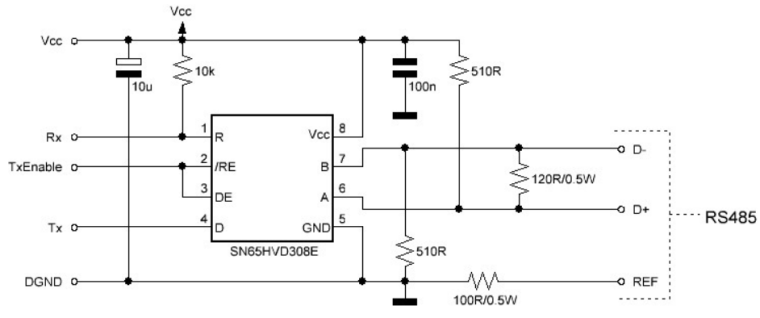
                      The 510 ohm pull up and pull down resistors are usually mounted on the master side. Theoretically it
                      would be best to install it in the middle of your bus line. The 120 ohm termination resistor must always
                      be used on distances greater than 1 meter and/or baud rates higher than 9600. It’s best to install it as a
                      norm as noise and reflections will cause havoc on your communication once implemented in the field.
                      The termination resistors should be mounted at both ends of the bus line. Please note that adding bias
                      resistors will load the driver IC output. With the indicated values the max number of units on the bus
                      line is limited to eight 12kΩ, sixteen 24kΩ, or thirty-two 48kΩ units.
                      For further protection transient suppressors can be installed across the differential lines, from the Vcc to
                      D+ and from GND to D-.!
                      0_1491314128147_upload-f4c63383-2b9a-4f3d-bd48-1e25fcf9dc76

                      MySensors 2.3.2; contr:Domoticz; layer: RS485, nRF24; gw: Ethernet, Serial

                      1 Reply Last reply
                      0
                      • A Offline
                        A Offline
                        ArduiSens
                        wrote on last edited by
                        #99

                        Google for simple Modbus Master dcouments (arduino forum)

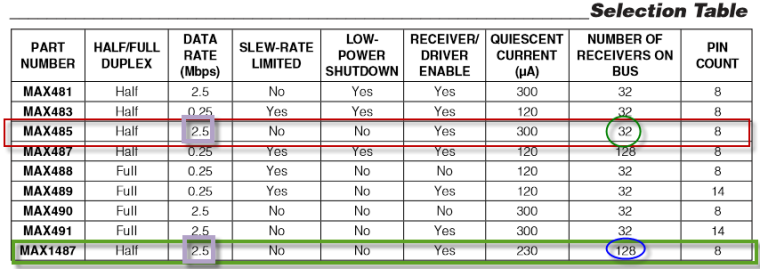
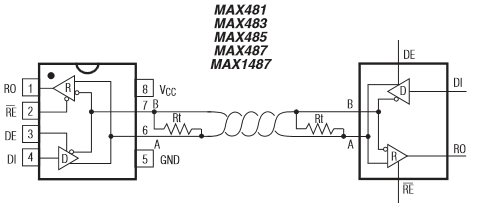
                        The MAX485 is not the best RS485 chip because of it's own internal impedance.
                        The chip in the diagram can be change by MAX485, MAX...
                        0_1491314500978_upload-db69c9ce-43b6-430d-8807-74438ad83b96

                        https://datasheets.maximintegrated.com/en/ds/MAX1487-MAX491.pdf

                        MySensors 2.3.2; contr:Domoticz; layer: RS485, nRF24; gw: Ethernet, Serial

                        1 Reply Last reply
                        0
                        • A Offline
                          A Offline
                          ArduiSens
                          wrote on last edited by
                          #100

                          FYI
                          0_1491315316611_upload-40d28ad1-8ba3-4a11-aa7b-5bd1e84424d2

                          MySensors 2.3.2; contr:Domoticz; layer: RS485, nRF24; gw: Ethernet, Serial

                          1 Reply Last reply
                          0
                          • nofoxN Offline
                            nofoxN Offline
                            nofox
                            wrote on last edited by
                            #101

                            Hi, I'm building my home automation system and I have UTP cables cat5e in walls going to my wall switches. I have four cables, 5 nodes on one cable, 2 nodes on the second cable, and one node on 3rd and one 4th cable. 9 nodes. I know that the RS485 should be connected in parallel on single twisted pair but i cant change cables now cause my walls are painted etc.. So I have few problems, nodes stops working, i need to reset them few times, after few days the network stops to work and i start to search for an answers here. I changed numbers of SOH from 1 to 3 in 274 line of MyTransportRS485.cpp and now I think the network working better. I have 120ohm resistor in every node. You think that I should remove them ? Nodes are max 10 meters from the gateway so the cable lengths aren't so long.

                            K 1 Reply Last reply
                            0
                            • nofoxN nofox

                              Hi, I'm building my home automation system and I have UTP cables cat5e in walls going to my wall switches. I have four cables, 5 nodes on one cable, 2 nodes on the second cable, and one node on 3rd and one 4th cable. 9 nodes. I know that the RS485 should be connected in parallel on single twisted pair but i cant change cables now cause my walls are painted etc.. So I have few problems, nodes stops working, i need to reset them few times, after few days the network stops to work and i start to search for an answers here. I changed numbers of SOH from 1 to 3 in 274 line of MyTransportRS485.cpp and now I think the network working better. I have 120ohm resistor in every node. You think that I should remove them ? Nodes are max 10 meters from the gateway so the cable lengths aren't so long.

                              K Offline
                              K Offline
                              kimot
                              wrote on last edited by
                              #102

                              @nofox
                              If you have got one free pair of wires in cat5e cable, it is easy to convert your "star" topology to pure 485 bus topology with terminal resistors on both ends only.

                              nofoxN 1 Reply Last reply
                              0
                              • gohanG Offline
                                gohanG Offline
                                gohan
                                Mod
                                wrote on last edited by
                                #103

                                I think the 120Ohms resistor needs to go at the end of the cable, not on each node

                                1 Reply Last reply
                                0
                                • K kimot

                                  @nofox
                                  If you have got one free pair of wires in cat5e cable, it is easy to convert your "star" topology to pure 485 bus topology with terminal resistors on both ends only.

                                  nofoxN Offline
                                  nofoxN Offline
                                  nofox
                                  wrote on last edited by
                                  #104

                                  @kimot I was thinking about that before I wrote here, and if nothing else can help I will convert star to bus.

                                  1 Reply Last reply
                                  0
                                  • A Offline
                                    A Offline
                                    ArduiSens
                                    wrote on last edited by
                                    #105

                                    @nofox it's what gohan stated, the 120ohm resistors should only put on the first and last node of you network. And you can only use a "bus" network topology for RS485.You should use the other wires of you Ethernet cable to accomplish this like kimot wrote.

                                    MySensors 2.3.2; contr:Domoticz; layer: RS485, nRF24; gw: Ethernet, Serial

                                    1 Reply Last reply
                                    0
                                    • nofoxN Offline
                                      nofoxN Offline
                                      nofox
                                      wrote on last edited by
                                      #106

                                      Ok, so i switched my RS485 network to "bus". I desolder all of 120ohm resistors and have them only on both ends of the bus. RS485 to Ethernet gateway is in the middle of the wire. There are still some problems.. When I switching on the power and reading debug from gate I see that only 4 from 9 nodes are presenting. I need to reset other nodes manually to get them properly presented to the gateway. What am I doing wrong ? I need help I think.. Maybe its caused by the fact that all nodes powering on at the same time and there are many collisions on the RS485 bus ?? Maybe I should add some different delay() to setup part of my sketches to give, a time for every single node to present to the gateway ? Someone have successful working rs485 mysensors network here ?

                                      This is code for one of my nodes with buttons, relays and temperature sensor:

                                      #define MY_NODE_ID 8
                                      
                                      // Enable debug prints to serial monitor
                                      #define MY_DEBUG 
                                      
                                      // Enable RS485 transport layer
                                      #define MY_RS485
                                      
                                      // Define this to enables DE-pin management on defined pin
                                      #define MY_RS485_DE_PIN 2
                                      
                                      // Set RS485 baud rate to use
                                      #define MY_RS485_BAUD_RATE 9600
                                      
                                      #include <SPI.h>
                                      #include <MySensors.h>
                                      #include <Bounce2.h>
                                      #include <DallasTemperature.h>
                                      #include <OneWire.h>
                                      #include <OneButton.h>
                                      
                                      // define actions for OneButton function
                                      typedef enum {
                                        ACTION_OFF_1,  // set relay "OFF".
                                        ACTION_ON_1,   // set relay "ON"
                                        ACTION_OFF_2, 
                                        ACTION_ON_2
                                      }
                                      MyActions;
                                      
                                      MyActions nextAction_1 = ACTION_OFF_1;
                                      MyActions nextAction_2 = ACTION_OFF_2;
                                      
                                      // define Arduino I/O pins for relays
                                      #define RELAY_1  3 // Arduino Digital I/O pin number for first relay
                                      #define RELAY_2  5 // Arduino Digital I/O pin number for first relay
                                      #define RELAY_ON 1  // GPIO value to write to turn on attached relay
                                      #define RELAY_OFF 0 // GPIO value to write to turn off attached relay
                                      
                                      // configure parameters for 1Wire temp sensor
                                      #define COMPARE_TEMP 1
                                      #define ONE_WIRE_BUS 6
                                      #define MAX_ATTACHED_DS18B20 16
                                      
                                      // define CHILD IDs for relays and virtual multiaction click/doubleclick/longpress buttons
                                      #define CHILD_ID_11 11 // child id for first relay and first button single click 
                                      #define CHILD_ID_12 12 // child id for second relay and second button single click
                                      // #define CHILD_ID_13 13 // child id for first button single click (in this version not active because single click is attached directly to relay state)
                                      #define CHILD_ID_14 14 // child id for first button double click
                                      #define CHILD_ID_15 15 // child id for first button long press
                                      // #define CHILD_ID_16 16 // child id for second button single click (in this version not active because single click is attached directly to relay state)
                                      #define CHILD_ID_17 17 // child id for second button double click
                                      #define CHILD_ID_18 18 // child id for second button long press
                                      
                                      // define variables for temperature (and other) 1Wire Sensors
                                      long previousMillis = 0;
                                      long sensorInterval = 60000; // interval for temperature measurement 
                                      long HI_interval = 1000;
                                      OneWire oneWire(ONE_WIRE_BUS);
                                      DallasTemperature sensors(&oneWire);
                                      
                                      float lastTemperature[MAX_ATTACHED_DS18B20];
                                      int numSensors=0;
                                      bool recivedConfig = false;
                                      bool metric = true;
                                      
                                      // define Arduino Digital I/O pins for OneButton function
                                      OneButton BUTTON_1(7, true); // Arduino Digital I/O pin number for first physical button
                                      OneButton BUTTON_2(10, true); // Arduino Digital I/O pin number for second physical button
                                      
                                      bool V1_BUTTON_1; // set variable for virtual one click button 1
                                      bool V2_BUTTON_1; // set variable for virtual double click button 1
                                      bool V3_BUTTON_1; // set variable for virtual long press button 1
                                      
                                      bool V1_BUTTON_2; // set variable for virtual one click button 2
                                      bool V2_BUTTON_2; // set variable for virtual one click button 2
                                      bool V3_BUTTON_2; // set variable for virtual one click button 2
                                      
                                      
                                      bool state1; // variable for RELAY_1 states 
                                      bool state2; // variable for RELAY_2 states 
                                      
                                      void before()
                                      {    
                                      
                                       sensors.begin();
                                      
                                      }
                                      
                                      //define messages for diferent type of sensors CHILD_IDs used
                                      MyMessage msg0(0,V_TEMP); // temperature sensor message
                                      MyMessage msg11(CHILD_ID_11, V_LIGHT); // first relay & single click message
                                      MyMessage msg12(CHILD_ID_12, V_LIGHT); // second relay & single click message
                                      
                                      // MyMessage msg13(CHILD_ID_13, V_LIGHT); // button 1 Single click
                                      MyMessage msg14(CHILD_ID_14, V_LIGHT); // button 1 Double click
                                      MyMessage msg15(CHILD_ID_15, V_LIGHT); // button 1 Long press
                                      
                                      // MyMessage msg16(CHILD_ID_16, V_LIGHT); // button 2 Single click
                                      MyMessage msg17(CHILD_ID_17, V_LIGHT); // button 2 Dobule click
                                      MyMessage msg18(CHILD_ID_18, V_LIGHT); // button 2 Long press
                                      
                                      void setup()
                                      {
                                      
                                      digitalWrite(RELAY_1, RELAY_OFF); // Set first relay state and pin mode
                                       pinMode(RELAY_1, OUTPUT);
                                      
                                      state1 = loadState(CHILD_ID_11);  // Set relay to last known state (using eeprom storage)
                                       digitalWrite(RELAY_1, state1?RELAY_ON:RELAY_OFF);
                                      
                                      digitalWrite(RELAY_2, RELAY_OFF); // Set second relay state and pin mode 
                                       pinMode(RELAY_2, OUTPUT);
                                      
                                      state2 = loadState(CHILD_ID_12);  // Set relay to last known state (using eeprom storage)
                                       digitalWrite(RELAY_2, state2?RELAY_ON:RELAY_OFF); 
                                      
                                       
                                      // sending states of relays after node bootup
                                      send(msg11.set(state1));
                                      send(msg12.set(state2));
                                      
                                      // attaching physical BUTTON_1 to OneButton function actions
                                      BUTTON_1.attachClick(singleclick_BUTTON_1);
                                      BUTTON_1.attachDoubleClick(doubleclick_BUTTON_1);
                                      BUTTON_1.attachLongPressStop(longpress_BUTTON_1);
                                      // attaching physical BUTTON_2 to OneButton function actions
                                      BUTTON_2.attachClick(singleclick_BUTTON_2);
                                      BUTTON_2.attachDoubleClick(doubleclick_BUTTON_2);
                                      BUTTON_2.attachLongPressStop(longpress_BUTTON_2);
                                      // setup for temperature sensor
                                      sensors.setWaitForConversion(false);
                                      
                                      }
                                      
                                      void presentation()
                                      {
                                          sendSketchInfo("pokoiczek_puszka_1", "1.0");
                                      
                                          numSensors = sensors.getDeviceCount();
                                      
                                        // Present all sensors to controller
                                        for (int i=0; i<numSensors && i<MAX_ATTACHED_DS18B20; i++) {   
                                           present(i, S_TEMP);
                                        }
                                      
                                          present(CHILD_ID_11, S_LIGHT);
                                          present(CHILD_ID_12, S_LIGHT);
                                          
                                          // present(CHILD_ID_13, S_LIGHT);
                                          present(CHILD_ID_14, S_LIGHT);
                                          present(CHILD_ID_15, S_LIGHT);
                                          
                                          // present(CHILD_ID_16, S_LIGHT);
                                          present(CHILD_ID_17, S_LIGHT);
                                          present(CHILD_ID_18, S_LIGHT);
                                          
                                      }
                                      
                                      
                                      void loop()
                                      {
                                      
                                        temperatureCheck(); // tmperature check function
                                      
                                        // states for nextAction of OneButton function
                                        if(state1 == HIGH)
                                          {
                                            nextAction_1 = ACTION_OFF_1;
                                          }
                                          else 
                                          {
                                            nextAction_1 = ACTION_ON_1;
                                          }
                                      
                                        BUTTON_1.tick();  // reading state of first physical button 
                                        
                                        if(state2 == HIGH)
                                          {
                                            nextAction_2 = ACTION_OFF_2;
                                          }
                                          else 
                                          {
                                            nextAction_2 = ACTION_ON_2;
                                          }  
                                        
                                        BUTTON_2.tick(); // // reading state of second physical button 
                                        
                                      }
                                      
                                      void singleclick_BUTTON_1()
                                       {
                                        if (nextAction_1 == ACTION_OFF_1 )
                                          {
                                            nextAction_1 = ACTION_ON_1;
                                            send(msg11.set(HIGH?false:true), true);
                                          }
                                        else
                                          {
                                          nextAction_1 = ACTION_OFF_1;
                                          send(msg11.set(LOW?false:true), true);
                                          }
                                        // send(msg13.set(LOW ? 1 : 0));
                                        // send(msg13.set(HIGH ? 1 : 0));
                                       }
                                      
                                      void doubleclick_BUTTON_1()
                                      {
                                         send(msg14.set(LOW ? 1 : 0));
                                         send(msg14.set(HIGH ? 1 : 0));
                                      }
                                      
                                      void longpress_BUTTON_1()
                                      {
                                         send(msg15.set(LOW ? 1 : 0));
                                         send(msg15.set(HIGH ? 1 : 0));
                                      }
                                      
                                      void singleclick_BUTTON_2()
                                      {
                                         
                                         if (nextAction_2 == ACTION_OFF_2 )
                                          {
                                            nextAction_2 = ACTION_ON_2;
                                            send(msg12.set(HIGH?false:true), true);
                                          }
                                        else
                                          {
                                          nextAction_2 = ACTION_OFF_2;
                                          send(msg12.set(LOW?false:true), true);
                                          }
                                         
                                        // send(msg16.set(LOW ? 1 : 0));
                                        // send(msg16.set(HIGH ? 1 : 0));
                                      }
                                      
                                      void doubleclick_BUTTON_2()
                                      {
                                         send(msg17.set(LOW ? 1 : 0));
                                         send(msg17.set(HIGH ? 1 : 0));
                                      }
                                      
                                      void longpress_BUTTON_2()
                                      {
                                         send(msg18.set(LOW ? 1 : 0));
                                         send(msg18.set(HIGH ? 1 : 0));
                                      }
                                      
                                      void temperatureCheck()
                                      {
                                       unsigned long currentMillis = millis();
                                       if(currentMillis - previousMillis > sensorInterval)
                                        {
                                          previousMillis = currentMillis;
                                          
                                        // Fetch temperatures from Dallas sensors
                                        sensors.requestTemperatures();
                                        // query conversion time and sleep until conversion completed
                                        int16_t conversionTime = sensors.millisToWaitForConversion(sensors.getResolution());
                                        // sleep() call can be replaced by wait() call if node need to process incoming messages (or if node is repeater)
                                        wait(conversionTime);
                                        // Read temperatures and send them to controller 
                                        for (int i=0; i<numSensors && i<MAX_ATTACHED_DS18B20; i++) {
                                          // Fetch and round temperature to one decimal
                                          float temperature = static_cast<float>(static_cast<int>((getControllerConfig().isMetric?sensors.getTempCByIndex(i):sensors.getTempFByIndex(i)) * 10.)) / 10.;
                                          // Only send data if temperature has changed and no error
                                          #if COMPARE_TEMP == 1
                                          if (lastTemperature[i] != temperature && temperature != -127.00 && temperature != 85.00) {
                                          #else
                                          if (temperature != -127.00 && temperature != 85.00) {
                                          #endif
                                            // Send in the new temperature
                                            send(msg0.setSensor(i).set(temperature,1));
                                            // Save new temperatures for next compare
                                            lastTemperature[i]=temperature;
                                          }
                                        }
                                        
                                      }
                                      
                                      }
                                      
                                      void receive(const MyMessage &message)
                                      {
                                        if (message.type == V_STATUS && message.sensor == 11) {
                                          // Change relay state
                                          state1 = message.getBool();
                                          digitalWrite(RELAY_1, state1?RELAY_ON:RELAY_OFF);
                                          // Store state in eeprom
                                          saveState(CHILD_ID_11, state1);
                                          
                                         // send(msg11.set(state1));
                                      
                                           // Write some debug info
                                          Serial.print("Incoming change for sensor:");
                                          Serial.print(message.sensor);
                                          Serial.print(", New status: ");
                                          Serial.println(message.getBool());
                                        }
                                        else if (message.type == V_STATUS && message.sensor == 12) {
                                      
                                          state2 = message.getBool();
                                          digitalWrite(RELAY_2, state2?RELAY_ON:RELAY_OFF);
                                      
                                          saveState(CHILD_ID_12, state2);
                                      
                                         // send(msg12.set(state2));
                                          
                                          // Write some debug info
                                          Serial.print("Incoming change for sensor:");
                                          Serial.print(message.sensor);
                                          Serial.print(", New status: ");
                                          Serial.println(message.getBool());
                                        }
                                      }
                                      

                                      I'm using OneButton library to get different actions when i'm clicking once, twice and holding buttons.

                                      1 Reply Last reply
                                      0
                                      • A Offline
                                        A Offline
                                        ArduiSens
                                        wrote on last edited by
                                        #107

                                        Nofox,

                                        1. The 510 ohm pull up and pull down resistors (between A (D+) and 5V / between B (D-) and ground) are usually mounted on the master side (which is your gateway). Theoretically it would be best to install it in the middle of your bus line.
                                        2. check if your power supply has enough power to feed all your nodes
                                        3. check that all the ground lines of your boards are connected with each other.

                                        MySensors 2.3.2; contr:Domoticz; layer: RS485, nRF24; gw: Ethernet, Serial

                                        nofoxN 1 Reply Last reply
                                        0
                                        • A ArduiSens

                                          Nofox,

                                          1. The 510 ohm pull up and pull down resistors (between A (D+) and 5V / between B (D-) and ground) are usually mounted on the master side (which is your gateway). Theoretically it would be best to install it in the middle of your bus line.
                                          2. check if your power supply has enough power to feed all your nodes
                                          3. check that all the ground lines of your boards are connected with each other.
                                          nofoxN Offline
                                          nofoxN Offline
                                          nofox
                                          wrote on last edited by
                                          #108

                                          @ArduiSens Thanks for your reply! I have found few post here on MYS Forum about biasing rs485 line with pull up and pull down resistors and I will try to do this tomorrow. I'm using standard rs485 module from aliexpress on the gateway side. There are pullups and pulldowns there but they are two 10k resistors, I will change them to 510 as you mentioned.
                                          All of my wired sensors, gateway and RPi are powered form 10A buffered power supply. I've checked voltage on every node. I have 5.25V on power supply pins in the middle of the line and 5.21 on both ends of line. I'm using one twisted pair for Vcc and one for GND. The bus is about 15 meter long form one end to another.
                                          As I mentioned above all of nodes are supplied from one power supply so the grounds are all connected.

                                          1 Reply Last reply
                                          0
                                          Reply
                                          • Reply as topic
                                          Log in to reply
                                          • Oldest to Newest
                                          • Newest to Oldest
                                          • Most Votes


                                          28

                                          Online

                                          11.7k

                                          Users

                                          11.2k

                                          Topics

                                          113.1k

                                          Posts


                                          Copyright 2025 TBD   |   Forum Guidelines   |   Privacy Policy   |   Terms of Service
                                          • Login

                                          • Don't have an account? Register

                                          • Login or register to search.
                                          • First post
                                            Last post
                                          0
                                          • MySensors
                                          • OpenHardware.io
                                          • Categories
                                          • Recent
                                          • Tags
                                          • Popular