Skip to content
  • MySensors
  • OpenHardware.io
  • Categories
  • Recent
  • Tags
  • Popular
Skins
  • Light
  • Brite
  • Cerulean
  • Cosmo
  • Flatly
  • Journal
  • Litera
  • Lumen
  • Lux
  • Materia
  • Minty
  • Morph
  • Pulse
  • Sandstone
  • Simplex
  • Sketchy
  • Spacelab
  • United
  • Yeti
  • Zephyr
  • Dark
  • Cyborg
  • Darkly
  • Quartz
  • Slate
  • Solar
  • Superhero
  • Vapor

  • Default (No Skin)
  • No Skin
Collapse
Brand Logo
T

tlund

@tlund
About
Posts
7
Topics
0
Shares
0
Groups
0
Followers
0
Following
0

Posts

Recent Best Controversial

  • Sensebender Micro
    T tlund

    @tbowmo

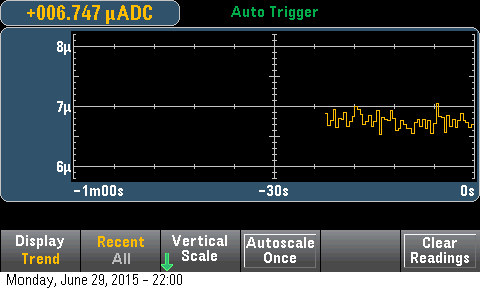
    I tried uploading the sensebender sketch using 1.0.5-r2 with board config "pro mini 328 3.3V 8MHz". The si7021 doesn't work in this configuration, but I managed to get a sleep current of ~6.8uA

    SenseBender.png

    I can provide the binary output from the two IDE versions if someone can give me an indication where to find the build binaries.

    Announcements

  • Sensebender Micro
    T tlund

    @tbowmo

    My NRF's are the same $1 nrf's listed in the mysensors store, so probably fake. But I have still measured them to draw ~900nA in powerDown.

    But I think I have found the culprint now. It seems the extra 20uA is caused by Arduino 1.6.5 (it may be that my installation is faulty).

    My test setup:

    • pro mini
    • nrf
    • a simple sketch that does gw.sleep(60s)

    1st test: sketch compiled & uploaded via Arduino 1.0.5-r2: 6uA
    2nd test: sketch compiled & uploaded via Arduino 1.6.5: 24uA

    Announcements

  • Sensebender Micro
    T tlund

    Hi @tbowmo

    Thanks for bringing this great project to the community.

    I'm trying to understand the sensebender's power profile, especially the sleep current.

    I have previously done some measurements with the atmega328p (pro mini) + NRF. In addition to that I have also looked at the datasheets for the other components on the sensebender.

    It seems the theoretical low sleep current consumption is something like this:

    * nrf24l01+    900nA
    * atmega328p     5uA (with WD)
    * si7021        60nA
    * atsha204      30nA
    * at23df512c   300nA
      =  Total     6.3uA
    

    The SBMicro seems to draw ~50uA in sleep mode with the default configuration.

    I managed to put the flash memory into "ultra deep sleep"(*), causing the total consumption to drop to ~27uA. So there is still around 20uA that is not accounted for.

    I've also tried putting the atsha204 into sleep, but that did not make any difference (also confirmed by the specs).

    Are there some other settings/sleep modes that have not been enabled yet? What about the atmega itself?

    Do any of you have the a sensebender prototype with separate components, and can test sleep current by removing components one
    by one? (Before I start cutting traces on my own sensebenders in order to zero in on the target component).

    Is there something I'm missing?

    Datasheets:
    ATSHA204
    AT25DF512C
    Si7021 A20

    (*) in setup(): flash.initialize(); flash.ultra_deep_sleep() <- From datasheet

    Announcements

  • Power consumption NRF24L01+
    T tlund

    I haven't experienced this before. Could be a faulty NRF.

    The NRF draws ~900nA when powered down, and ~15mA when awake/sending.

    If you need to send a message, do some (relatively lengthy) calculations, and then send something again, then you should:

    1. NRF send
    2. NRF powerDown
    3. perform calculations
    4. NRF send (automatically performs a powerup)

    If you do not power down the NRF before doing the calculations, then it will continue to draw mA's, even though it is not sending or receiving anything.

    Troubleshooting

  • Minimal design thoughts
    T tlund

    @tbowmo

    That current draw seems a bit high.

    A modified 3.3V pro mini draws ~100nA in "deep" sleep without watchdog timer (pretty much everything disabled). The nrf24l01+ draws ~900nA in power down. If you wake up the 328 using its watchdog timer (i.e. sleep != 0), then that watchdog will draw around 5uA, but it wakes up every 8 sec, so the average "extra" current consumption caused by the watchdog is closer to 6uA. According to the si7021 datasheet* it draws 60 nA standby current, and 150 uA active current.
    In other words, you should see a current consumption < 10uA in sleep mode. When active, the si7021 is negligible compared to the nrf and 328's current consumption, but the total consumption for nrf and 328 should still be less than 22mA... The 60ms you see probably indicates that the nrf is not able to get a hardware ("link-level") ACK, so it retries up to 15 times. Also, disabling DEBUG in MyConfig.h will save a few extra milliseconds. You should also make sure node.send() is the last thing you do before node.sleep(), or else the NRF will countinue to draw ~13mA until sleep() or RF24::powerDown() is called.

    This should not be too far from the theoretical current consumption profile for your board when reading hum+temp at given INTERVAL:
    (Assuming the nrf, 328 and si7021 has already been "booted")

    sleep(INTERVAL): ~7uA on average
    awake time 2+12+10.8+8 = 32.8ms
    - 328 wakeup: 3.6mA for 2ms
    - si7021 conversion hum: 3.6mA + 150uA for 12ms
    - si7021 conversion temp: 3.6mA + 150uA for 10.8ms
    - nrf24 send: 3.6mA + 13.4mA for 8ms (assuming no message retries)

    What components are actually mounted on the board you tested?
    The ATSHA204 should draw max 3mA active, and <150nA sleeping.
    The 25aa080sn*

    • Write current: 3 mA maximum
    • Read current: 500uA typical
    • Standby current: 500 nA typical

    You probably already know all this, but I thought I might mention it anyway :)

    http://www.silabs.com/Support Documents/TechnicalDocs/Si7021.pdf
    http://www.atmel.com/Images/Atmel-8740-CryptoAuth-ATSHA204-Datasheet.pdf
    http://ww1.microchip.com/downloads/en/DeviceDoc/21230E.pdf

    Hardware

  • Minimal design thoughts
    T tlund

    @tbowmo
    Sorry I was a bit unclear. I would like to buy all components as a package from you/mysensors. Preferably assembled, but I would also accept if you sell it unassembled (pcb+components). I would rather not have to source the components myself :)

    Btw, have you measured the actual power consumption? Sleep vs temp/hum measurement?

    Hardware

  • Minimal design thoughts
    T tlund

    I would be interested in 5 units. I lean towards including ATSHA204 and smt assembled, but I would buy without and unassembled.

    Hardware
  • Login

  • Don't have an account? Register

  • Login or register to search.
  • First post
    Last post
0
  • MySensors
  • OpenHardware.io
  • Categories
  • Recent
  • Tags
  • Popular