
Gateway Not Working
-
And your using the simple radio model on both ends (no amplified radio)?
Are you really sure the radio-wiring is correct? And no lose contacts (it has happened more than once for me:) ?The radios also seems to be very sensitive when it comes to stability of the power feeding (sometimes). Do you have the possibility to feed them through Wall-wart/USB or something else than your computer?
@hek said:
Are you really sure the radio-wiring is correct? And no lose contacts (it has happened more than once for me:) ?
me too. More than I care to admit and more frustrating than anything.
did you switch out the jumper wires already, too?
-
I think i've found the problem.
In the instructions on mysensors.org under building the USB-Serial Gateway it says
[code]
Building a USB-connected GatewayNOTE: You must use an Arduino Nano for the USB version of the gateway. The Nano is the officially supported and tested model so if you try a different version, we cannot guarantee that the Vera will recognize it.
Start by connecting the radio module.
[/code]When you follow the link to "connecting the radio module it leads to a Arduino Pro-Mini configuration NOT a Nano. I used the radio configuration from the Ethernet gateway because it depicts the wiring for a Nano.
I found some code on forum.micasaverde.com that was to debug the radio connection and put it in my Gateway code and it says the **radio is not connected properly. **
So now i'm confused, what wiring IS correct for the NANO in the USB Serial Gateway?
-
Yes, the radio wiring is different for ethernet vs serial version of the gateway.
So, like the instructions say, when building the Serial version you should follow the guide here:
http://www.mysensors.org/build/connect_radioThe pin numbers is identical between pro mini and nano.
-
Yes, the radio wiring is different for ethernet vs serial version of the gateway.
So, like the instructions say, when building the Serial version you should follow the guide here:
http://www.mysensors.org/build/connect_radioThe pin numbers is identical between pro mini and nano.
@hek As I recall the difference is in pins for CE/CSN (from memory here so I may be wrong) in which case my radio is in fact wired incorrectly as it used the Nano pinout from the Ethernet Gateway. I shall fix it and hopefully everything will start to play together. (Fingers, toes, legs, eyes crossed :-) )
-
Well, that didn't do it either. i do however now have a ERR LED indication on SOLID.
I have the following wiring (checked, rechecked)
Arduino...............Radio
Pin 2 IRQ Gray
Pin 4 LED Err
Pin 5 LED Tx
Pin 6 LED Rx
Pin 9 CE Org
Pin 10 CSN Yel
Pin 11 MOSI Blue
Pin 12 MISO Violet
Pin 13 SCK Grn
3.3 V Out Radio Vcc
5v Out LEDs
GND Radio GND4.7 uF Cap Radio Vcc to Radio GND
Changed power supply from Laptop USB to separate 5V USB Wall Wart -
Well, that didn't do it either. i do however now have a ERR LED indication on SOLID.
I have the following wiring (checked, rechecked)
Arduino...............Radio
Pin 2 IRQ Gray
Pin 4 LED Err
Pin 5 LED Tx
Pin 6 LED Rx
Pin 9 CE Org
Pin 10 CSN Yel
Pin 11 MOSI Blue
Pin 12 MISO Violet
Pin 13 SCK Grn
3.3 V Out Radio Vcc
5v Out LEDs
GND Radio GND4.7 uF Cap Radio Vcc to Radio GND
Changed power supply from Laptop USB to separate 5V USB Wall WartI just had a similar connectivity issue with a project I was completing. I switched to 1.2A 5V cell phone charger and that did it...
not enough power...
What is the output of your wall wort?
-
I just had a similar connectivity issue with a project I was completing. I switched to 1.2A 5V cell phone charger and that did it...
not enough power...
What is the output of your wall wort?
@BulldogLowell Rated 5 volts 1 amp. I'm having a hard time imagining this consuming that kind of power
-
@clippermiami said:
All looks ok from your description.
Pin 4 LED Err
Pin 5 LED Tx
Pin 6 LED Rx...and resistors in series I hope.
Maybe you should go back and run some of the examples in RF24/examples folder. Remember to use the same CE/CSN in constructor when testing Ping sketch for example.
-
@BulldogLowell Rated 5 volts 1 amp. I'm having a hard time imagining this consuming that kind of power
you are right...
-
Well, i'm pleased to say that I got my Serial Gateway and first Sensor up. After all the problems with the "scrambled wiring" version I used Ross Kinard's PCB from OSHPark and it came up the first time. It located and included the Light Sensor immediately although it doesn't seem to have picked up all the config data (Photo attached)
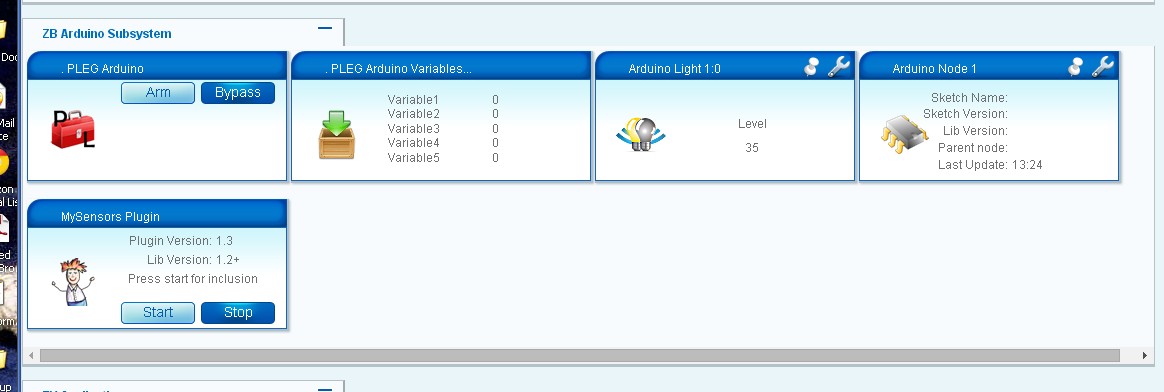 .
.But after the previous frustrations this is a major victory :)
Thanks to everyone but especially to @Ross for his excellent PCB and @hek for your patience and assistance.
John
-
Well, i'm pleased to say that I got my Serial Gateway and first Sensor up. After all the problems with the "scrambled wiring" version I used Ross Kinard's PCB from OSHPark and it came up the first time. It located and included the Light Sensor immediately although it doesn't seem to have picked up all the config data (Photo attached)
.But after the previous frustrations this is a major victory :)
Thanks to everyone but especially to @Ross for his excellent PCB and @hek for your patience and assistance.
John
@clippermiami said:
...although it doesn't seem to have picked up all the config data (Photo attached)!
John,
This is happening to me too when I first include the sensor. I just have to power cycle the sensor (light sensor in your case) and then the info appears.
Hope that will work for you too.
Pete
My "How To" home automation video channel: https://www.youtube.com/channel/UCq_Evyh5PQALx4m4CQuxqkA
-
@clippermiami said:
...although it doesn't seem to have picked up all the config data (Photo attached)!
John,
This is happening to me too when I first include the sensor. I just have to power cycle the sensor (light sensor in your case) and then the info appears.
Hope that will work for you too.
Pete
@petewill That got it, thanks




Hello! It looks like you're interested in this conversation, but you don't have an account yet.
Getting fed up of having to scroll through the same posts each visit? When you register for an account, you'll always come back to exactly where you were before, and choose to be notified of new replies (either via email, or push notification). You'll also be able to save bookmarks and upvote posts to show your appreciation to other community members.
With your input, this post could be even better 💗
Register Login