
Supercap Solar Powered Mysensors nodes as cheap as possible
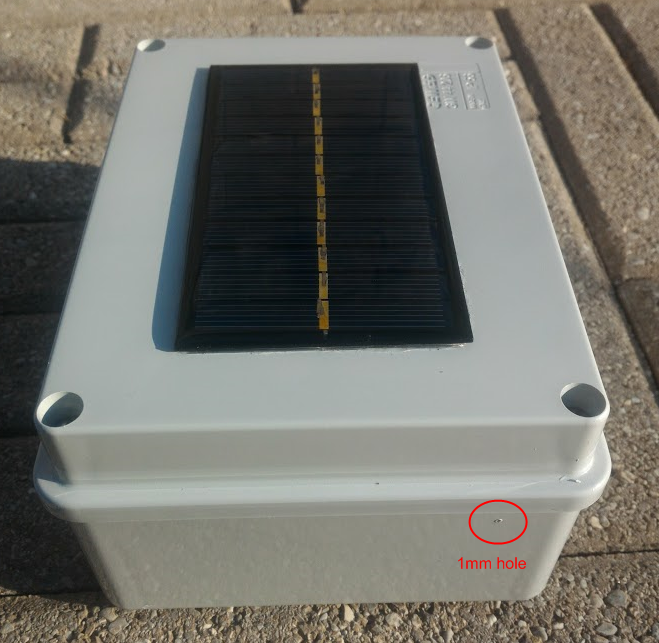
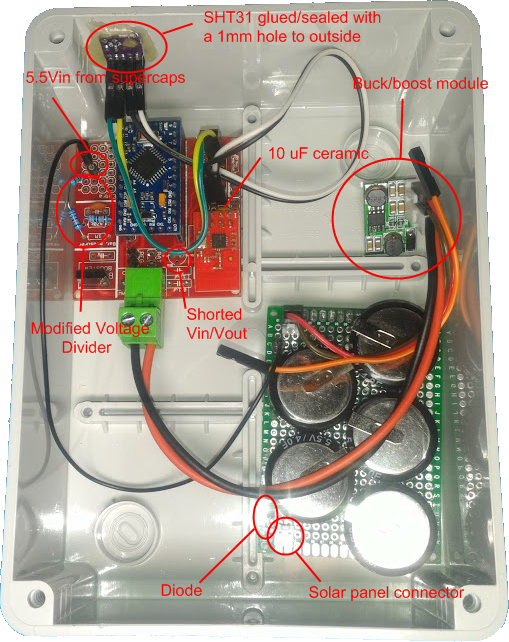
-
Since you're assuming access to direct sunlight, you can tolerate a lot of inefficiencies because of the overabundance of available energy compared to what most sensor nodes require. I remember one guy posted who had a similar 6v solar panel outdoors, and IIRC he said his 10F supercap was already fully recharged just from the daylight before sunrise. i.e. it's bright outside. So, even if your cheap 100F supercaps lose most of what they collect through high self discharge, but they collect a much larger amount all day long because of their higher capacity, maybe you come out ahead. Seems like a worthwhile experiment. Glad you're doing it.
-
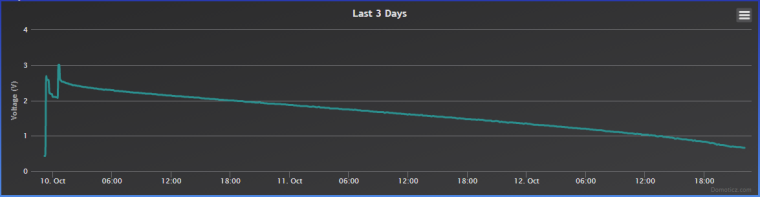
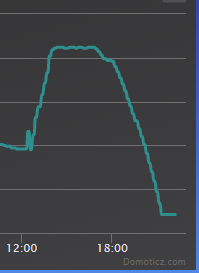
Here is the graph of the voltage: the measurements started ok at ~2.6V but now it is showing 0.66V while I read 0.936V on multimeter I wonder what it may be. My knowledge in electronics is quite poor :sweat_smile:@gohan said in Supercap Solar Powered Mysensors nodes as cheap as possible:
I wonder what it may be.
I would guess the capacitor has a high internal resistance. Your multimeter doesn't see it unless the capacitor is under load. But your arduino is a load, so it sees it.
-
Maybe a schematic of your setup would help the readers of your thread make informed comments. Otherwise, it starts to become 20 questions, if you know what I mean. People on this forum love to look at schematics.
@NeverDie https://www.openhardware.io/view/389/EasyNewbie-PCB-RFM69-HWW-edition-for-MySensors "battery operation", I use this setup with the code like on this page https://www.mysensors.org/build/battery#measuring-and-reporting-battery-level
-
@NeverDie https://www.openhardware.io/view/389/EasyNewbie-PCB-RFM69-HWW-edition-for-MySensors "battery operation", I use this setup with the code like on this page https://www.mysensors.org/build/battery#measuring-and-reporting-battery-level
@gohan
Well, if 0.1uf is normally sufficient, why wouldn't it be in your case?There's an easy way to test my hypothesis: why don't you try powering your setup from some fresh batteries (or a high quality supercap if you have one) and see if there's still the voltage discrepancy? If not, then it's the ESR of your cheap supercap. If it's still there, then maybe you just need to calibrate?
-
@gohan said in Supercap Solar Powered Mysensors nodes as cheap as possible:
I have uploaded 2 pictures of the solar powered 5.5V node
Uploaded to where? I don't see anything.Nevermind, I see it now at the beginning of the thread. -
I'm currently testing the single 100F cap but it seems the buck boost is barely able to charge the supercap in direct sunlight, while the solar panel connected directly to the 5.5v supercaps was working much better. I'll have to try with a normal buck converter as it seems now the boost mode is making the solar panel working on a voltage too low that doesn't produce much power.
-
I replaced the buck-boost module with a simple buck converter and it seems to work much better since the operating voltage is from 4.5V to 23V. As you can see from the below picture, the buck-boost barely charged the cap while in direct sunlight while the buck converter was able to charge the cap in a short time even with a cloudy day.
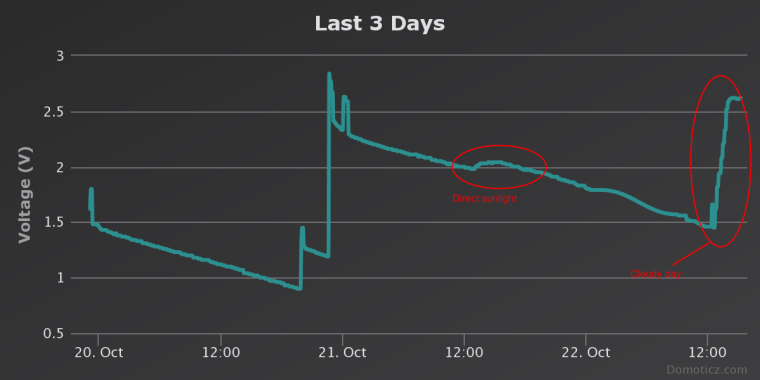
I am also very happy since I set the output voltage to 2.62V on the buck converter and I actually get 2.62V reported by the arduino.
I also forgot to say that I am using a booster like showed in @sundberg84 project link text -
I replaced the buck-boost module with a simple buck converter and it seems to work much better since the operating voltage is from 4.5V to 23V. As you can see from the below picture, the buck-boost barely charged the cap while in direct sunlight while the buck converter was able to charge the cap in a short time even with a cloudy day.
I am also very happy since I set the output voltage to 2.62V on the buck converter and I actually get 2.62V reported by the arduino.
I also forgot to say that I am using a booster like showed in @sundberg84 project link text@gohan I suspect it's "working" because the voltage on your boost converter is higher than 2.62v from the solar panel anyway at the time that it's charging. Even on a cloudy day, it's not hard to get more than 2.6v on a 6v solar panel.
-
The booster is only from the supercap to the node to keep a steady 3.3v. The solar panel if feeding the buck converter directly so it will start charging when panel is providing around 4,5v. It is a double conversion, I know, but efficiency is not the goal.
-
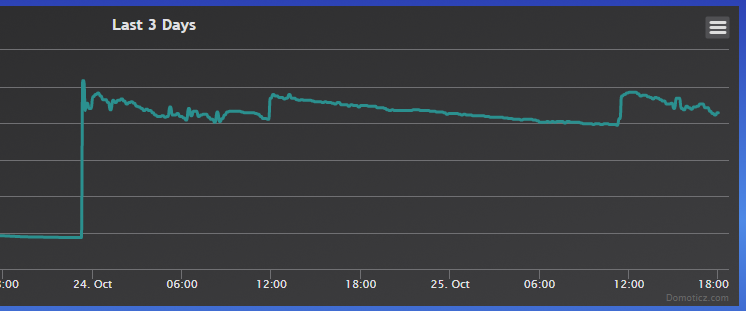
Now voltage stays between 2 and 2.4V (it should be 2.62V but I need to adjust the buck converter and add 0.2V as they are lost though the diode now). I don't understand why the voltage is so unstable now during discharge hours

Hello! It looks like you're interested in this conversation, but you don't have an account yet.
Getting fed up of having to scroll through the same posts each visit? When you register for an account, you'll always come back to exactly where you were before, and choose to be notified of new replies (either via email, or push notification). You'll also be able to save bookmarks and upvote posts to show your appreciation to other community members.
With your input, this post could be even better 💗
Register Login