
Best CNC for milling/routing wood?
-
This guy made his own CNC, and he went balls out on making it as stiff as possible:
https://youtu.be/DBm9c_TrH2gIt does indeed look very sturdy. The end result is massive, though, and so he uses relatively large motors to move it.
He did do a smart thing though which was ordering his extrusions from 80/20, who, it seems, did the cutting and drilling according to his instructions and so delivered the frame ready for final assembly.
-
This guy made his own CNC, and he went balls out on making it as stiff as possible:
https://youtu.be/DBm9c_TrH2gIt does indeed look very sturdy. The end result is massive, though, and so he uses relatively large motors to move it.
He did do a smart thing though which was ordering his extrusions from 80/20, who, it seems, did the cutting and drilling according to his instructions and so delivered the frame ready for final assembly.
@neverdie Yeah that is a surprisingly good machine as it seems to be built from scratch with no plans or whatnot. It says in the Youtube comments that he spent $4K-4.5K on it though, with 1K of that being for the extra cost of servos as compared to steppers. Nice to have those linear rails and ball screws though.
By comparison the machine we're building is maybe $2K. It will have worse precision (than ball screws) as it is rack and pinion. But a work area of ~100x150cm.
-
@neverdie Yeah that is a surprisingly good machine as it seems to be built from scratch with no plans or whatnot. It says in the Youtube comments that he spent $4K-4.5K on it though, with 1K of that being for the extra cost of servos as compared to steppers. Nice to have those linear rails and ball screws though.
By comparison the machine we're building is maybe $2K. It will have worse precision (than ball screws) as it is rack and pinion. But a work area of ~100x150cm.
@bjornhallberg said in Best CNC for milling/routing wood?:
It says in the Youtube comments that he spent $4K-4.5K on it though, with 1K of that being for the extra cost of servos as compared to steppers.
It's not clear to me why he chose servos, unless, again, it was a step to further bolster the effective rigidity.
For roughly the same amount of money, he could have purchased either a standard or a pro kit from: http://www.cncrouterparts.com/benchtop-cnc-machine-kits-c-59_60.html
Their "Pro" version appears to be a highly rigid variant of their standard edition.
Which leaves me wondering: how do I decide between a standard machine and a pro machine? In some sense, more rigid is better, but it clearly comes at a cost, so how rigid is "good enough"?
Since maybe that is a tough question to answer, perhaps the ideal kit would be one where one starts with a cheaper "standard" machine, but where one can easily upgrade it to a rigid "pro" machine by simply adding additional parts. That would minimize the risk if one discovers that a standard machine just isn't rigid enough. So far, I haven't seen such an easy-to-upgrade kit, but maybe one exists?
-
@bjornhallberg said in Best CNC for milling/routing wood?:
It says in the Youtube comments that he spent $4K-4.5K on it though, with 1K of that being for the extra cost of servos as compared to steppers.
It's not clear to me why he chose servos, unless, again, it was a step to further bolster the effective rigidity.
For roughly the same amount of money, he could have purchased either a standard or a pro kit from: http://www.cncrouterparts.com/benchtop-cnc-machine-kits-c-59_60.html
Their "Pro" version appears to be a highly rigid variant of their standard edition.
Which leaves me wondering: how do I decide between a standard machine and a pro machine? In some sense, more rigid is better, but it clearly comes at a cost, so how rigid is "good enough"?
Since maybe that is a tough question to answer, perhaps the ideal kit would be one where one starts with a cheaper "standard" machine, but where one can easily upgrade it to a rigid "pro" machine by simply adding additional parts. That would minimize the risk if one discovers that a standard machine just isn't rigid enough. So far, I haven't seen such an easy-to-upgrade kit, but maybe one exists?
-
@rfm69 The link you supplied, "https://forum.mysensors.org/topic/9034/best-cnc-for-milling-routing-wood/vicious1.com", isn't working.
-
@rfm69 Is this it?

Hmmm. That does look clever. I suppose one could scale it to use whatever bigger/stronger pipe might be needed to make it rigid enough. Pipe/tubing is usually plenty cheap, so I guess it might even be affordable.
If needed, you could maybe even replace the plastic joinery with Kee Klamps or similar: https://www.simplifiedbuilding.com/pipe-fittings/kee-klamp
When will you be done making yours? I'd love to hear how well you like it.
-
The MPCNC is a smart project but I would assume it would struggle with a bigger motor.
The 2.2kW we are going to use weighs A LOT. Around 5kg at least I'd guess. The 1.5kW is not much better. With a smaller spindle, or router like a Kress things would be different. Still I'm glad to have the extra power, and standard ER20 collets up to 13mm. Plus these chinese spindles are really quiet compared to a regular router. And the speed can be set and spindle can be started from the control panel or from the computer. The downside is the low quality VFD I guess, but if it works it works. And you can always use shielded cables everywhere.
-
I bet that diameter of unsupported tube would be a fail, based on what we saw in the earlier videos.
However, if you were to fill those flimsy tubes with self-leveling mortar/concrete, maybe even with a piece of re-bar running down the center of it, I bet they'd become a lot more rigid.... Maybe then you could keep the same size.
Also, would box tubing be more rigid? Seems like the same design idea could be adapted to that. I can imagine that a box geometry might even stabilize the spindle more (keep it from going ring-around-the-rosie like maybe it would on a circular tube).
-
Well, anyway, until someone proves otherwise, I'm going to assume a supported rod/rail is the way to go. At least that has been proven to work reliably using straightforward techniques.
-
@rfm69 Is this it?
Hmmm. That does look clever. I suppose one could scale it to use whatever bigger/stronger pipe might be needed to make it rigid enough. Pipe/tubing is usually plenty cheap, so I guess it might even be affordable.
If needed, you could maybe even replace the plastic joinery with Kee Klamps or similar: https://www.simplifiedbuilding.com/pipe-fittings/kee-klamp
When will you be done making yours? I'd love to hear how well you like it.
@neverdie Yes thats the one... I'm got it working but am waiting a few things by post to be able to connect the 3d printer. And then I need still to order a new spindle.
There are some modifications people have made on thingyverse to strenghten the Z access to take heavier spindles... you can redesign the connecting corners and just print them out.
I'd like to get a 1.5kw spindle, but might just get a small one to begin with.
-
I bet that diameter of unsupported tube would be a fail, based on what we saw in the earlier videos.
However, if you were to fill those flimsy tubes with self-leveling mortar/concrete, maybe even with a piece of re-bar running down the center of it, I bet they'd become a lot more rigid.... Maybe then you could keep the same size.
Also, would box tubing be more rigid? Seems like the same design idea could be adapted to that. I can imagine that a box geometry might even stabilize the spindle more (keep it from going ring-around-the-rosie like maybe it would on a circular tube).
-
@rfm69 Is this it?
Hmmm. That does look clever. I suppose one could scale it to use whatever bigger/stronger pipe might be needed to make it rigid enough. Pipe/tubing is usually plenty cheap, so I guess it might even be affordable.
If needed, you could maybe even replace the plastic joinery with Kee Klamps or similar: https://www.simplifiedbuilding.com/pipe-fittings/kee-klamp
When will you be done making yours? I'd love to hear how well you like it.
-
@neverdie They've already answered the concrete idea, many people consider that, but a simple center support I think solves the problem. They have nice forums over at the vicious.com link I shared.
-
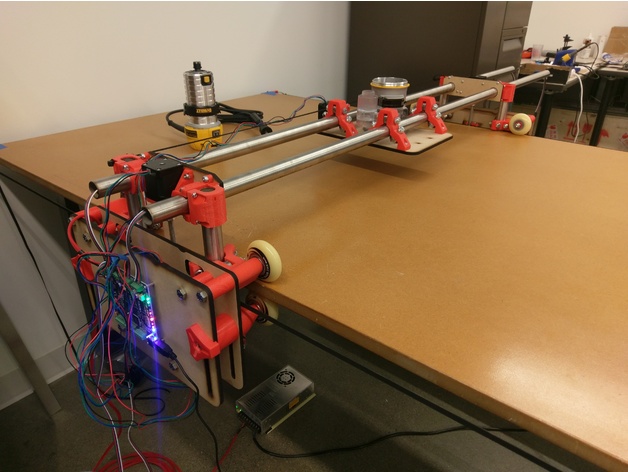
@rfm69 said in Best CNC for milling/routing wood?:
@neverdie The same web site has a few other designs for larger machines.
Hmm.. That Low Rider MPCNC does looks interesting. They're using just two stainless steel tubes for that. Should be relatively cheap to make, and it can handle large formats. :)
!
-
@rfm69
Ah, OK, that makes sense for the side supports:

The rods that move, though, remain unsupported, especially in the middle. What about those?@neverdie Generally I get the feeling from reading other peoples experience that its a mistake to quickly make the machine too big because of rigidity. But people do make mods to address this issue or to add heavier spindles.
Heres one mod i/d like to do link text
But to change the size just need to get new pipes which even if you use SS they are they cheapest part.
-
same here, a while I'm looking at the MPCNC. It's a nice and affordable project when you want to build a cnc.
Unfortunately never jumped into, because I have different requirements, need something more "powerful" for my job, not only for wood or thin sheets.
I don't think it's comparable with the others machine above (strength, speed, raw material that can be machined..). But if you don't need so much power, it might be pretty cool, you can make lot of things with it :) -
same here, a while I'm looking at the MPCNC. It's a nice and affordable project when you want to build a cnc.
Unfortunately never jumped into, because I have different requirements, need something more "powerful" for my job, not only for wood or thin sheets.
I don't think it's comparable with the others machine above (strength, speed, raw material that can be machined..). But if you don't need so much power, it might be pretty cool, you can make lot of things with it :) -
same here, a while I'm looking at the MPCNC. It's a nice and affordable project when you want to build a cnc.
Unfortunately never jumped into, because I have different requirements, need something more "powerful" for my job, not only for wood or thin sheets.
I don't think it's comparable with the others machine above (strength, speed, raw material that can be machined..). But if you don't need so much power, it might be pretty cool, you can make lot of things with it :) -
@neverdie
no, I haven't yet. still studying :) because i'll built mine, custom I think (inspired from multiple builds), for my job I need stronger than mpcnc (so far asking local subcontractor when I need it).if it would be for personal use, low cost, for soft materials, no speed concern, maybe I would pick the MPCNC as I already have a 3dprinter for printing parts (I think i've maybe just a few missing parts to build one though).
-
This guy took a very different approach, yet he took deflection into account and has supported rails. For its size, it may be the least expensive:
https://www.ebay.com/itm/BobsCNC-E3-CNC-Router-Engraver-Kit-includes-the-DeWalt-DW660-Router/222859180982?epid=530593462&hash=item33e3713bb6:g:HjsAAOSwJvpalajYhttps://www.youtube.com/watch?v=v-e2IVQUh1k
Also, the Y-axis is easily extensible:
https://www.youtube.com/watch?v=k44hWAIadjc





Hello! It looks like you're interested in this conversation, but you don't have an account yet.
Getting fed up of having to scroll through the same posts each visit? When you register for an account, you'll always come back to exactly where you were before, and choose to be notified of new replies (either via email, or push notification). You'll also be able to save bookmarks and upvote posts to show your appreciation to other community members.
With your input, this post could be even better 💗
Register Login