
How to calibrate a gauge sensor
-
Hello all!
I am checking gauge sensor value and it looks like the values are wrong.
I followed that example:.I have the same gauge and the bunket should be 0.2794mm of water and my mico controller count the number if tips within one hour. Si I supposed, if the bunket tips one, we can say there were 0.2794mm/h of rain.
I also red that 1mm/h is egal of 1 liter for 1m2 of surface.
Yesterday, I took a bottle and I filled it up of 1 liter of water and I empty the bottle on my gauge, and I counted the number of tips: 353 tips. (I may have missed 2 or 4 tips).
So now if I make the calcul
353x * 0.2794mm = 98.62mm/h(if i poured 1 liter of water, I should get 0.9862 as 1mm/h is egal of 1 liter).
If I want to know the size of my bunket, I can calculate, for 1 liter of water I poured (let's take the same number as before 0.9862 istead of 1)
0.9862mm/h / 353 = 0.002794Si I can observed that the tutorial may be wrong and the size of the bunket should be 0.002794 instead of 0.2794, BUT I oft obeserved the value of 0.2794
Or I missunderstanded something, could you enlighten me?
Secondely, my micro controller count the tips and the the amount of tips within one hour and simply make the calcul:
[amount of tips]*0.2794=rainfallthe returned value is 13.08
(in my code I make a small mistake, I inversed 7 and 9 : 0.2974 but it does not make a big difference, I corrected it)353*0.2974=104.98and not 13.08
but it's interesting to see, if I moved the coma we have 103.8. I wunder I make a mistake of decimal and unit.
(I also will later double check my gauge in order to make sure that it count correctly)
Could you unlighten me about to understand and calibrate my gauge?
Many thank
Cheers@pierrot10 is the bucket really 1x1m big?
1 liter rain over 1m2 would spread the water equally over 1m2. If the bucket atea, as seen from above, is smaller than 1m2, some (a lot) of that liter will end up outside the bucket.
My guess is that the area of the bucket is 0.01m2. If that’s the case, the measurement is correct.
-
@mfalkvidd
Hello, thank for your reply. Si let make sure I do not confuse people with my bad englishFor my the bucket is the "tings" which toogle at the right side of the picture:

Should I consider the area of the "funnel" at left side of the picture?
You wrote:
My guess is that the area of the bucket is 0.01m2
if the area of the bucket is well the "things" that toogle, this evening, I will check the width and the length of my bucket and make sure is make 10mm2, but I have a doubt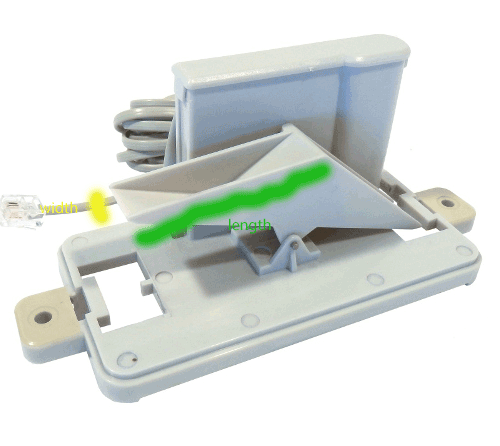
the width (yellow) make at less 10mm and the length should be about 60mm
0.01m*0.06m=0.0006m2:upside_down_face:
-
@mfalkvidd
Hello, thank for your reply. Si let make sure I do not confuse people with my bad englishFor my the bucket is the "tings" which toogle at the right side of the picture:
Should I consider the area of the "funnel" at left side of the picture?
You wrote:
My guess is that the area of the bucket is 0.01m2
if the area of the bucket is well the "things" that toogle, this evening, I will check the width and the length of my bucket and make sure is make 10mm2, but I have a doubtthe width (yellow) make at less 10mm and the length should be about 60mm
0.01m*0.06m=0.0006m2:upside_down_face:
-
@mfalkvidd
Hello, thank for your reply. Si let make sure I do not confuse people with my bad englishFor my the bucket is the "tings" which toogle at the right side of the picture:
Should I consider the area of the "funnel" at left side of the picture?
You wrote:
My guess is that the area of the bucket is 0.01m2
if the area of the bucket is well the "things" that toogle, this evening, I will check the width and the length of my bucket and make sure is make 10mm2, but I have a doubtthe width (yellow) make at less 10mm and the length should be about 60mm
0.01m*0.06m=0.0006m2:upside_down_face:
@pierrot10 Flawed mathematics, 0.01m2 is not 10mm2 but 10,000mm2....
-
@pierrot10 when rain falls, it will hit the area of the funnel above the bucket, not the area of the bucket itself. So you're correct that you should calculate the area of the top of the funnel.
@mfalkvidd
Thank for your reply, but something is interreting to me. If the funnel area is twice bigger and the bucket is the same, what will it change? the bucket will toggle when it will get 0.2794mm of water, specially if the hole the funnel has the same diameter. Am I wrong?
If the diamter is bigger, the buncket will toggle faster. -
@mfalkvidd
Thank for your reply, but something is interreting to me. If the funnel area is twice bigger and the bucket is the same, what will it change? the bucket will toggle when it will get 0.2794mm of water, specially if the hole the funnel has the same diameter. Am I wrong?
If the diamter is bigger, the buncket will toggle faster.@pierrot10 the bucket will tip based on a volume (or technically weight, but that is almost the same thing) of water, not based on a distance.
Lest's say it is raining 1mm/h.
With the current funnel, the bucket will tip x times.
If you had a funnel that was twice as big (area, as seen from above), the bucket would tip x * 2 times, since the funnel would be collecting water twice as fast. -
@pierrot10 the bucket will tip based on a volume (or technically weight, but that is almost the same thing) of water, not based on a distance.
Lest's say it is raining 1mm/h.
With the current funnel, the bucket will tip x times.
If you had a funnel that was twice as big (area, as seen from above), the bucket would tip x * 2 times, since the funnel would be collecting water twice as fast.@mfalkvidd Ok, but if the diameter of the hole of the funnel does not change, dot it really make a difflrence?
What is unclear for me,
- I which to display the result in mm/h.
- If I full up 1 liter of water into a bottle, I got about 353 toggles.
- If divide 1000ml by 353 I get 2.832mm
Let's say, I wrongly counted the tips of the buncket (I may missed 2or 4 tips over 353) and there were 358 tips then
1000/358=2.793 => 2.794Are you agree with my reasoning?
Should I conclude that bucket is 2.794 and not 0.2794?
BUT, I oft read this
The rain gauge is a self-emptying
tipping bucket type.  Each 0.011”
(0.2794 mm) of rain causes one mo
mentary contact closure that can
be recorded with a digital counter or
 microcontroller interrupt input
I am a bit frustrated because I oft read the number of 0.2794 and I have the same gauge meter as the above picture.
Then if within one hour, my bucket tips 358 time because I poured 1 liter of water, the calcul is
358*0.2794mm=100.02mm/hBUT, 1mm/h is egal to 1liter of water (for 1m2)
So I guess my problem is a mathematical issue :sweat_smile: , or conversion. Isn't? I missed something :fearful:
If I make an error of conversion and specially, if I forget to take in consideration the area of the funnel surface.
I am bit confuse :)
I am not at home yet, and I can not calculate the surface of my funnel yet but I will do as soon as possible (it should be around 50mm*110mm=5500mm2)
-
@mfalkvidd Ok, but if the diameter of the hole of the funnel does not change, dot it really make a difflrence?
What is unclear for me,
- I which to display the result in mm/h.
- If I full up 1 liter of water into a bottle, I got about 353 toggles.
- If divide 1000ml by 353 I get 2.832mm
Let's say, I wrongly counted the tips of the buncket (I may missed 2or 4 tips over 353) and there were 358 tips then
1000/358=2.793 => 2.794Are you agree with my reasoning?
Should I conclude that bucket is 2.794 and not 0.2794?
BUT, I oft read this
The rain gauge is a self-emptying
tipping bucket type.  Each 0.011”
(0.2794 mm) of rain causes one mo
mentary contact closure that can
be recorded with a digital counter or
 microcontroller interrupt input
I am a bit frustrated because I oft read the number of 0.2794 and I have the same gauge meter as the above picture.
Then if within one hour, my bucket tips 358 time because I poured 1 liter of water, the calcul is
358*0.2794mm=100.02mm/hBUT, 1mm/h is egal to 1liter of water (for 1m2)
So I guess my problem is a mathematical issue :sweat_smile: , or conversion. Isn't? I missed something :fearful:
If I make an error of conversion and specially, if I forget to take in consideration the area of the funnel surface.
I am bit confuse :)
I am not at home yet, and I can not calculate the surface of my funnel yet but I will do as soon as possible (it should be around 50mm*110mm=5500mm2)
-
@pierrot10 Other stupid question, does 1liter of water from a bottle, will cover 1m2 of surface with a high of 1mm?
I red, 1mm/h is egal to 1liter over 1m2 with a high of 1mm
For sure, I missundertand something :confounded:
@pierrot10 yes, one litre spread evenly over 1m2 will equal 1mm height.
But you're not spreading that litre equally over 1m2. You are pouring everything into the funnel, right?
If you take a regular drinking glass and pour 1 litre into it, will the height of the water in the glass be 1mm?
-
@pierrot10
Since I am using almost the same tipping bucket rain gauge, let me try to explain how it works:The top of my funnel measures 109 x 49 mm = 5341 mm2 (square millimeters). For now, let us not worry about the rounded corners of the funnel.
If it rains 1 mm the funnel will collect 5341 mm3 (cubic millimeters) which is 5,341 cubic centimeters equal to 5,34 milliliters. This is difficult to use for calibration so let's try with 10 mm of rain which then equals 53,4 milliliters or 0,53 deciliters of water.So, you pour 53,4 milliliters of water into the funnel, not spilling any and you count the number of bucket tips. In my example, when I do this, the bucket tips 30 times. So if the bucket tips 30 times during a time period, it has rained 10 mm during that time. Or, the other way around: One tip of the bucket = 10/30 = 0,33 mm of rain.
Do not worry about the size of the bucket inside. What matters is how many times the bucket tips for a given amount of water. It is the area of the funnel which is important.
When it rains 1 mm an area of one square meter will receive 1 liter of water but the little funnel will only receive 5,34 milliliters as explained above.Now, if you really want to be accurate, you should take away the area of the rounded corners. But that will be less than 0,5% and there are other sources of inaccuracy.
-
@pierrot10 yes, one litre spread evenly over 1m2 will equal 1mm height.
But you're not spreading that litre equally over 1m2. You are pouring everything into the funnel, right?
If you take a regular drinking glass and pour 1 litre into it, will the height of the water in the glass be 1mm?
@mfalkvidd said in How to calibrate a gauge sensor:
You are pouring everything into the funnel, right?
Hello, yes that right, I poured the litre from my bottle into the funnel.
If you take a regular drinking glass and pour 1 litre into it, will the height of the water in the glass be 1mm?
Yes, of course, that make sense!
I forgetten, but my 3 gauge are in the filed and I can neasure the area surface, unfortunately, but let's say, it 0.05m*0.11m = 0.0055m2 or 55000mm2. I do have the same as below

So in my case, each tips will be egal to
0.2794mm of high over 0.0055m2 of surfaceIf I know I need 358 tips for 1 liter of water (is egal of 1mm over 1m2) within 1 hour. How can I make sure that 0.2794mm is the correct value of my bucket?
0.2794*358=100.02mm/hBut 100.02mm/h is over 0.0055m2 of surface.
But how can I calculate the high if I poured the same amount of water in 1m2
It should be 1mm because we know that 1 liter over 1m2 has a hight of 1mmBut how calculate it in order to make sure that 0.2794 is the correct value of the bucket?
-
@mfalkvidd said in How to calibrate a gauge sensor:
You are pouring everything into the funnel, right?
Hello, yes that right, I poured the litre from my bottle into the funnel.
If you take a regular drinking glass and pour 1 litre into it, will the height of the water in the glass be 1mm?
Yes, of course, that make sense!
I forgetten, but my 3 gauge are in the filed and I can neasure the area surface, unfortunately, but let's say, it 0.05m*0.11m = 0.0055m2 or 55000mm2. I do have the same as below
So in my case, each tips will be egal to
0.2794mm of high over 0.0055m2 of surfaceIf I know I need 358 tips for 1 liter of water (is egal of 1mm over 1m2) within 1 hour. How can I make sure that 0.2794mm is the correct value of my bucket?
0.2794*358=100.02mm/hBut 100.02mm/h is over 0.0055m2 of surface.
But how can I calculate the high if I poured the same amount of water in 1m2
It should be 1mm because we know that 1 liter over 1m2 has a hight of 1mmBut how calculate it in order to make sure that 0.2794 is the correct value of the bucket?
@pierrot10
I make easier. If one liter make 358 tips. One bucket has a value of 2.7932rain fall [mm/h] = 2.7932 * nb of tips -
@pierrot10
1 mm of rain over 1 square meter is 1 liter of water. Correct!
One liter makes 358 tips so one tip is then 2,7932 milliliters that is correct.
But rainfall mm/hr is 2,7932 * nbr of tips only if the area of the funnel is 1 square meter.Your funnel is only 55 square centimeters so you will only collect 55/10000 of the rain that falls on the whole square meter.
The example you are using at the top of your post does not have the size of the funnel anywhere in the code.



Hello! It looks like you're interested in this conversation, but you don't have an account yet.
Getting fed up of having to scroll through the same posts each visit? When you register for an account, you'll always come back to exactly where you were before, and choose to be notified of new replies (either via email, or push notification). You'll also be able to save bookmarks and upvote posts to show your appreciation to other community members.
With your input, this post could be even better 💗
Register Login