
Has anyone else seen a varistor/MOV failure in a power supply?

-
Has anyone else seen a varistor/MOV failure in a power supply?
I recently had a 120v varistor fail on a HLK-PM01 breakout board (thanks @sundberg84 !). The varistor now shows a resistance of 262 ohms. The low resistance took out the 200ma AC input fuse (as expected).
The odd thing is I have six nodes powered by HLK-PM01 breakout boards and each board has exactly the same varistor. Only one has failed, so I doubt if it was an AC power problem. We haven't had any lightning strikes and the APC power supply on my PC didn't record any power problems. All of these nodes have run for several months without problems.
Has anyone else had a varistor fail like this?
I'm really nervous about this because in one month I'm going to be away from the location where these nodes are installed for about six months. The nodes control heat pump systems which will control the humidity while I'm away and the home is closed up. I'm considering just removing the varistors rather than risk a bad varistor taking a node off line.
These are the varistors that I bought on Aliexpress: https://goo.gl/2qhnaR
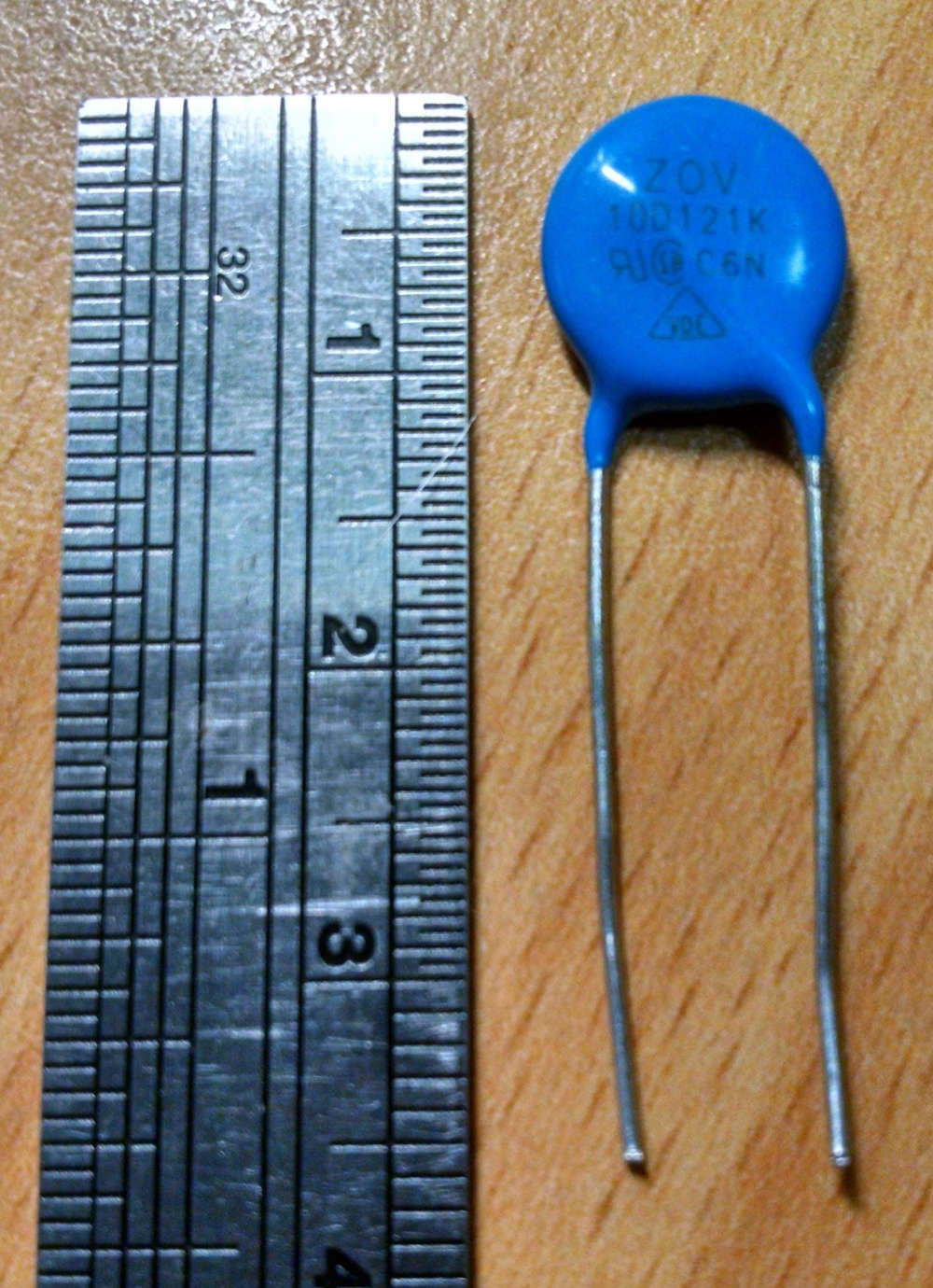
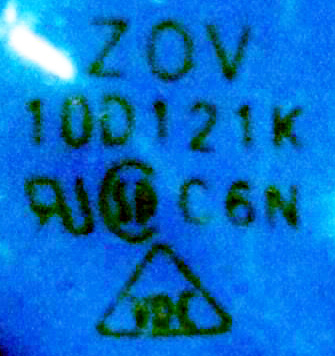
Below are photos showing the varistor and its markings.
-
@tomg what I've read some people seem to dislike varistors just because the can fail causing a short. If you don't have a fuse before you will have a fire. Have a look on Wikipedia under hazards.
Offcourse with a fuse this seems to be a good tool to avoid surge damage with a MOV but I guess selecting it's values are crusial.
I'm don't have knowledge enough and it's been pointed out to me that selecting the varistor values and specs are very important. Unfortunately I haven't got that far in my readings yet...
Edit: myself are also using the HLK with MOV. Even one outside (under roof) and it's been working great for a while... so offcourse there might be a chance it was just an unlucky event.
Controller: Proxmox VM - Home Assistant
MySensors GW: Arduino Uno - W5100 Ethernet, Gw Shield Nrf24l01+ 2,4Ghz
MySensors GW: Arduino Uno - Gw Shield RFM69, 433mhz
RFLink GW - Arduino Mega + RFLink Shield, 433mhz -
@tomg what I've read some people seem to dislike varistors just because the can fail causing a short. If you don't have a fuse before you will have a fire. Have a look on Wikipedia under hazards.
Offcourse with a fuse this seems to be a good tool to avoid surge damage with a MOV but I guess selecting it's values are crusial.
I'm don't have knowledge enough and it's been pointed out to me that selecting the varistor values and specs are very important. Unfortunately I haven't got that far in my readings yet...
Edit: myself are also using the HLK with MOV. Even one outside (under roof) and it's been working great for a while... so offcourse there might be a chance it was just an unlucky event.
If I were you I would simply take out all the aliexpress mov's and replace them with good quality ones from a reputable supplier of electronic equipment (RS in UK or Farnell/Element14 or Mouser in US etc.) That way you can be sure you have the components from a known source with full spec.
Maybe the ones from ali were seconds or rejects sold as the real thing. You never know. I once encountered a seller who was getting his 'stock' from the wheelie bins at the back of a factory......
-
Replacing them with better parts is definitely a good idea. Unfortunately, I'm limited in what I can buy locally. I have to order them from another continent if my local electronics store doesn't have them. I may just cut them off the PCB and replace them at a future date.
-
Hello, I had a similar case with a varistor from AliExpress too, after some time and for an unknown reason it shorted, but without any visual indication of a problem. It was on the dual ssr board that didn't have a fuse before the varistor so it triggered the circuit breaker... Board worked fine for a few weeks without varistor after that, but I didn't feel confident to continue using it for a long time.
-
I found some varistors at the best electronic component store in the area. They had a wide variety of voltages. One was 120v (part number CNR-07D121K). We have 110v AC (measured) here. On the outside of the plastic bag with five parts was a store printed label that included "120v1ma +- 10%". If that 10% applies to the max voltage, then that may explain the failure of my varistor. 120v * .9 = 108v. Perhaps it was working just fine, but it was at the low end of the tolerance range. The next voltage up on the supplier's shelf was 150v. The more I learn about these things, the less I think I know. A datasheet I found was 24 pages long!
-
I found some varistors at the best electronic component store in the area. They had a wide variety of voltages. One was 120v (part number CNR-07D121K). We have 110v AC (measured) here. On the outside of the plastic bag with five parts was a store printed label that included "120v1ma +- 10%". If that 10% applies to the max voltage, then that may explain the failure of my varistor. 120v * .9 = 108v. Perhaps it was working just fine, but it was at the low end of the tolerance range. The next voltage up on the supplier's shelf was 150v. The more I learn about these things, the less I think I know. A datasheet I found was 24 pages long!
That is good news.
As you now know the rating on them is where they start to conduct. Here in UK we have 240V mains voltage. I wouldn't use a 250V mov. Generally a 380v or 470V would be my choice. There are some good youtube videos that explain varistors rather well.
Good luck. ;) -
That is good news.
As you now know the rating on them is where they start to conduct. Here in UK we have 240V mains voltage. I wouldn't use a 250V mov. Generally a 380v or 470V would be my choice. There are some good youtube videos that explain varistors rather well.
Good luck. ;)@skywatch i was looking for a good video about varistors - mostly about finding the right one for my AC rating. Do you happen to know one? All i found was "this is how a mov functions"-videos.
Controller: Proxmox VM - Home Assistant
MySensors GW: Arduino Uno - W5100 Ethernet, Gw Shield Nrf24l01+ 2,4Ghz
MySensors GW: Arduino Uno - Gw Shield RFM69, 433mhz
RFLink GW - Arduino Mega + RFLink Shield, 433mhz -
@skywatch i was looking for a good video about varistors - mostly about finding the right one for my AC rating. Do you happen to know one? All i found was "this is how a mov functions"-videos.
@sundberg84 Try this one......
https://www.youtube.com/watch?v=r2o0Y8wI2Z0
But mainly once you know how they work and what they do, you really only need to look up the data sheet(s) to see which one is suitable for your application.
My rule has been to use 1.5x - 2.0x the usual operating voltage. Remember this is protection from big surges and spikes, not to limit noise and glitches on the power line. For that you need capacitors and a common mode inductor.
-
@sundberg84 Try this one......
https://www.youtube.com/watch?v=r2o0Y8wI2Z0
But mainly once you know how they work and what they do, you really only need to look up the data sheet(s) to see which one is suitable for your application.
My rule has been to use 1.5x - 2.0x the usual operating voltage. Remember this is protection from big surges and spikes, not to limit noise and glitches on the power line. For that you need capacitors and a common mode inductor.
@skywatch - great, I will have a look.
The question im asking myself now is if AC voltage is the only parameter you need to know when selecting a MOV. I had a comment here suggesting there was more to it.Edit: Something like this? https://www.electronicdesign.com/power/select-right-varistors-overvoltage-circuit-protection
Controller: Proxmox VM - Home Assistant
MySensors GW: Arduino Uno - W5100 Ethernet, Gw Shield Nrf24l01+ 2,4Ghz
MySensors GW: Arduino Uno - Gw Shield RFM69, 433mhz
RFLink GW - Arduino Mega + RFLink Shield, 433mhz -
@skywatch - great, I will have a look.
The question im asking myself now is if AC voltage is the only parameter you need to know when selecting a MOV. I had a comment here suggesting there was more to it.Edit: Something like this? https://www.electronicdesign.com/power/select-right-varistors-overvoltage-circuit-protection
@sundberg84 You first have to decide what you are protecting against, then define the parameters you are likely (or even unlikely) to face. You always should have a fuse with a mov. Like all electronic parts there is a whole depth of knowledge and physics waiting for you! ;)
If you have a specific concern then an electronics forum like this one would be a good place to ask. That way you get a lot of opinions and can make a better judgement.
I have rarely needed to use them as I don't build psu's much these days, so I copied what I saw in commercial designs.
-
My recollection of MOV specifications is the are often rated for AC operation I.e. In the US we might use a 130Vac MOV. While others are rated for DC operation. For most folks it is probably wise to follow those ratings. If you are really into MOV.s then you look to the curves.
I do not mean to imply that AC rated MOVs a different from DC rated MOVs, they are both physically the same parts, its just how the catalog presents the specifications.




Hello! It looks like you're interested in this conversation, but you don't have an account yet.
Getting fed up of having to scroll through the same posts each visit? When you register for an account, you'll always come back to exactly where you were before, and choose to be notified of new replies (either via email, or push notification). You'll also be able to save bookmarks and upvote posts to show your appreciation to other community members.
With your input, this post could be even better 💗
Register Login