
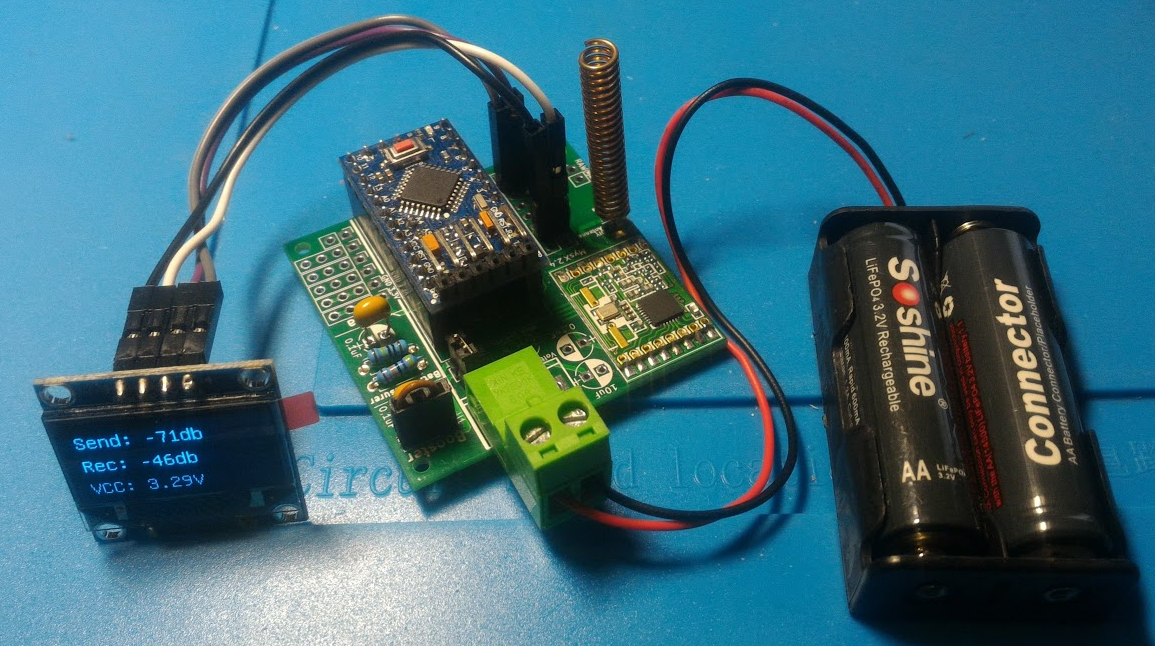
Portable RFM69 Signal Scanner
-
-
Nice job! Looks very dapper.
Alternatively, you may (?) be able to plug your screen directly into the I2C connector used for the TH sensor on:
https://www.openhardware.io/view/268/Arduino-Pro-Mini-Shield-for-RFM69HW
Depends on the pinout, of course. -
-
-
-
Here is the new code that uses the TX power readings. I think that RSSI values and tx power values could be useful to be reported by nodes every once and a while, at least to provide a feedback on how they are doing.
#include <U8glib.h> #include <Wire.h> //#define MY_DEBUG // Enable debug prints U8GLIB_SSD1306_128X64 lcd(U8G_I2C_OPT_DEV_0 | U8G_I2C_OPT_NO_ACK | U8G_I2C_OPT_FAST); // Fast I2C / TWI #define MY_RADIO_RFM69 #define MY_RFM69_FREQUENCY RFM69_433MHZ #define MY_RFM69_NEW_DRIVER #define MY_TRANSPORT_WAIT_READY_MS 10000 //#define MY_NODE_ID 240 //#define VBAT_VCC #include <SPI.h> #include <MySensors.h> #define CHILD_ID_VBAT 201 // Battery voltage unsigned long SLEEP_TIME = 2000; // Sleep time between reads (in milliseconds) #define SKETCH_NAME "Signal Monitor" // Change to a fancy name you like #define SKETCH_VERSION "1.0" // Your version MyMessage msgVBat(CHILD_ID_VBAT, V_VOLTAGE); int Send_rssi, Rec_rssi; // RSSI RFM69 chip #define CHILD_ID_RSSI_HIGH 7 // RSSI received signal level #define CHILD_ID_RSSI_LOW 8 // RSSI background noise level MyMessage msgRSSI1(CHILD_ID_RSSI_HIGH, V_LEVEL); MyMessage msgRSSI2(CHILD_ID_RSSI_LOW, V_LEVEL); //========================= // BATTERY VOLTAGE DIVIDER SETUP // 1M, 470K divider across battery and using internal ADC ref of 1.1V // Sense point is bypassed with 0.1 uF cap to reduce noise at that point // ((1e6+470e3)/470e3)*1.1 = Vmax = 3.44 Volts // 3.44/1023 = Volts per bit = 0.003363075 #define VBAT_PER_BITS 0.003363075 #define VMIN 2.8 // Vmin (radio Min Volt)=1.9V (564v) #define VMAX 3.44 // Vmax = (2xAA bat)=3.0V (892v) int batteryPcnt = 0; // Calc value for battery % int batLoop = 0; // Loop to help calc average int batArray[3]; // Array to store value for average calc. float Vbat; #ifdef VBAT_VCC #include <Vcc.h> const float VccCorrection = 1.0 / 1.0; // Measured Vcc by multimeter divided by reported Vcc Vcc vcc(VccCorrection); #else int BATTERY_SENSE_PIN = A0; // select the input pin for the battery sense point #endif // VBAT_VCC void setup() { analogReference(INTERNAL); // For battery sensing lcd.setFont(u8g_font_unifont); } void presentation() { // Send the Sketch Version Information to the Gateway sendSketchInfo(SKETCH_NAME, SKETCH_VERSION); // Register all sensors to gw (they will be created as child devices) present(CHILD_ID_RSSI_HIGH, S_SOUND); present(CHILD_ID_RSSI_LOW, S_SOUND); present(CHILD_ID_VBAT, S_MULTIMETER); } void loop() { delay(500); // Allow time for radio if power used as reset Send_rssi = RFM69_getSendingRSSI(); // read RSSI in RFM69. Measure reception signal from gw send(msgRSSI1.set(Send_rssi)); // send RSSI level wait(500); // wait to get idle Rec_rssi = RFM69_getReceivingRSSI(); // read RSSI in RFM69. Wait and measure background noise send(msgRSSI2.set(Rec_rssi)); // send RSSI level wait(200); // wait for next send batM(); lcd.firstPage(); do { UpdateDisplay(); } while (lcd.nextPage()); sleep(SLEEP_TIME); //sleep a bit } void UpdateDisplay() { lcd.setPrintPos(0, 20); String row; row = (String)"S/R: " + Send_rssi + "/"+ Rec_rssi +"db"; lcd.print(row); lcd.setPrintPos(0, 42); row = (String)"Pwr%: " + RFM69_getTxPowerPercent() + "%"; lcd.print(row); lcd.setPrintPos(0, 64); row = (String)"PWR: " + RFM69_getTxPowerLevel() + "db"; lcd.print(row); } void batM() //The battery calculations { delay(500); int batteryPcnt; // Battery monitoring reading #ifdef VBAT_VCC Vbat = vcc.Read_Volts(); batteryPcnt = vcc.Read_Perc(VMIN, VMAX); #else int sensorValue = analogRead(BATTERY_SENSE_PIN); Vbat = sensorValue * VBAT_PER_BITS; // Calculate the battery in % batteryPcnt = static_cast<int>(((Vbat - VMIN) / (VMAX - VMIN))*100.); #endif delay(500); send(msgVBat.set(Vbat, 2)); Serial.print("Battery percent: "); Serial.print(batteryPcnt); Serial.println(" %"); // Add it to array so we get an average of 3 (3x20min) batArray[batLoop] = batteryPcnt; if (batLoop > 2) { batteryPcnt = (batArray[0] + batArray[1] + batArray[2] + batArray[3]); batteryPcnt = batteryPcnt / 3; if (batteryPcnt > 100) { batteryPcnt = 100; } Serial.print("Battery Average (Send): "); Serial.print(batteryPcnt); Serial.println(" %"); sendBatteryLevel(batteryPcnt); batLoop = 0; } else { batLoop++; } } -
-
Nice clean signal scanner build! I must have one.
Is that an open source proto board you used? I couldn't find it poking around a bit.
Thanks for sharing it!
@grubstake I think it is an earlier revision of https://www.openhardware.io/view/389/EasyNewbie-PCB-RFM69-HWW-edition-for-MySensors
-
@grubstake I think it is an earlier revision of https://www.openhardware.io/view/389/EasyNewbie-PCB-RFM69-HWW-edition-for-MySensors
@mfalkvidd
Thanks, it looks like the Rev 9?, where the older pic you posted looks like a smaller version. I didn't realize the board was rearranged between Rev9 and recent R10. -



Hello! It looks like you're interested in this conversation, but you don't have an account yet.
Getting fed up of having to scroll through the same posts each visit? When you register for an account, you'll always come back to exactly where you were before, and choose to be notified of new replies (either via email, or push notification). You'll also be able to save bookmarks and upvote posts to show your appreciation to other community members.
With your input, this post could be even better 💗
Register Login