Skip to content
  • MySensors
  • OpenHardware.io
  • Categories
  • Recent
  • Tags
  • Popular
Skins
  • Light
  • Brite
  • Cerulean
  • Cosmo
  • Flatly
  • Journal
  • Litera
  • Lumen
  • Lux
  • Materia
  • Minty
  • Morph
  • Pulse
  • Sandstone
  • Simplex
  • Sketchy
  • Spacelab
  • United
  • Yeti
  • Zephyr
  • Dark
  • Cyborg
  • Darkly
  • Quartz
  • Slate
  • Solar
  • Superhero
  • Vapor

  • Default (No Skin)
  • No Skin
Collapse
Brand Logo
  1. Home
  2. OpenHardware.io
  3. 💬 Supercap solar charger

💬 Supercap solar charger

Scheduled Pinned Locked Moved OpenHardware.io
harvestingharvetersolarharvestchargesuper capacitorsupercapchargerideal diode
31 Posts 7 Posters 3.8k Views 6 Watching
  • Oldest to Newest
  • Newest to Oldest
  • Most Votes
Reply
  • Reply as topic
Log in to reply
This topic has been deleted. Only users with topic management privileges can see it.
  • openhardware.ioO openhardware.io

    https://www.openhardware.io/view/620/Supercap-solar-charger

    Nca78N Offline
    Nca78N Offline
    Nca78
    Hardware Contributor
    wrote on last edited by
    #2

    That's an interesting take on "solar harvesting", I think I will test it.
    Do you know of any equivalent to the max40200 ? It's not available for me :(

    NeverDieN 1 Reply Last reply
    0
    • Nca78N Nca78

      That's an interesting take on "solar harvesting", I think I will test it.
      Do you know of any equivalent to the max40200 ? It's not available for me :(

      NeverDieN Offline
      NeverDieN Offline
      NeverDie
      Hero Member
      wrote on last edited by NeverDie
      #3

      @nca78 said in 💬 Easy Supercap Solar Harvester:

      That's an interesting take on "solar harvesting", I think I will test it.
      Do you know of any equivalent to the max40200 ? It's not available for me :(

      Stumbling across the max40200 was actually what motivated me to make this project, because it was both small and cheap. There are some others, but more expensive (around $3). and bigger. I could provide you with a link to that, or I could provide you with a schematic for making your own ideal diode using an opamp and some other discrete parts. Let me know if you want to pursue either one or both.

      In terms of harvesting under low light conditions, I'm imagining that two 6v panels in series will be quite effective, but I haven't yet tried that, as I'm still waiting for the PCB to arrive from the fab.

      1 Reply Last reply
      0
      • NeverDieN Offline
        NeverDieN Offline
        NeverDie
        Hero Member
        wrote on last edited by NeverDie
        #4

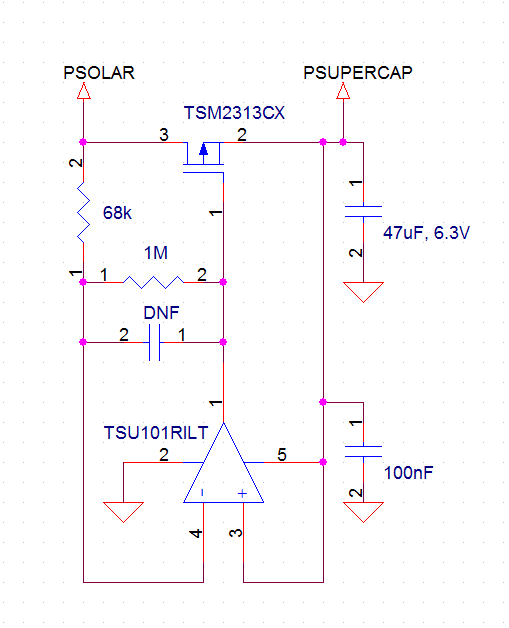
        Here's a similar "ideal diode" circuit made from discretes, as I mentioned:
        0_1536252391186_ideal_diode_opamp (1).PNG

        The attribution for that goes to "Perky" on the lowpowerlab forum.

        1 Reply Last reply
        0
        • NeverDieN Offline
          NeverDieN Offline
          NeverDie
          Hero Member
          wrote on last edited by NeverDie
          #5

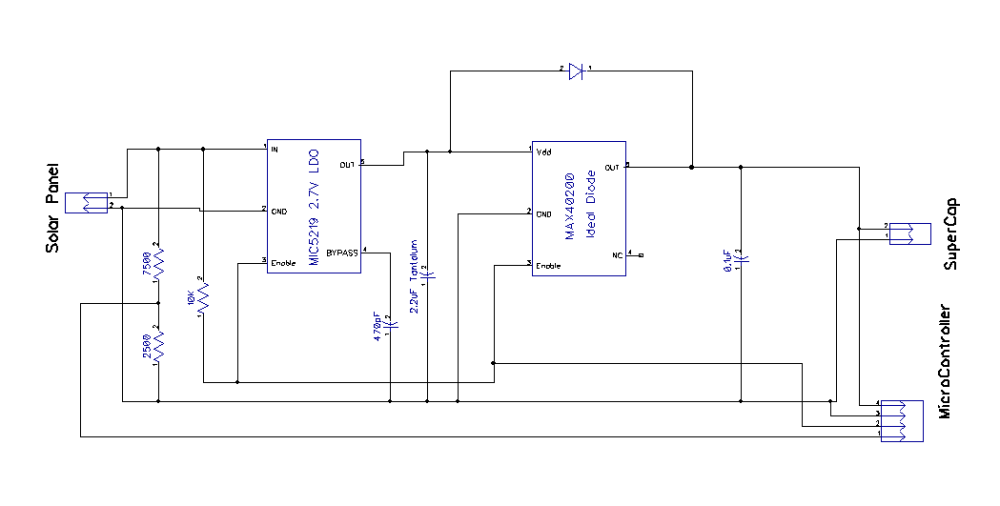
          This may be an improvement over the project schematic:
          0_1536263686526_improved_ideal_diode.png

          It uses an additional diode so that a nearly empty supercap can still be charged if the solar panel voltage is below the 1.5v minimum for the MAX40200 ideal diode. This needs to be tested, but the idea is that the MAX40200 would dominate once higher input voltages are reached. Anyway, the benefit of using an ideal diode in the first place is to avoid the very long charge tail that you get with a regular diode, but that isn't really a factor if the supercap is nearly empty. Hence, a hybrid approach may turn out to be optimal.

          On the other hand, I expect most of the charging would happen at higher voltages anyway, so this is really just a refinement that may well be optional.

          NeverDieN 1 Reply Last reply
          1
          • NeverDieN NeverDie

            This may be an improvement over the project schematic:
            0_1536263686526_improved_ideal_diode.png

            It uses an additional diode so that a nearly empty supercap can still be charged if the solar panel voltage is below the 1.5v minimum for the MAX40200 ideal diode. This needs to be tested, but the idea is that the MAX40200 would dominate once higher input voltages are reached. Anyway, the benefit of using an ideal diode in the first place is to avoid the very long charge tail that you get with a regular diode, but that isn't really a factor if the supercap is nearly empty. Hence, a hybrid approach may turn out to be optimal.

            On the other hand, I expect most of the charging would happen at higher voltages anyway, so this is really just a refinement that may well be optional.

            NeverDieN Offline
            NeverDieN Offline
            NeverDie
            Hero Member
            wrote on last edited by NeverDie
            #6

            OK, I tried it both with and without the diode, and the diode makes no difference. I think it's maybe because maybe the LDO (or its enable pin?) needs to see a minimum of 1v to pass any current at all, and more like 1.5v to pass current freely.

            Nca78N 1 Reply Last reply
            0
            • NeverDieN Offline
              NeverDieN Offline
              NeverDie
              Hero Member
              wrote on last edited by NeverDie
              #7

              I updated and finalized the design files and BOM. I've also verified that it works. Project completed. :)

              The main advantage of this design is the ability of the MCU to disable the Harvester enough to accurately read the voltage on the solar panel. If that doesn't matter to you, then my earlier solar charger project is simpler:
              https://www.openhardware.io/view/382/Tiny-Solar-Charger-for-27v-Mote-Supercap

              1 Reply Last reply
              0
              • NeverDieN NeverDie

                OK, I tried it both with and without the diode, and the diode makes no difference. I think it's maybe because maybe the LDO (or its enable pin?) needs to see a minimum of 1v to pass any current at all, and more like 1.5v to pass current freely.

                Nca78N Offline
                Nca78N Offline
                Nca78
                Hardware Contributor
                wrote on last edited by
                #8

                @neverdie said in 💬 Easy Supercap Fast Solar Harvester:

                OK, I tried it both with and without the diode, and the diode makes no difference. I think it's maybe because maybe the LDO (or its enable pin?) needs to see a minimum of 1v to pass any current at all, and more like 1.5v to pass current freely.

                You mean you made it only with the LDO ???

                NeverDieN 2 Replies Last reply
                0
                • Nca78N Nca78

                  @neverdie said in 💬 Easy Supercap Fast Solar Harvester:

                  OK, I tried it both with and without the diode, and the diode makes no difference. I think it's maybe because maybe the LDO (or its enable pin?) needs to see a minimum of 1v to pass any current at all, and more like 1.5v to pass current freely.

                  You mean you made it only with the LDO ???

                  NeverDieN Offline
                  NeverDieN Offline
                  NeverDie
                  Hero Member
                  wrote on last edited by
                  #9

                  @nca78 No. I made one board that is what the project is. I made a second board that is what is shown in the schematic above, with the extra diode. The second board with the extra diode made no difference. Both boards contained the ideal diode.

                  1 Reply Last reply
                  1
                  • Nca78N Nca78

                    @neverdie said in 💬 Easy Supercap Fast Solar Harvester:

                    OK, I tried it both with and without the diode, and the diode makes no difference. I think it's maybe because maybe the LDO (or its enable pin?) needs to see a minimum of 1v to pass any current at all, and more like 1.5v to pass current freely.

                    You mean you made it only with the LDO ???

                    NeverDieN Offline
                    NeverDieN Offline
                    NeverDie
                    Hero Member
                    wrote on last edited by NeverDie
                    #10

                    @nca78 said in 💬 Easy Supercap Fast Solar Harvester:

                    You mean you made it only with the LDO ???

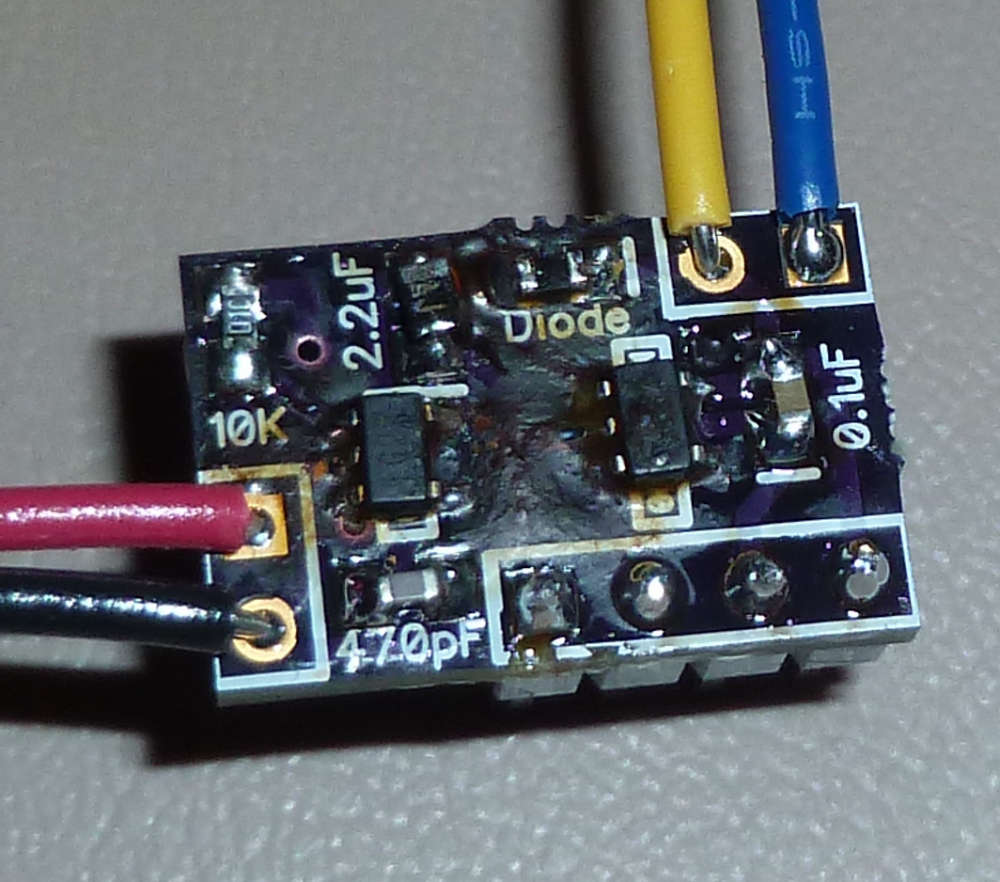
                    Here's a photo of the board I made and tested with the extra diode:
                    0_1537024761563_solar_diode.jpg

                    Hopefully that clears up any potential confusion.

                    1 Reply Last reply
                    1
                    • NeverDieN Offline
                      NeverDieN Offline
                      NeverDie
                      Hero Member
                      wrote on last edited by NeverDie
                      #11

                      Bad news I'm afraid. The enable/disable feature tested out correctly when powered by a bench power supply, but I found out today that when powered by a weak solar panel, it doesn't work as intended. DISABLE just doesn't provide enough of a full shut-off to accurately read the solar panel's voltage (the same voltage as if the solar panel were disconnected). Instead, a lower voltage is manifested.

                      Unfortunately, I don't know how to correct for this. Unless someone else can post a solution, I'm afraid this project probably is not worth doing. :(

                      Therefore, I am reverting it to "work in progress."

                      1 Reply Last reply
                      0
                      • gohanG Offline
                        gohanG Offline
                        gohan
                        Mod
                        wrote on last edited by
                        #12

                        This isn't really harvesting, is it? Shouldn't be harvesting the collecting of even the lower voltages to be stored in the supercap?

                        NeverDieN 1 Reply Last reply
                        0
                        • gohanG gohan

                          This isn't really harvesting, is it? Shouldn't be harvesting the collecting of even the lower voltages to be stored in the supercap?

                          NeverDieN Offline
                          NeverDieN Offline
                          NeverDie
                          Hero Member
                          wrote on last edited by
                          #13

                          @gohan How low does it need to be to qualify as harvesting?

                          1 Reply Last reply
                          0
                          • NeverDieN Offline
                            NeverDieN Offline
                            NeverDie
                            Hero Member
                            wrote on last edited by NeverDie
                            #14

                            OK, I changed the name, since two people have now commented upon it.

                            I have a new but totally different design sent off to fab which, while more elaborate, should allow proper voltage measurements of the solar panel by making it 100% completely unloaded for the duration of the measurement. I think in the end it will be cheaper to use some other sensor than the solar panel itself to get solar intensity measurements, but with this new design I'll be able to compare and then know for sure.

                            1 Reply Last reply
                            0
                            • gohanG Offline
                              gohanG Offline
                              gohan
                              Mod
                              wrote on last edited by
                              #15

                              I'd consider harvesting anything that can store small quantities of energy and then convert them into usable energy. The other project you made with the booster being powered by a small cap is more hervester like
                              Why do you need to measure the solar intensity?

                              1 Reply Last reply
                              0
                              • NeverDieN Offline
                                NeverDieN Offline
                                NeverDie
                                Hero Member
                                wrote on last edited by NeverDie
                                #16

                                Not sure yet, but, for example, it might be useful to know for managing energy expenditure if using smaller than supercap capacitors. You can get quite a lot of transmissions out of even a 100uF capacitor, but maybe it's better to simply queue the transmissions until the small cap is fully charged and the sun is shining brightly, so that the transmissions are "free", so to speak. With gobs of spare memory, a nRF52840 could store lots of detailed info which it only transmits under the right conditions. This might be especially true for very small devices with very tiny solar panels.

                                1 Reply Last reply
                                1
                                • alexsh1A Offline
                                  alexsh1A Offline
                                  alexsh1
                                  wrote on last edited by
                                  #17

                                  @NeverDie

                                  I am looking at schematic and I cannot understand why this does not work.
                                  May be a low quality solar panel? What's wattage of the solar panel you tested?

                                  NeverDieN 1 Reply Last reply
                                  0
                                  • alexsh1A alexsh1

                                    @NeverDie

                                    I am looking at schematic and I cannot understand why this does not work.
                                    May be a low quality solar panel? What's wattage of the solar panel you tested?

                                    NeverDieN Offline
                                    NeverDieN Offline
                                    NeverDie
                                    Hero Member
                                    wrote on last edited by
                                    #18

                                    @alexsh1 It turns out it does work. You just need to substitute much higher value resistors (e.g. 10M instead of 10K and use much higher values for the resistors in the voltage divider) so that under low light conditions the voltage measured on the unloaded solar panel doesn't show less than it should.

                                    alexsh1A 1 Reply Last reply
                                    1
                                    • NeverDieN NeverDie

                                      @alexsh1 It turns out it does work. You just need to substitute much higher value resistors (e.g. 10M instead of 10K and use much higher values for the resistors in the voltage divider) so that under low light conditions the voltage measured on the unloaded solar panel doesn't show less than it should.

                                      alexsh1A Offline
                                      alexsh1A Offline
                                      alexsh1
                                      wrote on last edited by
                                      #19

                                      @neverdie That's good news. I am going to assemble one as I like the idea of disabling the harvester.

                                      FYG - I am using this small board to read solar panel voltage and disable / enable voltage divider:

                                      https://github.com/hallard/Battery-Voltage-Measure

                                      works really well and simple enough.

                                      1 Reply Last reply
                                      0
                                      • alexsh1A Offline
                                        alexsh1A Offline
                                        alexsh1
                                        wrote on last edited by
                                        #20

                                        I must admit that the choice of the LDO is perfect.
                                        I assembled one of these board and can use it with any solar panel up to 12V

                                        1 Reply Last reply
                                        1
                                        • NeverDieN Offline
                                          NeverDieN Offline
                                          NeverDie
                                          Hero Member
                                          wrote on last edited by
                                          #21

                                          Maybe the cleanest way to settle this would be to use an op-amp to buffer the voltage that's to be measured.

                                          NeverDieN 1 Reply Last reply
                                          0
                                          Reply
                                          • Reply as topic
                                          Log in to reply
                                          • Oldest to Newest
                                          • Newest to Oldest
                                          • Most Votes


                                          24

                                          Online

                                          11.7k

                                          Users

                                          11.2k

                                          Topics

                                          113.1k

                                          Posts


                                          Copyright 2025 TBD   |   Forum Guidelines   |   Privacy Policy   |   Terms of Service
                                          • Login

                                          • Don't have an account? Register

                                          • Login or register to search.
                                          • First post
                                            Last post
                                          0
                                          • MySensors
                                          • OpenHardware.io
                                          • Categories
                                          • Recent
                                          • Tags
                                          • Popular