
Efficiency of Voltage Boosters
-
@a-lurker Hmm. Perhaps the store shouldn't recommend electrolytic capacitors then for the radio decoupling.
Comparison between tantalum and ceramic capacitors:
http://www.avx.com/docs/techinfo/mlc-tant.pdfPertinent conclusion table:
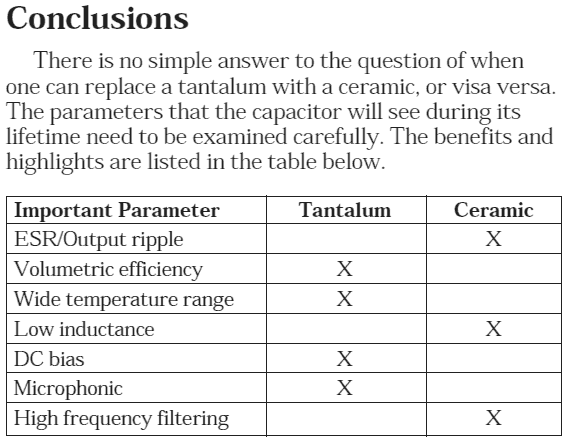
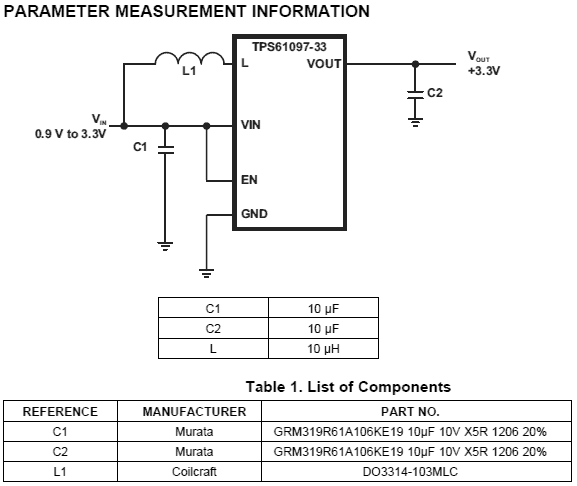
Texas Instruments recommends (fancy SMD) ceramic capacitors for the TPS61097 and TPS6122x. Empirical evidence would suggest that cheap Ebay caps may not be the best idea. Nor would it be prudent to replace them with Tantalum, though that could also be attributed to cheap Ebay goods. The post is unclear on this.
From the TI datasheet on the TPS61097:
@bjornhallberg said:
@a-lurker Hmm. Perhaps the store shouldn't recommend electrolytic capacitors then for the radio decoupling.
Yep, we should probably do that. Need help finding a good candidate. Found this. Any good?
Search: "tantalum 47uf -smd"
-
Yes, you got the result from the booster voltage ripple test correct, the 4.7 microF is the one recommended from the MySensors store, and the other 220 microF is a high-end audio electrolytic. The low ESR is here. Here is the data,
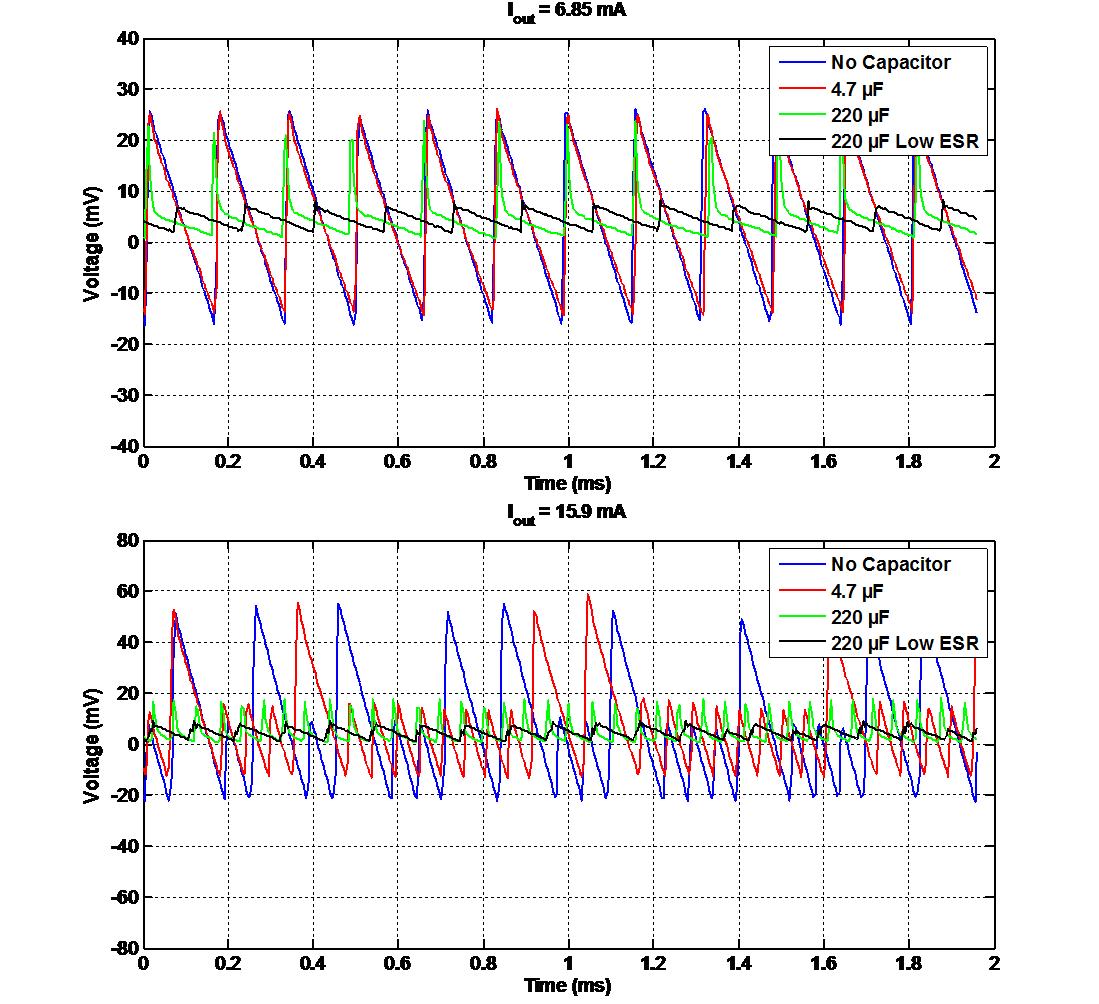
Now, with that being said; why power the radio from the booster at all? I would submit, for battery powering a sensor node, that one should simply connect the radio directly to the battery (2xAA). The Arduino seems to be less sensitive, but still need to test. Connecting the battery directly also is more efficient, no power loss through the booster.
My observation was, at a range of ~few feet, that I would get ~20-70% radio communication fails in the 'pingpair' sketch with the radio powered by the booster, and 100% success radio powered from 2xAA batteries, and 100% success radio powered by booster with the low ESR capacitor mentioned above. I didn't have any lower capacitor values to test (actually, I think I might have a 150 microF as well, but no lower values).
I also tested the 5 V -to- 3 V step-down regulator from the MySensors store and that is dead flat, no voltage ripple (~1-2 mV noise). But, that is also power inefficient, however it is a good option for a plug-in node or gateway.
-
So, you are saying that it looks like there is no capacitor or anything else needed when powering the radio separately?
And, when using a capacitor the 220 microF is better in any case (good or less quality)?
-
Nice summary. I'd like to add the booster chip that axillent was using for his project, the MCP1640.
Also, since this project is utilizing radio communication, both EMI and the quality of the boosted power could be an issue. There were some other post, probably gone now, that talked about connecting batteries directly and separately to the radio to get around such issues. Probably had something to do with ebay regulators or the regulator on the arduino?
Looking forward to more test results. Don't forget to mention what brand / type of inductor and capacitors you go for in the circuits.
@bjornhallberg said:
Looking forward to more test results. Don't forget to mention what brand / type of inductor and capacitors you go for in the circuits.
I'm currently doing tests with prototype of future MySensors board.
It is started today from a single AA battery.
The radio part is not yet soldered but will be soldered as soon as I will compile and test a correct bootloader -
As for capacitors.
Do not mix different things.old-style electrolitic and tantalum can be used to decouple radio module power.
this capacitor is needed to reduce drop of the voltage at a time of receiving and sendingas for step-ups/step-downs/LDO there is no ideal capacitor in general. You should always refer to the recommendations from the datasheet.
Most modern power chips are required multil-layers ceramic capacitors. Such capacitors they have stable characteristics and very low ESR (much lower than tantalum have). In most cases it is X7R or X5R (the difference between this two is temperature stability)
But for some power chips ceramic will be not recommended. Refer to the datasheet. -
So, you are saying that it looks like there is no capacitor or anything else needed when powering the radio separately?
And, when using a capacitor the 220 microF is better in any case (good or less quality)?
-
I've (perhaps naively) built my battery powered MySensors pcb's around the 3 pin configuration of the ebay cheapie. If many others have done the same then I can see some value in someone creating a drop-in replacement board based on the more efficient chips. I'd definitely buy the more efficient version if someone created it, whether pre-made or solder-it-yourself.
-
Good to see new activity on this thread again.
@axillent Unless there is some EMI coupled into the power leads of a battery connected radio, or current draw from the battery can't keep up with demand, I don't see why a capacitor is needed. In fact, the product brief for the nRF24L01+ states that it is designed with an on-board voltage regulator and permits operation with a coin-cell battery. Is there something I'm missing?
Also, regarding capacitors, I think you mean 220 microF is 'overkill' or 'more-than-enough', rather than 'too-much'. Right?
Anyway, here is a comparison of aluminum polymer capacitors of different capacitance. Note how the 220 microF cap is cheaper and has lower ESR than either the 10 microF or the 47 microF, and is only slightly larger in physical size.
Tantalum on the other hand has a quite high ESR, on the order of ohms, not good for suppressing voltage ripple according to this document.
That being said, ceramics may be the way to go for sub-100 microF as they are lower cost, smaller, and very low ESR; above 100 microF ceramics get very expensive, ~$4 for a 220 microF.
-
I've (perhaps naively) built my battery powered MySensors pcb's around the 3 pin configuration of the ebay cheapie. If many others have done the same then I can see some value in someone creating a drop-in replacement board based on the more efficient chips. I'd definitely buy the more efficient version if someone created it, whether pre-made or solder-it-yourself.
@Bandra Great, would you be able to share your run times so that we can get some real world data? That is, how long can you run a node before the battery is discharged?
I was thinking about making a board using one of the high efficiency boosters listed in the first post, if they prove their worth. I get my components in on Saturday, so sometime next week I should have preliminary results.
-
Good to see new activity on this thread again.
@axillent Unless there is some EMI coupled into the power leads of a battery connected radio, or current draw from the battery can't keep up with demand, I don't see why a capacitor is needed. In fact, the product brief for the nRF24L01+ states that it is designed with an on-board voltage regulator and permits operation with a coin-cell battery. Is there something I'm missing?
Also, regarding capacitors, I think you mean 220 microF is 'overkill' or 'more-than-enough', rather than 'too-much'. Right?
Anyway, here is a comparison of aluminum polymer capacitors of different capacitance. Note how the 220 microF cap is cheaper and has lower ESR than either the 10 microF or the 47 microF, and is only slightly larger in physical size.
Tantalum on the other hand has a quite high ESR, on the order of ohms, not good for suppressing voltage ripple according to this document.
That being said, ceramics may be the way to go for sub-100 microF as they are lower cost, smaller, and very low ESR; above 100 microF ceramics get very expensive, ~$4 for a 220 microF.
@axillent Unless there is some EMI coupled into the power leads of a battery connected radio, or current draw from the battery can't keep up with demand, I don't see why a capacitor is needed. In fact, the product brief for the nRF24L01+ states that it is designed with an on-board voltage regulator and permits operation with a coin-cell battery. Is there something I'm missing?
I'm not an EMI or decoupling freak but I knew from practice own and others that communication distance is very vary with and without capacitor soldered very close to the radio.
You can try yourself. My PA+LNA modules are having tantalum soldered near power pins while cheap $1 modules do not have a capacitor on board -
@axillent Unless there is some EMI coupled into the power leads of a battery connected radio, or current draw from the battery can't keep up with demand, I don't see why a capacitor is needed. In fact, the product brief for the nRF24L01+ states that it is designed with an on-board voltage regulator and permits operation with a coin-cell battery. Is there something I'm missing?
I'm not an EMI or decoupling freak but I knew from practice own and others that communication distance is very vary with and without capacitor soldered very close to the radio.
You can try yourself. My PA+LNA modules are having tantalum soldered near power pins while cheap $1 modules do not have a capacitor on board@axillent I totally agree with the radio being very sensitive to noise and voltage ripple on the power pins. I have had great improvements with running the radio on battery directly.
I know that the 4.7 microF electrolytic recommended on the MySensors store does very little to help.
When I powered the radio from the booster I was getting poor reception and many failed messages; I didn't have any tantalum capacitors on hand, so I tried to look at suppressing the voltage ripple of the power to the radio using the beastly 220 microF polymer capacitors and it worked well.
I think we have come to the same conclusion...voltage ripple to the radio is bad, suppress it any way you can and one will have better results.
-
@Bandra Great, would you be able to share your run times so that we can get some real world data? That is, how long can you run a node before the battery is discharged?
I was thinking about making a board using one of the high efficiency boosters listed in the first post, if they prove their worth. I get my components in on Saturday, so sometime next week I should have preliminary results.
@therik said:
@Bandra Great, would you be able to share your run times so that we can get some real world data? That is, how long can you run a node before the battery is discharged?
I was thinking about making a board using one of the high efficiency boosters listed in the first post, if they prove their worth. I get my components in on Saturday, so sometime next week I should have preliminary results.
I only sent my pcb's off for production a couple of days ago. They have a 5cm x 3cm footprint which is designed to fit perfectly on top of a 2xAA battery holder. If the analysis of the chinese cheapie step up converters is right then it may be a couple of months before I run out of battery and have some real world results. However they have the battery level sensing circuit on them so I may have some results sooner once I tweak the algorithm for the 1.2 volt cells. Will let you know how I go.
-
-
(Note resurrected post) @therik I used to think that you could run the MySensor stuff just using two batteries connected directly to the processor but came to the conclusion that's a bad idea. First, to get the best out of some sensors running them off a fixed Voltage is preferable.
Secondly two alkaline AAs supply about 2.4V to 2.6V (during most of their operational life time) and the 3.3V CPUs have the brownout set to 2.7 V (typ). So if you use this method, you need to ensure the brown out detector (BOD) fuses are set to disable the brownout detection completely. Doing it in software is not sufficient, as the BOD is automatically re-enabled as soon as the CPU comes out of sleep.
The CPU spec shows the maximum Frequency vs. VCC line for between 1.8 V and 2.7 V. The line equation is Vmin = (F-k)/m, where from the spec k = -8 and m =6.6666 so for 8 MHz: Vmin = 2.4V Towards the end of their life two AAs will go below this Voltage. What happens then? With an inverter you can monitor the battery Voltage and trigger an alarm when it gets really, really low.
Also with the inverter you can squeeze every last ounce of juice out of them and everything will still work.
@axillent Totally agree about charging batteries - probably more hassle than it's worth. Depending on the application, just solar charging a super capacitor could work well. Imagine a temperature sensor reporting back every fifteen minutes and it consumes say 30ma at 3V3 for 0.5 seconds while it reports and we use one of these:
https://www.sparkfun.com/products/746
time roughly = (C/I)*(Vmax-Vmin)
so say we use say a Vmax of 2V and Vmin of 1V and use that to power an inverter to 3V3. Also assume we draw 100 mA at 1V, which is about 30 mA at 3V3 for the CPU and radio. We have a ten Farad cap but it's a bit out of tolerance, so it's actually only five Farads.
(5/0.1)*(2-1)= 50 seconds
That allows for one hundred 0.5 second samples to sent before the cap is "flat", which is 25 hours if sent every 15 minutes. So it looks like it could work OK. Should work for @HeK in Sweden where the shortest day is only about 7 hours long, with the main problem is keeping snow off the solar panel.
-
Just adding to the above. It does make sense to run the radio directly off the battery (1V9 to 3V6) but two problems remain: the CPU brownout detector and the minimum Voltage required to run the CPU, which is 2V4 at 8 MHz.. See also:
http://forum.micasaverde.com/index.php/topic,20078.msg164716.html#msg164716
The radio must have a supply Voltage of 2V7 to 3V3 if the input signals are greater than 3V6. you would encounter this when running a CPU at 5V, which hopefully you wouldn't be doing on a battery powered set up.
-
Just adding to the above. It does make sense to run the radio directly off the battery (1V9 to 3V6) but two problems remain: the CPU brownout detector and the minimum Voltage required to run the CPU, which is 2V4 at 8 MHz.. See also:
http://forum.micasaverde.com/index.php/topic,20078.msg164716.html#msg164716
The radio must have a supply Voltage of 2V7 to 3V3 if the input signals are greater than 3V6. you would encounter this when running a CPU at 5V, which hopefully you wouldn't be doing on a battery powered set up.
@a-lurker If brownout detection is disabled we could power atmega328p with 1.9V minimum, but frequency of operation will decrease.
I know you get it right, i just want to standout that there is no problem of operation at low voltage if we know 2 thinks:- disable BOD (no soft)
- we get lower frequency
-
There are a few subjects in this valuable thread.
One is the best type of capacitor to use across the power and ground of the nRF24L01+ module. I'm very interested in that. My earliest tests were frustrating, I was busy trying to figure out what was wrong with the software (before I came here by the way), but it turned out to be power and/or too long SPI wires. A cap across the power at the module made a great difference. So I'm tending towards always doing that in the future, and I'd like to know what kind to stock up on.
I'm seeing some opinion that tantalum would be better, some that it has too high ESR. So a low ESR electrolytic (probable aluminum polymer) would be better. Or maybe a ceramic is better still, and cheap.
Are there any recommended caps below 50 cents in small quantities? Is there anything from eBay or Tayda or are those all junk for our purposes? If not, Digikey or Mouser is OK, tho the minimum shipping raises the effective cost per unit substantially for small quantities (and I may not have a large order to combine it with for months).
There is a variation of this question which is about caps for use with noisy boost converters. I am thinking that a good cap for that purpose would also be a good cap for use with the tranceiver in general - low ESR and with an appropriate value, with low leakage. (In another case the noise of a sensor or actuator might be what needs to be filtered out rather than a boost voltage converter).
-
I changed the capacitor that I used for my radios from 4.7 mF into 220 mF and I can only say thank you for this discussion, it is really immediately much better :)
Fulltime Servoy Developer
Parttime Moderator MySensors boardI use Domoticz as controller for Z-Wave and MySensors (previously Indigo and OpenHAB).
I have a FABtotum to print cases. -
I changed the capacitor that I used for my radios from 4.7 mF into 220 mF and I can only say thank you for this discussion, it is really immediately much better :)
@marceltrapman mF as in milli or micro? :) µF I suppose..
-
I changed the capacitor that I used for my radios from 4.7 mF into 220 mF and I can only say thank you for this discussion, it is really immediately much better :)






Hello! It looks like you're interested in this conversation, but you don't have an account yet.
Getting fed up of having to scroll through the same posts each visit? When you register for an account, you'll always come back to exactly where you were before, and choose to be notified of new replies (either via email, or push notification). You'll also be able to save bookmarks and upvote posts to show your appreciation to other community members.
With your input, this post could be even better 💗
Register Login