
PIR AM312/412/612
-
Good news! I wired up my primitive breakout board on a breadboard such that it turns on a blue LED if it detects motion. I have (I think) set sensitivity to maximum by using just an 82K pulldown resistor and a 4.7uF capacitor on the SEN pin. I powered it using two AA alkaline batteries.
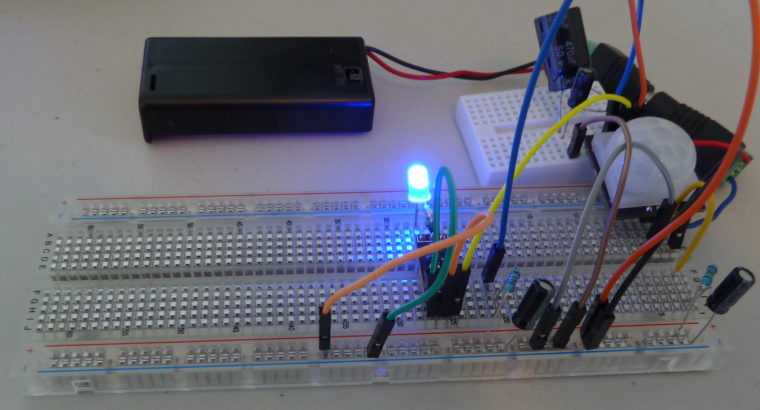
Bottom line: Even in this half-baked breadboard prototype, it seems to perform much better than the am312 I tried earlier. I'm not even noticing any significant blind spots. :) Go figure.
-
Attached is my attempt at a conversion of the reference schematic on page 9 of the AM612 datasheet (http://akizukidenshi.com/download/ds/senba/Pir-Am612.pdf) to a setup where the AM612 is at maximum sensitivity and minimum "on time" after being triggered.
Can it be further simplified?
0_1498834397166_Schematic for AM612 Breakout v402.pdf
For instance, do the 10uF capacitors any longer serve a useful purpose? Or would eliminating them be of no consequence?
-
I can't open your document.
You confirm that the test is with he double PIR PCB under one lens ?
I'm surprised that this work as the lens is supposed to focus the IR on the two sides of the sensor, and if you move them away of the center it should lower sensitivity. -
I can't open your document.
You confirm that the test is with he double PIR PCB under one lens ?
I'm surprised that this work as the lens is supposed to focus the IR on the two sides of the sensor, and if you move them away of the center it should lower sensitivity.@Nca78 said in PIR AM312/412/612:
I can't open your document.
Strange. It's an ordinary PDF. I'm even able to open it on my wife's computer.
You confirm that the test is with he double PIR PCB under one lens ?
What I tested was just a single am612 PIR under one lens. I re-tested last night to be sure, and, indeed, it seems to have excellent sensitivity and no meaningful blinds spots.
-
@Nca78 said in PIR AM312/412/612:
I can't open your document.
Strange. It's an ordinary PDF. I'm even able to open it on my wife's computer.
You confirm that the test is with he double PIR PCB under one lens ?
What I tested was just a single am612 PIR under one lens. I re-tested last night to be sure, and, indeed, it seems to have excellent sensitivity and no meaningful blinds spots.
-
@Terrence
Thanks! Not sure what's going wrong. Let's try it again from a different computer:
0_1498851552407_Schematic for AM612 Breakout v402.pdf
In case that still doesn't work, here it is as a .PNG file:
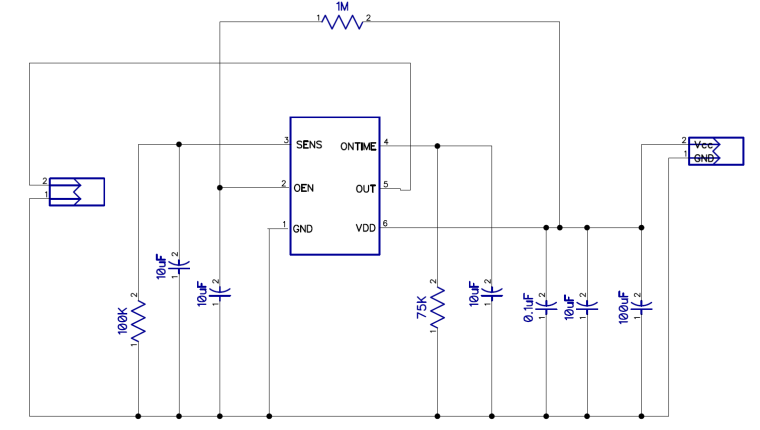
which is large enough to be legible and will serve the purpose. -
I guess answering my own question, I removed my load switch as well as all of the capacitors from my breadboard circuit, and the remaining am612 circuit still appears to function just fine. :)
-
I updated the board, and it's now 23mmx24.5mm:
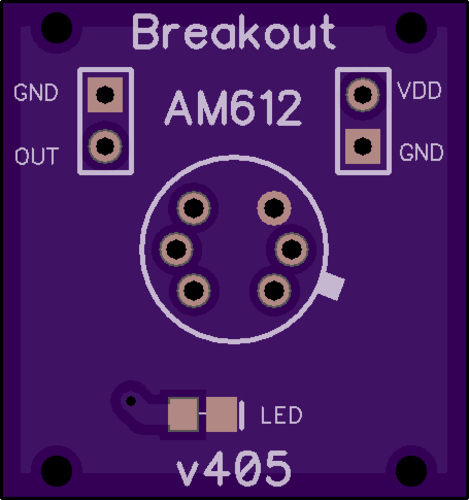
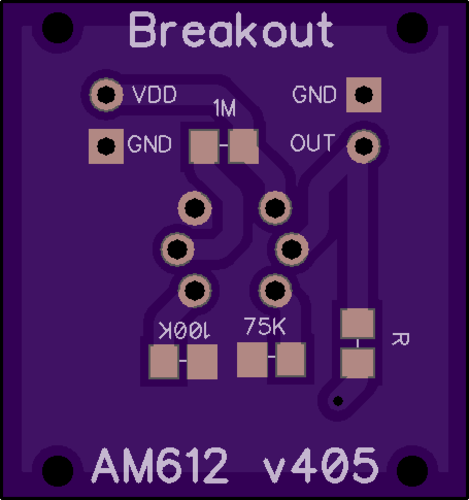
It also has pads for an LED for range testing purposes.
-
I also ordered some of these lenses:
https://www.aliexpress.com/item/FREE-SHIPPING-50PCS-PIR-D203S-LHI874-LHI878-RE200B-P228-Fresnel-lens-PIR-Sensor/1295771560.html?spm=2114.01010208.3.31.Be4wmU&ws_ab_test=searchweb0_0,searchweb201602_5_10152_10065_10151_10068_10130_10084_10083_10119_10080_10082_10081_10110_10178_10136_10137_519_10111_10060_10112_10113_10155_10114_437_10154_10056_10055_10054_10182_10059_303_100031_10099_10078_10079_10103_10073_10102_10120_10052_10053_10142_10107_142_10050_10051-10120,searchweb201603_49,ppcSwitch_4&btsid=f043368c-9fc4-4f1a-ae33-850a00860ef5&algo_expid=2cec72d6-8e82-4481-92b3-9a4b26711616-4&algo_pvid=2cec72d6-8e82-4481-92b3-9a4b26711616
They look a little different, so I thought them worth a try. While not plug compatible with the exist SR501-type layout, maybe they can somehow (?) grip the outside of the PCB instead, allowing an even slightly smaller PCB. If only they had manufactured the barbs facing inward rather than outward, they might have been perfect! -
I guess answering my own question, I removed my load switch as well as all of the capacitors from my breadboard circuit, and the remaining am612 circuit still appears to function just fine. :)
@NeverDie said in PIR AM312/412/612:
I guess answering my own question, I removed my load switch as well as all of the capacitors from my breadboard circuit, and the remaining am612 circuit still appears to function just fine. :)
It's a somewhat surprising result, because even the cheapskate am312 sensors appear to use caps:
https://www.aliexpress.com/item/Mini-IR-Pyroelectric-Infrared-PIR-Motion-Human-Sensor-Automatic-Detector-Module-high-reliability-12mm-x-25mm/32749737125.html?spm=2114.01010208.3.32.JSXzcv&ws_ab_test=searchweb0_0,searchweb201602_5_10152_10065_10151_10068_10130_10084_10083_10119_10080_10082_10081_10110_10178_10136_10137_519_10111_10060_10112_10113_10155_10114_437_10154_10056_10055_10054_10182_10059_303_100031_10099_10078_10079_10103_10073_10102_10120_10052_10053_10142_10107_142_10050_10051-10120,searchweb201603_49,ppcSwitch_4&btsid=b87e2064-287c-4fe9-ba44-53ca575f5350&algo_expid=3e550c0f-0a35-465b-8691-27d092d21bbd-4&algo_pvid=3e550c0f-0a35-465b-8691-27d092d21bbd
I coun't three caps there. Surely not all of them are there because of the LDO? -
@NeverDie said in PIR AM312/412/612:
I guess answering my own question, I removed my load switch as well as all of the capacitors from my breadboard circuit, and the remaining am612 circuit still appears to function just fine. :)
It's a somewhat surprising result, because even the cheapskate am312 sensors appear to use caps:
https://www.aliexpress.com/item/Mini-IR-Pyroelectric-Infrared-PIR-Motion-Human-Sensor-Automatic-Detector-Module-high-reliability-12mm-x-25mm/32749737125.html?spm=2114.01010208.3.32.JSXzcv&ws_ab_test=searchweb0_0,searchweb201602_5_10152_10065_10151_10068_10130_10084_10083_10119_10080_10082_10081_10110_10178_10136_10137_519_10111_10060_10112_10113_10155_10114_437_10154_10056_10055_10054_10182_10059_303_100031_10099_10078_10079_10103_10073_10102_10120_10052_10053_10142_10107_142_10050_10051-10120,searchweb201603_49,ppcSwitch_4&btsid=b87e2064-287c-4fe9-ba44-53ca575f5350&algo_expid=3e550c0f-0a35-465b-8691-27d092d21bbd-4&algo_pvid=3e550c0f-0a35-465b-8691-27d092d21bbd
I coun't three caps there. Surely not all of them are there because of the LDO? -
Has anyone here run across a highly directional version of either the AM312/612 or some other PIR sensor?
I have an application (https://forum.mysensors.org/topic/7388/how-to-detect-wild-animal-pests-in-a-windy-garden/1) which would benefit from that.
-
Is there an SMD version of the PIR AM312/412/612 (it may have a different number, of course)?
-
Closing the loop on my earlier questions, I finally did some long overdue experiments involving the AM612. It turns out that the 75K and 100K resistors aren't doing much, if anything. They can be replaced with simple shorts. So, in future designs, I'll be eliminating them.
On the other hand, the 1Megaohm resistor appears to be necessary. If I simply removed it, the PIR no longer did detections. If I put it back, the PIR worked again.
-
At time index 6:20 this guy finds that using the AM312 is a solution to his intermittent problems that he was having with a the more commonplace PIR sensor:
https://www.youtube.com/watch?v=jpjfVc-9IrQ -
Just a quick question about these AM612 sensors.. What is the shortest trigger delay that can be achieved by connecting the SENS pin to ground? The datasheet suggests that by connecting ONTIME to ground a 2.3s "ontime" would be created, but does this also apply to the triggering delay?
I'm asking as I'm planning on using these sensors to switch on lights at home and obviously would like to have as little delay as possible between the actual detection and output trigger. AM312 seems to have a fixed ~2s delay, but how is it with the more tunable AM612? Maybe @NeverDie has some first hand experience?
-
(A lot of the comments in that video mention MySensors :-) )
-
Just a quick question about these AM612 sensors.. What is the shortest trigger delay that can be achieved by connecting the SENS pin to ground? The datasheet suggests that by connecting ONTIME to ground a 2.3s "ontime" would be created, but does this also apply to the triggering delay?
I'm asking as I'm planning on using these sensors to switch on lights at home and obviously would like to have as little delay as possible between the actual detection and output trigger. AM312 seems to have a fixed ~2s delay, but how is it with the more tunable AM612? Maybe @NeverDie has some first hand experience?
@chacal said in PIR AM312/412/612:
I'm asking as I'm planning on using these sensors to switch on lights at home and obviously would like to have as little delay as possible between the actual detection and output trigger. AM312 seems to have a fixed ~2s delay, but how is it with the more tunable AM612? Maybe @NeverDie has some first hand experience?
The output trigger is triggered as soon as the movement is fixed. A fixed delay of 2 seconds, here we mean that the HIGH level will be on the output trigger for 2 seconds.
-
Closing the loop on my earlier questions, I finally did some long overdue experiments involving the AM612. It turns out that the 75K and 100K resistors aren't doing much, if anything. They can be replaced with simple shorts. So, in future designs, I'll be eliminating them.
On the other hand, the 1Megaohm resistor appears to be necessary. If I simply removed it, the PIR no longer did detections. If I put it back, the PIR worked again.
@neverdie hello, can you please provide the final schematic which one worked best for you with minimum no. of components
-
I updated the board, and it's now 23mmx24.5mm:
It also has pads for an LED for range testing purposes.
@neverdie is this board without any capacitors working well??I want to test AM612 so I want testing circuit that works well




Hello! It looks like you're interested in this conversation, but you don't have an account yet.
Getting fed up of having to scroll through the same posts each visit? When you register for an account, you'll always come back to exactly where you were before, and choose to be notified of new replies (either via email, or push notification). You'll also be able to save bookmarks and upvote posts to show your appreciation to other community members.
With your input, this post could be even better 💗
Register Login