
Whole house power monitoring.
-
I'm using an arduino pro mini with an W500 Ethernet module connected directly to router,and a clamp from ebay(100amps i think). arduino and w500 fits inside a small box and its inside main power box,clamped to the main wire from main eletric deferential . I have the (ATI) Telecomonication box at side of power box so its easy to connect to the router. i dont use transformer for volt read,just read Amps because my power its very stable at 230/235v and this is just for " power waste "control
on first moth that i build it i saved 30€/moth in power(i not a commercial advertisement :P ).i had the electric resistance from water solar heating panel (3000w) working during the night,useless because we don't need hot water in morning,only at end of the day. so now i have another arduino that handle the hot water if there is no enough sun during the day... ( arduino pro minifor the win!!!:+1: )
This is a screenshot from my emoncms page. like you see my wife its doing cakes and dinner,and the oven and induction plate eat a lot of power 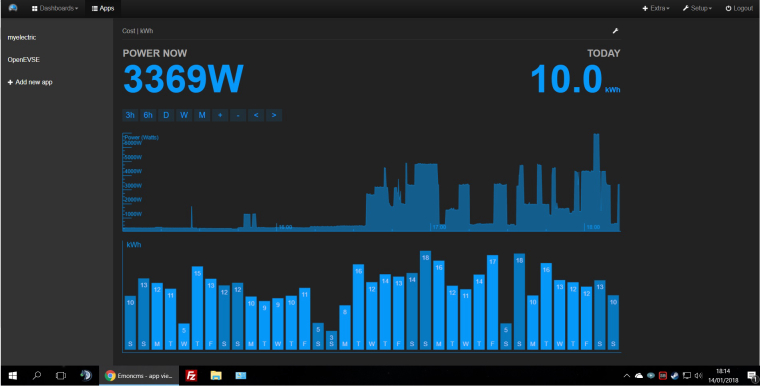
-
@gohan said in Whole house power monitoring.:
https://openenergymonitor.org/forum-archive/node/58.html then you add the mysensors code for communication.
+1 to that
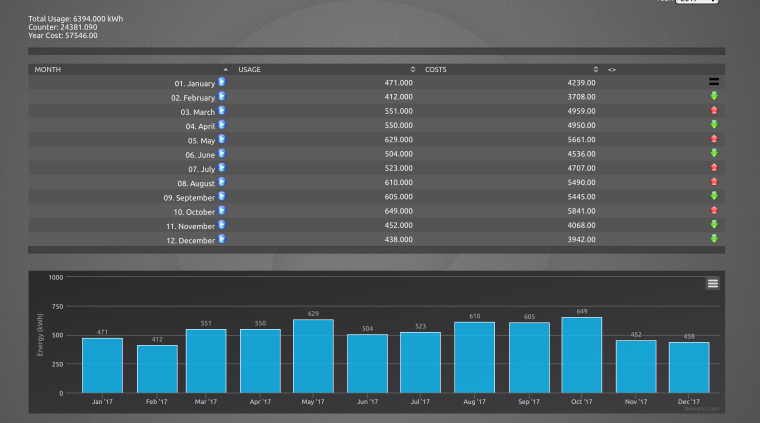
I have been using a single clamp sensor on my neutral at the power meter (SCT-030) hooked to an arduino/ESP8266
It's been working great close to 3 years now with an accuracy of +- 7%
I even use the readings to detect brown-outs and trigger devices to original state after power flips back to mains from the back-up (I live in an area where brown-outs , or power-cuts as we call them , are quite common)
-
+/-7% is good, because Domoticz has it own error -8% when energy consumption calculation is done by Domoticz.
When I send 660 W constantly a few hours, I obtain energy consumption 604 - 609 Wh in this interval :o(
They do not add last 5 min energy consumption in one hour interval ( Argument - because data arrived not at xx:00:00 but XX:00:05 )
Look at Domoticz forum about this bug, if interested.
Boys from Domoticz said - it is not important ....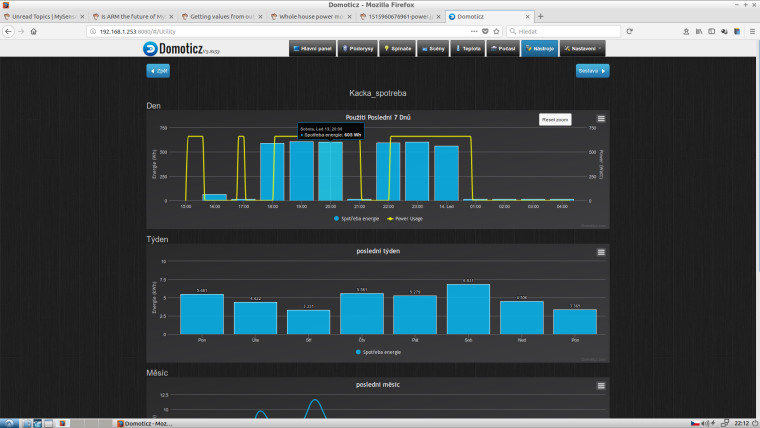
-
+/-7% is good, because Domoticz has it own error -8% when energy consumption calculation is done by Domoticz.
When I send 660 W constantly a few hours, I obtain energy consumption 604 - 609 Wh in this interval :o(
They do not add last 5 min energy consumption in one hour interval ( Argument - because data arrived not at xx:00:00 but XX:00:05 )
Look at Domoticz forum about this bug, if interested.
Boys from Domoticz said - it is not important .... -
+/-7% is good, because Domoticz has it own error -8% when energy consumption calculation is done by Domoticz.
When I send 660 W constantly a few hours, I obtain energy consumption 604 - 609 Wh in this interval :o(
They do not add last 5 min energy consumption in one hour interval ( Argument - because data arrived not at xx:00:00 but XX:00:05 )
Look at Domoticz forum about this bug, if interested.
Boys from Domoticz said - it is not important .... -
@kimot yeah, 5 minutes intervals are not the best for that kind of statistics; you'd probably better look at influxDB for more accurate statistics
@gohan Agreed that the Domoticz 5 minute sample frequency is inadequate for any accurate measurement, there was talk on the forums that this was to change to accurate time based series for the next version of Domoticz, how true that was and when this might appear is unknown.
I wasn't aware of that flaw @kimot, quite a curiosity...
I was pointed to NodeRed previously as a mechanism to duplicate the data stream and accurately record time-based data from pulse meters while passing on the data to Domoticz, I just haven't waded into the thrills of NodeRed yet.
Agreed that clamp meters are easier to install, when I was looking into them, many specifications show an average range of accuracy, but also read elsewhere that this accuracy is not linear, and becomes in reality quite inaccurate at low currents, I cannot recall the error %age.
-
@gohan Agreed that the Domoticz 5 minute sample frequency is inadequate for any accurate measurement, there was talk on the forums that this was to change to accurate time based series for the next version of Domoticz, how true that was and when this might appear is unknown.
I wasn't aware of that flaw @kimot, quite a curiosity...
I was pointed to NodeRed previously as a mechanism to duplicate the data stream and accurately record time-based data from pulse meters while passing on the data to Domoticz, I just haven't waded into the thrills of NodeRed yet.
Agreed that clamp meters are easier to install, when I was looking into them, many specifications show an average range of accuracy, but also read elsewhere that this accuracy is not linear, and becomes in reality quite inaccurate at low currents, I cannot recall the error %age.
@zboblamont said in Whole house power monitoring.:
Agreed that clamp meters are easier to install, when I was looking into them, many specifications show an average range of accuracy, but also read elsewhere that this accuracy is not linear, and becomes in reality quite inaccurate at low currents, I cannot recall the error %age.
But probably it's not a big issue if you have 30% or more (no idea of the real numbers) of inaccuracy at low current, as long as you're much closer at high current which make the bulk of your power consumption ?
-
@zboblamont said in Whole house power monitoring.:
Agreed that clamp meters are easier to install, when I was looking into them, many specifications show an average range of accuracy, but also read elsewhere that this accuracy is not linear, and becomes in reality quite inaccurate at low currents, I cannot recall the error %age.
But probably it's not a big issue if you have 30% or more (no idea of the real numbers) of inaccuracy at low current, as long as you're much closer at high current which make the bulk of your power consumption ?
@nca78 Possibly that would be one approach, but there are so many other effects on CTs as opposed to direct reading meters, proximity of adjacent cable, temperature, humidity, etc., all introducing errors on top of it's spec and how well it is QC'd at manufacture.
Industrial 50A clamps can work down to 0.125A with 2.5% error, the typical 100A domestic variety would not get close I suggest.
Don't misunderstand my comments, where it is impossible to install direct reading meters I see the necessity, just cautioning that they are by nature a compromise.
-
@nca78 Possibly that would be one approach, but there are so many other effects on CTs as opposed to direct reading meters, proximity of adjacent cable, temperature, humidity, etc., all introducing errors on top of it's spec and how well it is QC'd at manufacture.
Industrial 50A clamps can work down to 0.125A with 2.5% error, the typical 100A domestic variety would not get close I suggest.
Don't misunderstand my comments, where it is impossible to install direct reading meters I see the necessity, just cautioning that they are by nature a compromise.
-
@zboblamont just for clarification, what do you mean by "direct reading "?
-
@gohan Sorry for any confusion, I meant in-line meters, where there is direct reading of voltage, current, pf, etc....
-
@zboblamont have you found any worth mentioning?
@gohan I guess you meant in-line meters? Not specific device recommendations, but more a methodology, none of which is new.
The supply here is about 65A, so perhaps not euro-typical, in the UK it would be a standard 100A supply even though full load current would rarely top 50A unless you were simultaneously loading supply with some hefty coincidental peak demand, and electricity ain't cheap particularly in the UK.
If you were measuring each major circuit separately, a 45A meter could easily cover all sockets, another could cover all lighting, each with a kWh pulse output, all you need is space for 2 standard DIN units, or 3 if you had a high load such as an instant shower or cooker. These will comfortably measure kWh to a high degree of accuracy, pulsing out according to choice of model, probably 30 euro each.
Where expanding the consumer box or adding to it is not physically possible, that is where I view CTs as solution to achieve the objective, but it remains a compromise.
-
I am using a couple of sonoff pow to measure kitchen and washing machine as they are the most power hungry devices. I am also using a pulse counter on the electric company meter but I figured it is not really working well in reporting instant power readings, while the pulse counter is counting fine but power calculation by domoticz is too slow and I can't use it to switch off the big loads in case of overload ( over here we have 3000W maximum allowed and if you exceed that for few minutes the main switch will cut the power and I was planning to avoid those situations with the help of the sonoffs pow)
-
I am using a couple of sonoff pow to measure kitchen and washing machine as they are the most power hungry devices. I am also using a pulse counter on the electric company meter but I figured it is not really working well in reporting instant power readings, while the pulse counter is counting fine but power calculation by domoticz is too slow and I can't use it to switch off the big loads in case of overload ( over here we have 3000W maximum allowed and if you exceed that for few minutes the main switch will cut the power and I was planning to avoid those situations with the help of the sonoffs pow)
-
@kimot yeah, 5 minutes intervals are not the best for that kind of statistics; you'd probably better look at influxDB for more accurate statistics
@gohan
5 min interval is not big problem for me.
Problem is, that this last 5 min interval in each hour is completely lost.
They do not add it to next hour.
Next hour is calculated from hh:mm:00 again.
So first interval hh:00:00 to hh:mm:04.
InfluxDB is good, but I want all at one web ( domoticz ).
I try calculate power consumption myself through some Domoticz script. -
Hi,
I see some commercial offering that count meter ticks but are there any clamp style current meters that people have used to measure power usage in a house?Thanks!
@shabba I have used a clamp meter and arduino uno to monitor power levels, disadvantages are that you need to full wave rectify, provide load resistor and smoothing. Measurement becomes a bit of guesswork as to how many volts o/p in a Kwh.
Here in Britain, meters have a LED that flashes 1000 times per Kw. I have used a digital light sensor input into arduino uno digital input and then measured the time between flashes in msecs to give accurate readings. I use have used both methods to monitor solar panel output, then turn on Leaf BEV car when sufficient free power is available and off again when clouds arrive. Next step is to o/p readings to a Nextion for both solar and grid power readings with adjustment of turn on thresholds to optimise summer and winter useage. -
@shabba I have used a clamp meter and arduino uno to monitor power levels, disadvantages are that you need to full wave rectify, provide load resistor and smoothing. Measurement becomes a bit of guesswork as to how many volts o/p in a Kwh.
Here in Britain, meters have a LED that flashes 1000 times per Kw. I have used a digital light sensor input into arduino uno digital input and then measured the time between flashes in msecs to give accurate readings. I use have used both methods to monitor solar panel output, then turn on Leaf BEV car when sufficient free power is available and off again when clouds arrive. Next step is to o/p readings to a Nextion for both solar and grid power readings with adjustment of turn on thresholds to optimise summer and winter useage. -
@shabba I have used a clamp meter and arduino uno to monitor power levels, disadvantages are that you need to full wave rectify, provide load resistor and smoothing. Measurement becomes a bit of guesswork as to how many volts o/p in a Kwh.
Here in Britain, meters have a LED that flashes 1000 times per Kw. I have used a digital light sensor input into arduino uno digital input and then measured the time between flashes in msecs to give accurate readings. I use have used both methods to monitor solar panel output, then turn on Leaf BEV car when sufficient free power is available and off again when clouds arrive. Next step is to o/p readings to a Nextion for both solar and grid power readings with adjustment of turn on thresholds to optimise summer and winter useage.@terryrow Out of curiosity, was there no output pulse connection on the meter, or is it a sealed 'smart' meter from the supplier?
Wh pulses appear to be rare on supplier provided meter which piqued my curiosity, they are generally kWh pulses...


Hello! It looks like you're interested in this conversation, but you don't have an account yet.
Getting fed up of having to scroll through the same posts each visit? When you register for an account, you'll always come back to exactly where you were before, and choose to be notified of new replies (either via email, or push notification). You'll also be able to save bookmarks and upvote posts to show your appreciation to other community members.
With your input, this post could be even better 💗
Register Login