
Pinging other MySensors fans
-
Still checking in fairly often. I just moved to a new house, so I'm using it as an opportunity to pair down from 4 different gateways that I made over the years to 2: nrf5 for shorter range and LoRa for longer range. I could probably go to just 1 gateway, but what would I do with all those other sensors : )
-
-
@eiten sounds interesting. Could you share what your openthread setup looks like and what you have built? How would you compare it to the MySensors build experience?
I haven’t built any sensors in a while but maybe I should try openthread next time.
Hey @mfalkvidd,
Sorry for the massive delay in getting back to you! You know how it goes—day job, family, late summer madness... I promise to do better.
Where do I even begin? It all kicked off when I managed to snag two nRF52840-DKs on the cheap. And as the saying goes: when you have a hammer, every problem starts looking like a nail. The nRF52 series is absolute magic when it comes to battery life, and in theory, they’re totally MySensors-compatible. I know the MySensors codebase pretty well, mostly from the LoRa side of things (I contributed the ASR and SX126x drivers back in the day, if memory serves), though I never really dived deep into the nRF24 side.
Naturally, Zephyr RTOS is the obvious choice for the nRF52, and I’ve become a massive fan of it. Early on, I made a few half-hearted attempts to port MySensors over to Zephyr, but it never really panned out.
So, I pivoted to Zigbee. However, once you leave the standard clusters behind (like basic temperature or humidity), things get pretty tedious on the controller/backend side. The Nordic Connect SDK also supports Matter over Thread, which runs into the exact same headache for custom payloads. That’s how I finally landed on pure OpenThread—which, remarkably, runs completely fine on the exact same Thread mesh network alongside Matter devices.
Infrastructure
Living in a sprawling, 350-year-old Appenzeller house with a huge garden, having multiple Border Routers is a massive upgrade over a single Zigbee coordinator. Packets always find a way home via one route or another.
I currently have three Border Routers active:
- Basement: An old
slae.shstick (retired from its former life as a Zigbee coordinator) running an OTBR inside an LXC container on my Proxmox cluster. - Roof / Outdoors: Two PoE Border Routers from AliExpress mounted under the bargeboards at opposite ends of the roof.
Sensors & Actuators
I’ve got a pretty wide zoo of nodes running now, including a few of
rbaron’s b-parasites flashed with custom Thread firmware. Beyond those, I built a pool thermometer, a solar radiation sensor, a rain gauge, and several temp/pressure/humidity nodes.They are all built around the EByte E73-2G4M08S1C module and powered in one of two ways:
- Directly from a single CR123 (or its LiFePO4 equivalent) with zero voltage regulators.
- From 3x AA/AAA cells, adding just an inductor and a capacitor so I can utilize the nRF52’s built-in DC/DC converter.
On the actuator side, I integrated our rainwater pump house and automated garden/raised-bed irrigation into Thread. Those nodes are beefier, powered either by a 24V PSU or an 8S LiFePO4 battery bank.
Transport & The MySensors Comparison
For transport, I usually stick to CoAP. It’s brilliant because downstream messages destined for Sleepy End Devices (SEDs) get buffered by their parent router and fired off the exact millisecond the node wakes up.
For the pump house, though, I use raw UDP. Inside the pump house, the valves and sensors talk over a CAN bus, and skipping the CoAP overhead makes the latency of my Thread-to-CAN bridge much more predictable. Sadly, it's running without DTLS—I couldn't for the life of me get DTLS working properly in Python (though I verified with
opensslthat my hardware implementation on the node was solid).Compared to the MySensors build experience, the learning curve with Zephyr + OpenThread is definitely steeper—you're trading Arduino-style plug-and-play simplicity for a real-time OS, device trees, and Kconfig. It takes more upfront effort, especially wrap-your-head-around-IPv6 effort, but once it's running, the rock-solid stability, native IPv6 routing, and power profiling tools make it completely worth it.
Most of my repos are still... uh, let's say "creatively organized." However, if you want to give it a spin, I’d be happy to throw together a clean sample project using CoAP on an nRF52840-DK alongside a matching Python script and push it to my Forgejo server.
Side note: The most annoying boss fight in this entire setup was getting IPv6 multicast routing to behave properly between the Thread network, my server VLAN, and my IoT VLAN. If you ever go down this rabbit hole and hit a wall there, just ping me—I’m happy to share what worked!
HTH,
Edi
- Basement: An old
-
Hi I'm also a long time MySensors person who has gradually tried various radio systems to try to achieve a situation where everything works 100% of the time to not annoy the 'users' too much!
I still use MySensors for a few things including 'critical' tasks. I expanded on the library a bit to provide sensors that show how many NACKS my nodes get and it was certainly interesting.
I keep assessing to decide if I should cease MySensors since it doesn't seem to be going anywhere lately but I have a lot of hardware still around...
But up against ESPHome it is 'harder' and lacks over the air updates (that actually work that is). However I don't want wifi devices so I avoided ESPHome until OpenThread was added and have now expanded into that too.To compare the radios I check my MySensors error rate sensors against 'Unavailable' time in Home Assistant for Thread and others....
So NRF24 radios is only good for passive sensors like temperature as the error rate is pretty high especially in my basement. I don't deploy these nodes anymore unless something that doesn't matter much to use up old hardware.
RFM69 is really good and will out perform Zigbee and Thread in terms of missed messages. But hardware can be tricky:- Most Arduinos run at 5v so require level shifting for the most part to work with the 3.3v radio. And because of memory requirements it is better to use a Mega not Uno and others unless you just need a single sensor (then I can use the 3.3v Mini and the nice base PCB I found on this forum somewhere).
- I did find an Arduino shield for Mega with the RFM69 radio on it. Perfect it is and makes the hardware simple but that shield is very hard to find and was expensive for what it was.
So I've moved onto using ESP32-C6 boards with OpenThread on ESPHome. Generally its worked well, the ESPHome UI is now great, has over the air updates and is a mesh network so everything I add is making it better.
It's still unreliable at times however and sometimes just all the nodes go down for a few minutes before coming back. This never happens on MySensors nodes.So for now I still run a MySensors dual radio Sensebender gateway (so beta version of MySensors to support dual radio) and use what hardware I have left without investing in anything new.
I'd probably go for it more if the RFM hardware were easier (perhaps it is and I don't know it) and MySensors was moving forward again.. There's only a few hundred of us left using the Home Assistant MySensors integration now! -
Hi I'm also a long time MySensors person who has gradually tried various radio systems to try to achieve a situation where everything works 100% of the time to not annoy the 'users' too much!
I still use MySensors for a few things including 'critical' tasks. I expanded on the library a bit to provide sensors that show how many NACKS my nodes get and it was certainly interesting.
I keep assessing to decide if I should cease MySensors since it doesn't seem to be going anywhere lately but I have a lot of hardware still around...
But up against ESPHome it is 'harder' and lacks over the air updates (that actually work that is). However I don't want wifi devices so I avoided ESPHome until OpenThread was added and have now expanded into that too.To compare the radios I check my MySensors error rate sensors against 'Unavailable' time in Home Assistant for Thread and others....
So NRF24 radios is only good for passive sensors like temperature as the error rate is pretty high especially in my basement. I don't deploy these nodes anymore unless something that doesn't matter much to use up old hardware.
RFM69 is really good and will out perform Zigbee and Thread in terms of missed messages. But hardware can be tricky:- Most Arduinos run at 5v so require level shifting for the most part to work with the 3.3v radio. And because of memory requirements it is better to use a Mega not Uno and others unless you just need a single sensor (then I can use the 3.3v Mini and the nice base PCB I found on this forum somewhere).
- I did find an Arduino shield for Mega with the RFM69 radio on it. Perfect it is and makes the hardware simple but that shield is very hard to find and was expensive for what it was.
So I've moved onto using ESP32-C6 boards with OpenThread on ESPHome. Generally its worked well, the ESPHome UI is now great, has over the air updates and is a mesh network so everything I add is making it better.
It's still unreliable at times however and sometimes just all the nodes go down for a few minutes before coming back. This never happens on MySensors nodes.So for now I still run a MySensors dual radio Sensebender gateway (so beta version of MySensors to support dual radio) and use what hardware I have left without investing in anything new.
I'd probably go for it more if the RFM hardware were easier (perhaps it is and I don't know it) and MySensors was moving forward again.. There's only a few hundred of us left using the Home Assistant MySensors integration now!Most Arduinos run at 5v so require level shifting for the most part to work with the 3.3v radio. And because of memory requirements it is better to use a Mega not Uno and others unless you just need a single sensor (then I can use the 3.3v Mini and the nice base PCB I found on this forum somewhere).
I did find an Arduino shield for Mega with the RFM69 radio on it. Perfect it is and makes the hardware simple but that shield is very hard to find and was expensive for what it was.Hey! That’s a super interesting setup you've got there—tracking NACK rates as actual sensors to benchmark reliability against Home Assistant's "Unavailable" times is peak home-automation nerdery. Love it!
Have you ever tried the ASR650x-based boards, like the Heltec CubeCell series?
They run natively at 3.3V and have the LoRa transceiver (SX1262) built right onto the module, so you completely skip the whole 5V level-shifting headache and wiring mess you get with standalone RFM69s. Plus, you get way more flash and RAM than an ATmega328P, along with ultra-low deep sleep current.
Full disclosure: I haven't actively developed on them for the past two or three years, so I can't really vouch for the state of their current Arduino core support. However, I still have two CubeCells humming along reliably on my MySensors network today without any drama—so if you're looking for an easy, self-contained sub-GHz hardware option without soldering radio breakouts, they might still be worth a look!
Cheers,
Edi
-
@eiten Thanks for your SX1262 library. I have been using it with some tweaks to Run WIO-E5 modules (STM32WL LoRa). Great for range. Still working of the battery consumption. I love the NRF52 series for shorter ranges.
Looked at Zephyr, but as you say, the learning curve is a bit steep. Can it give you OTA programming? That is one thing I really would like. -
Most Arduinos run at 5v so require level shifting for the most part to work with the 3.3v radio. And because of memory requirements it is better to use a Mega not Uno and others unless you just need a single sensor (then I can use the 3.3v Mini and the nice base PCB I found on this forum somewhere).
I did find an Arduino shield for Mega with the RFM69 radio on it. Perfect it is and makes the hardware simple but that shield is very hard to find and was expensive for what it was.Hey! That’s a super interesting setup you've got there—tracking NACK rates as actual sensors to benchmark reliability against Home Assistant's "Unavailable" times is peak home-automation nerdery. Love it!
Have you ever tried the ASR650x-based boards, like the Heltec CubeCell series?
They run natively at 3.3V and have the LoRa transceiver (SX1262) built right onto the module, so you completely skip the whole 5V level-shifting headache and wiring mess you get with standalone RFM69s. Plus, you get way more flash and RAM than an ATmega328P, along with ultra-low deep sleep current.
Full disclosure: I haven't actively developed on them for the past two or three years, so I can't really vouch for the state of their current Arduino core support. However, I still have two CubeCells humming along reliably on my MySensors network today without any drama—so if you're looking for an easy, self-contained sub-GHz hardware option without soldering radio breakouts, they might still be worth a look!
Cheers,
Edi
@eiten
Thanks for the tip - will look into those. Although on a quick look they don't seem very available here in Germany and not cheap as most LoRa stuff seems to be.As for the nerdery - here's some graphs! Measuring those NACKs - NRF is just constant low level missed messages.
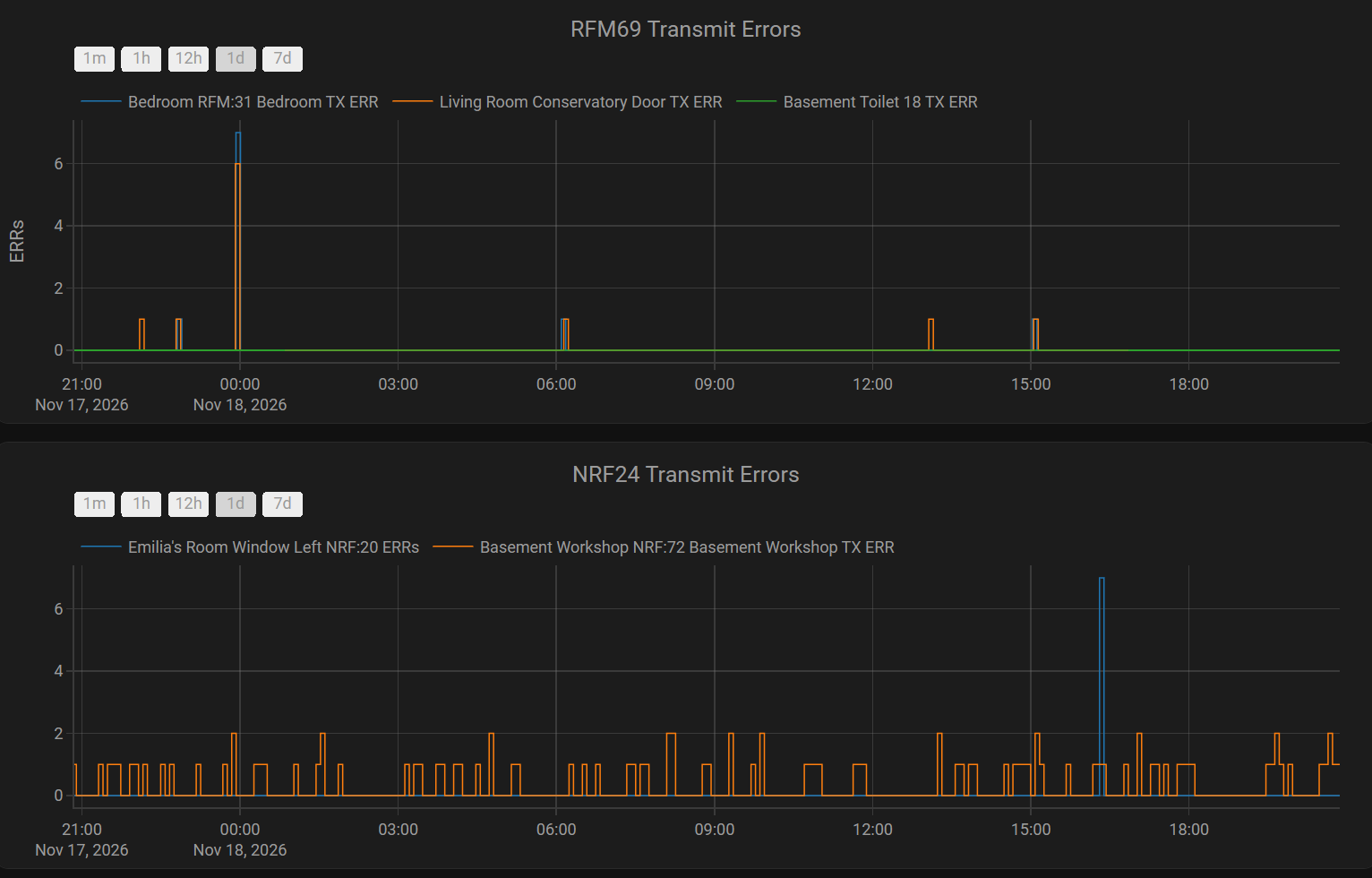
-
@eiten Thanks for your SX1262 library. I have been using it with some tweaks to Run WIO-E5 modules (STM32WL LoRa). Great for range. Still working of the battery consumption. I love the NRF52 series for shorter ranges.
Looked at Zephyr, but as you say, the learning curve is a bit steep. Can it give you OTA programming? That is one thing I really would like.@nagelc Glad to hear someone else is actually putting the SX126x libs to good use!
As for OTA: it depends on which stack you're asking about. In Zephyr, I have OTA running smoothly across several transports—Thread (UDP), CAN, and even over LoRaWAN for a sensor 4 km away on the other side of the valley. Thanks to MCUboot, that works rock-solid.
With MySensors on nRF52, however, OTA doesn't work out of the box—the stock OTA bootloaders (DualOptiboot and MYSBootloader) are AVR-only. Basically, you'd have two options there:
- Use a BLE bootloader (Nordic/Adafruit): You'd need to add a virtual switch or a physical button to write the magic byte into the
GPREGRETregister and reboot into DFU mode, since MySensors normally runs the radio in ESB (nRF24-compatible) mode rather than BLE. - Custom flash-based OTA: Thanks to the 1 MB of flash on the nRF52840, you could theoretically write a custom bootloader that speaks the MySensors OTA protocol, or integrate MCUboot and adapt the MySensors OTA routines to write the incoming image into
slot1(plus adjust the application start offset and generate the MCUboot image header).
The real question is whether that's worth the effort just to stay in the Arduino ecosystem. Porting to Zephyr might actually be the cleaner path: you get full RTOS capabilities out of the box, and thinking one step further, it also opens up the LoRa/LoRaWAN route—especially since STM32WL-based silicon (like the Wio-E5 mini or similar modules) is now readily available on affordable, "Arduino-like" dev boards with solid Zephyr support. That said, purely out of nostalgia, I have to admit I'm still a bit tempted to write a custom nRF52 bootloader for MySensors anyway, even if the limited range of nRF24 mode makes it hard to justify from a purely practical standpoint.
- Use a BLE bootloader (Nordic/Adafruit): You'd need to add a virtual switch or a physical button to write the magic byte into the
-
@nick-willis Thanks for the plots—I won't ask what kind of sensors you've got running in the bedroom and the toilet! :)
Things look a bit better here in Switzerland—local shops like bastelgarage.ch usually have the CubeCells in stock for around CHF 22. That said, I have to admit I normally order them straight from China for $7–9.
As I mentioned in my last post: if I were starting a brand-new project from scratch today, I'd probably take a close look at the STM32WL55 instead. The modules are pretty inexpensive—and if you want to stick with the Arduino ecosystem, there is official STM32duino support (including Sub-GHz / LoRaWAN libraries), though I have to admit I've never actually tried it myself, especially not together with MySensors (I run mine under Zephyr).
If you're genuinely interested in trying out the CubeCells, I'm pretty sure I still have a few lying around—if you'd like, I can drop a board in the mail and send it up north to you.
-
Hi I'm also a long time MySensors person who has gradually tried various radio systems to try to achieve a situation where everything works 100% of the time to not annoy the 'users' too much!
I still use MySensors for a few things including 'critical' tasks. I expanded on the library a bit to provide sensors that show how many NACKS my nodes get and it was certainly interesting.
I keep assessing to decide if I should cease MySensors since it doesn't seem to be going anywhere lately but I have a lot of hardware still around...
But up against ESPHome it is 'harder' and lacks over the air updates (that actually work that is). However I don't want wifi devices so I avoided ESPHome until OpenThread was added and have now expanded into that too.To compare the radios I check my MySensors error rate sensors against 'Unavailable' time in Home Assistant for Thread and others....
So NRF24 radios is only good for passive sensors like temperature as the error rate is pretty high especially in my basement. I don't deploy these nodes anymore unless something that doesn't matter much to use up old hardware.
RFM69 is really good and will out perform Zigbee and Thread in terms of missed messages. But hardware can be tricky:- Most Arduinos run at 5v so require level shifting for the most part to work with the 3.3v radio. And because of memory requirements it is better to use a Mega not Uno and others unless you just need a single sensor (then I can use the 3.3v Mini and the nice base PCB I found on this forum somewhere).
- I did find an Arduino shield for Mega with the RFM69 radio on it. Perfect it is and makes the hardware simple but that shield is very hard to find and was expensive for what it was.
So I've moved onto using ESP32-C6 boards with OpenThread on ESPHome. Generally its worked well, the ESPHome UI is now great, has over the air updates and is a mesh network so everything I add is making it better.
It's still unreliable at times however and sometimes just all the nodes go down for a few minutes before coming back. This never happens on MySensors nodes.So for now I still run a MySensors dual radio Sensebender gateway (so beta version of MySensors to support dual radio) and use what hardware I have left without investing in anything new.
I'd probably go for it more if the RFM hardware were easier (perhaps it is and I don't know it) and MySensors was moving forward again.. There's only a few hundred of us left using the Home Assistant MySensors integration now!@Nick-Willis Is your NACK code available on github somewhere? Sounds really useful.


Hello! It looks like you're interested in this conversation, but you don't have an account yet.
Getting fed up of having to scroll through the same posts each visit? When you register for an account, you'll always come back to exactly where you were before, and choose to be notified of new replies (either via email, or push notification). You'll also be able to save bookmarks and upvote posts to show your appreciation to other community members.
With your input, this post could be even better 💗
Register Login