
Gas (Co2) sensors on batteries
-
-
@epierre There is a french company manufacturing a weather station called Netatmo. They manage to implement Co2 sensor battery powered. I wonder what Co2 sensor they have used. Do you know by any chance?
@alexsh1 the Co2 sensors in the Netatmo modules are the main reason I got the Netatmo system in the first place. The price is high but the performance is accordingly.
Anyhow I'm surprised that no one has opened a Netatmo indoor module to see whats inside. The only info I could find is that they use some kind of optical sensor.
-
@korttoma I have Netatmo myself and yes it is a good premium product. The problem comes if you want to add a new module - it is a whopping Euro 60 or around that. I have MQ-135 with mysensors for probably around Euro 10-12 and it is working really well with Domoticz and push notifications. Why paying more? Besides, I like building and programing things myself.
OK, I found an interesting module - http://www.co2meter.com/products/cozir-5-100-co2-sensor
Ultra-low power: 3.3V, 3.5mW
Peak current only 33mAIf I find it on aliexpress, this could be a good sensor for a battery powered node.
PS I just saw prices: COZIR 100% CO2 for $109.00! Crazy! Back to my search...
-
@arraWX I wonder in your setup how long you can run the Co2 sensor on 4 x 1.5V batteries. Assuming everything goes to sleep for 5-10mins and a Co2 measurement takes only 10 seconds.
I have been trying to keep voltage at 3.3V (2 x 1.5V batteries) running booloader @ 8Mhz or below.
-
@epierre There is a french company manufacturing a weather station called Netatmo. They manage to implement Co2 sensor battery powered. I wonder what Co2 sensor they have used. Do you know by any chance?
@alexsh1 said:
@epierre There is a french company manufacturing a weather station called Netatmo. They manage to implement Co2 sensor battery powered. I wonder what Co2 sensor they have used. Do you know by any chance?
haem... http://www.aragonvalley.com/en/assessment-netatmo-weather-station/
calibration has a cost, but too few found it useful to check if this was worth it... Many kickstarter propose readings of gases without calibration, they provide their own indexes... I've proved many times that you could be alarmed of too much gas just by restarting a sensor, or break a perfume bottle nearby and why would your CO2 raise so much ? only because there are many organic particles in the air, full stop.
-
@epierre - I understand, but paying $109 for a sensor is just ridiculous. I would spend on a node project about $10-20 per node and paying 10 times more for the sensor is just not right in my opinion.
Anyway back to google searching for a reasonably priced alternative.
How do you find mh-z14? Accurate? -
@epierre - I understand, but paying $109 for a sensor is just ridiculous. I would spend on a node project about $10-20 per node and paying 10 times more for the sensor is just not right in my opinion.
Anyway back to google searching for a reasonably priced alternative.
How do you find mh-z14? Accurate?@alexsh1 said:
@epierre - I understand, but paying $109 for a sensor is just ridiculous. I would spend on a node project about $10-20 per node and paying 10 times more for the sensor is just not right in my opinion.
Anyway back to google searching for a reasonably priced alternative.
How do you find mh-z14? Accurate?sure cost can be an issue, but you get what you pay for in the end... people say netatmo expensive but they have chosen their quality level, as many kickstarters projects...
MH-Z14 is very fine, you can see it on Davide Gironi posts where he compared both technology.
cooking hacks has calibrated CO or O3 gas sensor $200 ...too much for me too...
-
just a glimpse of where CookingHacks / libellium is now going: https://www.cooking-hacks.com/shop/sensors/gas
-
-
The circuit diagram that I posted above did not show communication lines between the K-30 and the sensebender. These are included here:
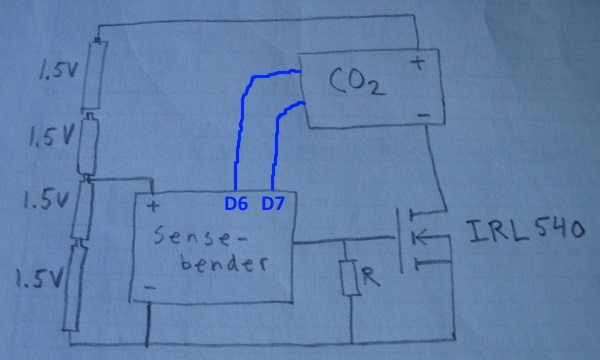
However, I now realise that the K-30 and the sensebender cannot be connected this way because the sensebender (ATmega328P) digital inputs do not accept voltages higher than Vcc + 0.5V.
Does anyone have a suggestion how this problem can be solved?
@alexsh1 As you can see my experiments with powering the K-30 from batteries are not going that well...
-
The circuit diagram that I posted above did not show communication lines between the K-30 and the sensebender. These are included here:
However, I now realise that the K-30 and the sensebender cannot be connected this way because the sensebender (ATmega328P) digital inputs do not accept voltages higher than Vcc + 0.5V.
Does anyone have a suggestion how this problem can be solved?
@alexsh1 As you can see my experiments with powering the K-30 from batteries are not going that well...
@arraWX OK, found an excellent sensor. The only problem is price - one has to pay for a precise sensor with ultra low power consumption.
Linearity:Nonlinear (% F.S.)
Sluggish:None (% F.S.)
Repeatability:Standard (% F.S.)
Sensitivity:High sensitivity
Drift:No
Resolution:High Resolution
MH-Z19-W01-GSS-COZIRCarbon dioxide sensor
Ultra-low-power carbon dioxide sensor
MH-Z19-W01-GSS-COZIR carbon dioxide sensor (hereinafter referred to as COZIR) COZIR is an ultra-low power consumption (3.5mW), high-precision carbon dioxide sensor, ideal for battery-powered portable instruments and equipment. Based on IR LED, detector technology and patented optical detection cavity, so COZIR become the lowest power NDIR sensor, optional temperature and humidity testing. GSS is carbon dioxide detection infrared LED leader in the field, COZIR GSS company is the third generation of products.
COZIR Ambient measurable range 0 ~ 2000PPM, 0 ~ 5000ppm and 0 to 1 percent, and is suitable for building control such as gardening and other occasions.
Ultra-low-power 3.5MW
Measuring range: 0 to 1%
Low noise measurement (<10PPM)
3.3V power supply
peak current is only 33 mA
Temperature and humidity output optional -
@arraWX OK, found an excellent sensor. The only problem is price - one has to pay for a precise sensor with ultra low power consumption.
Linearity:Nonlinear (% F.S.)
Sluggish:None (% F.S.)
Repeatability:Standard (% F.S.)
Sensitivity:High sensitivity
Drift:No
Resolution:High Resolution
MH-Z19-W01-GSS-COZIRCarbon dioxide sensor
Ultra-low-power carbon dioxide sensor
MH-Z19-W01-GSS-COZIR carbon dioxide sensor (hereinafter referred to as COZIR) COZIR is an ultra-low power consumption (3.5mW), high-precision carbon dioxide sensor, ideal for battery-powered portable instruments and equipment. Based on IR LED, detector technology and patented optical detection cavity, so COZIR become the lowest power NDIR sensor, optional temperature and humidity testing. GSS is carbon dioxide detection infrared LED leader in the field, COZIR GSS company is the third generation of products.
COZIR Ambient measurable range 0 ~ 2000PPM, 0 ~ 5000ppm and 0 to 1 percent, and is suitable for building control such as gardening and other occasions.
Ultra-low-power 3.5MW
Measuring range: 0 to 1%
Low noise measurement (<10PPM)
3.3V power supply
peak current is only 33 mA
Temperature and humidity output optional -
@alexsh1 at that prize you could buy a few Netatmo additional indoor modules. Might be that the sensor you suggested would be allot more accurate though.
@korttoma Yes, I know what you are saying, but Netatmo is not precise. I have MH-Z14 showing 750ppm and Netatmo 1100ppm, for example. I think Netatmo is using index.
All I can say that a calibrated low power CO2 sensor is very expensive. Probably for a home use you do not need to know the exact number. Personally, I have MH-Z14 - it is reasonably expensive and very accurate.
-
-
-
@korttoma I got mine a month ago from China. I think it can be used with batteries, but it has to be something like 18650 3000mAh to last longer.
@alexsh1 I was not planing on using it on batteries'. I now have an MQ-2 sensor in the ventilation fresh air intake to detect smoke but it has proven to be unreliable so I thought id try the MH-Z14 instead. Sometimes smoke comes in through the ventilation an then I want it to turn off automatically.
- Tomas
-
@alexsh1 I was not planing on using it on batteries'. I now have an MQ-2 sensor in the ventilation fresh air intake to detect smoke but it has proven to be unreliable so I thought id try the MH-Z14 instead. Sometimes smoke comes in through the ventilation an then I want it to turn off automatically.
-
-
I received my MH-Z14 yesterday hocked it up on a breadboard to test it and it seems to be working as expected. Now I need a more permanent setup so I can test and compare to a Netatmo indoor module. I may add an SI7021 to the same node.



Hello! It looks like you're interested in this conversation, but you don't have an account yet.
Getting fed up of having to scroll through the same posts each visit? When you register for an account, you'll always come back to exactly where you were before, and choose to be notified of new replies (either via email, or push notification). You'll also be able to save bookmarks and upvote posts to show your appreciation to other community members.
With your input, this post could be even better 💗
Register Login