
Node running on supercaps and a solar panel.
-
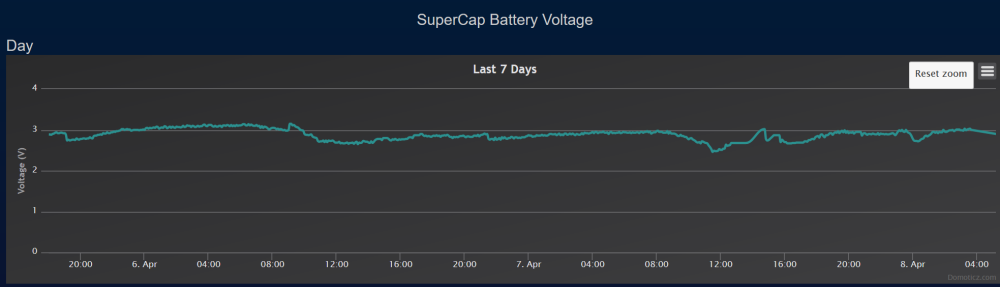
@gohan However, in the nutshell you are right. With a small solar battery (53mm x 30mm, 5V 0.15W), this is what I get:
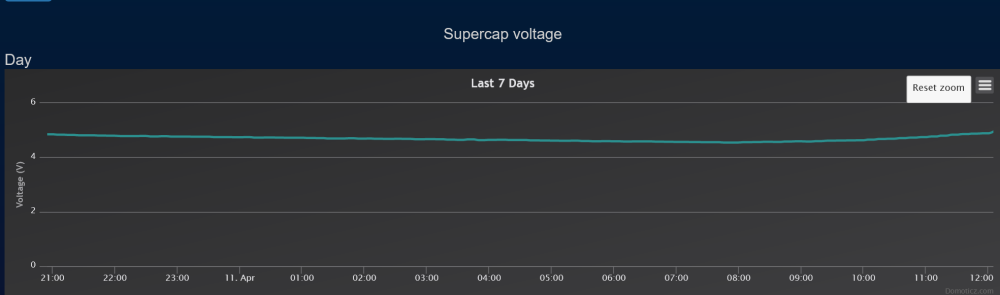
and today is an extremely cloudy day (no sun at all). Harvesting works really well.
I implemented a voltage divider yesterday with 1.8M / 470k resistors. Now I can monitor voltage in Domoticz:
voltage at 22:00 yesterday - 4.797V
voltage at 12:00 today - 4.887V@alexsh1 I use a total of 20F 5.5V supercaps and they discharge much more during night most likely because the buck/boost converter is not very low power and supercaps are chinese quality, but as far as I can get 36/48h of runtime without solar charge I should be fine
-
@alexsh1 I use a total of 20F 5.5V supercaps and they discharge much more during night most likely because the buck/boost converter is not very low power and supercaps are chinese quality, but as far as I can get 36/48h of runtime without solar charge I should be fine
@gohan As you may see from the graph above my self discharge + sleep/tx consumption during the night dropped voltage from 4.851V at 21:00 (I charged supercaps initially) to 4.549V at 08:00. This is the rate of about 0.3V per 12 hours, I estimate that I have around 10 days without any charging before I run out of energy.
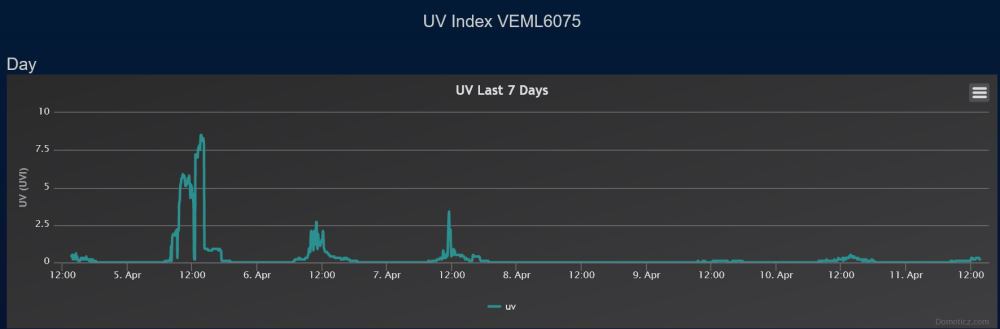
It took 4h 25mins on a cloudy day (see another graph) to get 2x10F in series supercaps fully charged to 5.047V
-
You are using a very efficient circuit and good quality supercaps, I loose about 1V in 12 hours
-
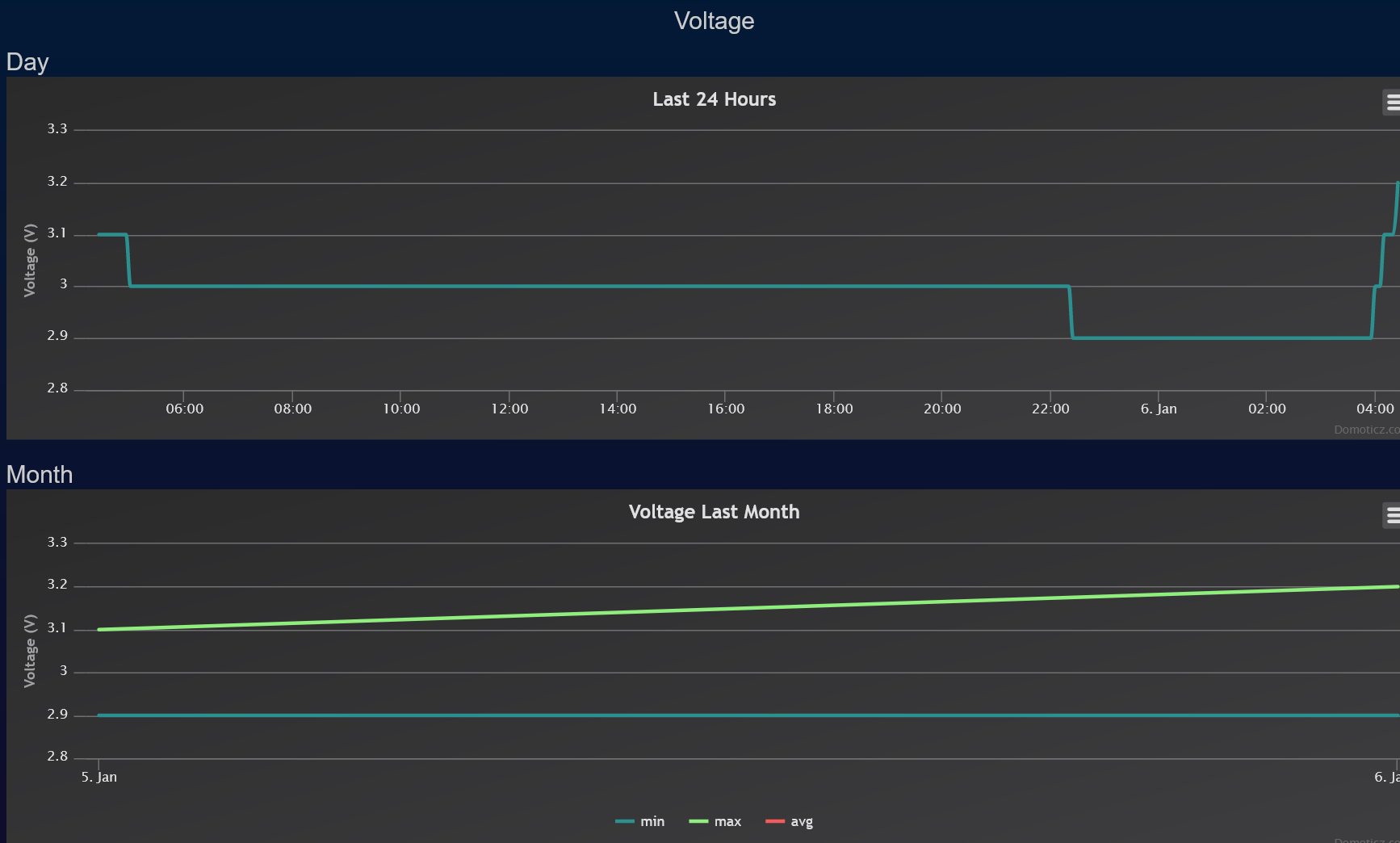
@neverdie I have already all that. I am using this node https://www.openhardware.io/view/76/Stamp-size-MySensor-node
Let's see when I have final results. I have this supercap AVX 30F with ESR = 0.02ohm (vs Vishay 15F ESR=1.8Ohm used with Moteino and BQ25570 at lowpowerlab)
EDIT: Another point is signing/encryption. This would affect supercap charge as the node would be transmitting more data to GW.
@alexsh1 said in Node running on supercaps and a solar panel.:
I am using this node https://www.openhardware.io/view/76/Stamp-size-MySensor-node
If anything, you should have an advantage, since the nRF24L01 transmits at a faster bitrate, and using significantly less Tx power also.
-
Are you using the passive mode option for mysensors? If not, that could be part of what's draining you.
@neverdie said in Node running on supercaps and a solar panel.:
passive mode option for mysensors
I did notice there is an option:
#define MY_PASSIVE_NODEWhat is the passive node option please?
I am not using it and yet I do not have any problems with drainingEDIT: I see now
All transport-related checks and safety-mechanisms are disabled. Requires that MY_NODE_ID is set, MY_PARENT_NODE_ID and MY_PARENT_NODE_IS_STATIC are optional. Singing, registration, and OTA FW update are disabled. -
@neverdie said in Node running on supercaps and a solar panel.:
passive mode option for mysensors
I did notice there is an option:
#define MY_PASSIVE_NODEWhat is the passive node option please?
I am not using it and yet I do not have any problems with drainingEDIT: I see now
All transport-related checks and safety-mechanisms are disabled. Requires that MY_NODE_ID is set, MY_PARENT_NODE_ID and MY_PARENT_NODE_IS_STATIC are optional. Singing, registration, and OTA FW update are disabled. -
It sounds like you're happy already. Good luck!
-
If I remeber well, passive node is used when you have a very tiny node, with low memory that only send data one way, like RF433
@gohan OK, but I think the key here is to get consumption down to something meaningful - 5uA or something. The only down side when not using a passive node is that if GW is disconnected, node would not go to sleep, but will be trying to connect to GW. define MY_TRANSPORT_UPLINK_CHECK_DISABLED would disable the node sending more than MY_TRANSPORT_STATE_RETRIES times message
-
even if it drains the battery when the GW is dead, it is no big deal as you just have to wait for some sunlight
-
For this type of comparison, I think you're better off charging up the supercap in a standardized way and then running with the solar panel disconnected. Otherwise, how recently and how long the supercap was charged to full capacity can affect the rate of discharge.
-
Maybe it has to do with the harvesting chip. My graph looks like a sawtooth from day to day.
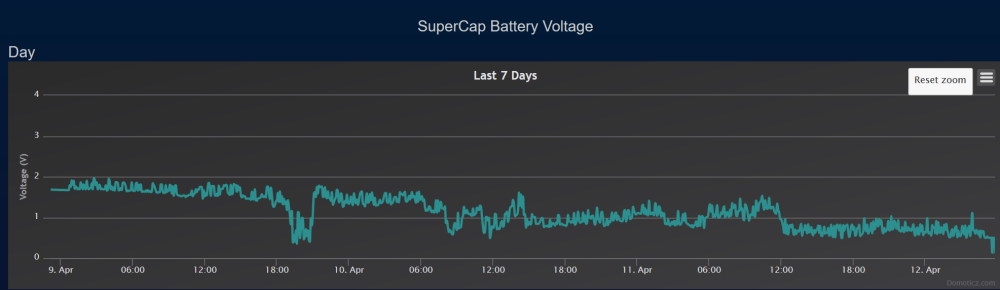
@gohan there is no harversting - this is just 30F cap connected to a node.
I have two setups:- BQ25570 + 2x10F supercaps in series and a small solar panel connected to a node. This is an excellent setup which can last for days without recharging
- 30F cap connected directly (initially I tried it via mcp1640) to a different node. The above graphs are from this setup.
I am re-measuring it them right now as the code was wrong.
-
@gohan Well, the point is that signing does take more tx time. Therefore, voltage does drop upto 0.2-0.3V.
I am not sure about irregularities though
@alexsh1 with signing you also get message bursts. Not only is the max size data transmitted for every signed message, two more messages are exchanged; a nonce request (small) and a nonce (big).
Do you feel secure today? No? Start requiring some signatures and feel better tomorrow ;)

Hello! It looks like you're interested in this conversation, but you don't have an account yet.
Getting fed up of having to scroll through the same posts each visit? When you register for an account, you'll always come back to exactly where you were before, and choose to be notified of new replies (either via email, or push notification). You'll also be able to save bookmarks and upvote posts to show your appreciation to other community members.
With your input, this post could be even better 💗
Register Login