Air quality node
-
Well, having played around now with both the HPNA and the PMS5003, I'm finding the PMS5003 to be more interesting. At least in my environment, there aren't very many of the larger particles, whereas there seems to be a lot of activity in the very small particle range. Even though the PMS5003 is uncalibrated, I can still look at relative measurements and make comparisons. It just seems more sensitive to what's going on. For larger particles, the HPNA is, I think, the better choice. So, perhaps the two complement one another.
-
These academics came up with a different, easier to calculate indoor air quality index:
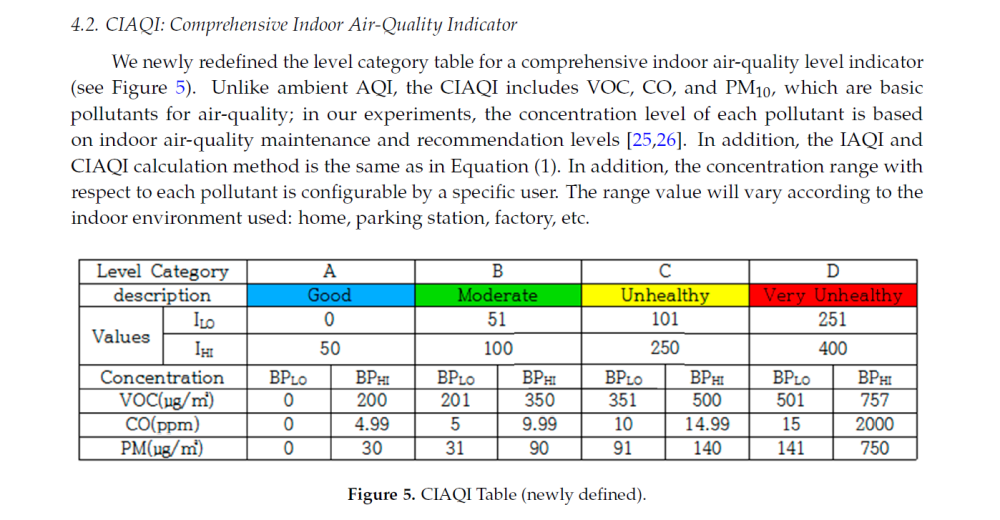
https://res.mdpi.com/sustainability/sustainability-08-00881/article_deploy/sustainability-08-00881.pdf?filename=&attachment=1and that's good enough for me. If anyone here has found a better way, please post.
Interestingly, my sensors are good enough that this morning they picked up a significant spike in pollutants indoors after my gardener cut the grass outdoors with his gasoline powered lawnmower. They actually linger for a lot longer than I would have thought.
I'm not going to buy any more BME680's. I think the AGP30's provide easier to interpret data.
@neverdie said in Air quality node:
I'm not going to buy any more BME680's. I think the AGP30's provide easier to interpret data.
Have you tried using the Bosch software to manage the sensor and compute the raw values ?
-
@neverdie said in Air quality node:
I'm not going to buy any more BME680's. I think the AGP30's provide easier to interpret data.
Have you tried using the Bosch software to manage the sensor and compute the raw values ?
-
@neverdie said in Air quality node:
@nca78 Not as yet. Have you?
No I have only one and I didn't even solder it yet.
-
These academics came up with a different, easier to calculate indoor air quality index:
https://res.mdpi.com/sustainability/sustainability-08-00881/article_deploy/sustainability-08-00881.pdf?filename=&attachment=1and that's good enough for me. If anyone here has found a better way, please post.
Interestingly, my sensors are good enough that this morning they picked up a significant spike in pollutants indoors after my gardener cut the grass outdoors with his gasoline powered lawnmower. They actually linger for a lot longer than I would have thought.
I'm not going to buy any more BME680's. I think the AGP30's provide easier to interpret data.
@neverdie same with me. I gave up using the BME680 for the same reasons you have. It is cheap and offers 4 readings in one chip but can not be really used with a small microcontroller like arduino nano or the sensebender micro as Bosch does all the drift compensation using software that requires large memory.
I believe theis chip was meant to be used in smartphones instead of homeautomation sensors.
I will order a SGP30 today. Thanks for pointing into that direction...
Gr Heinz -
@neverdie same with me. I gave up using the BME680 for the same reasons you have. It is cheap and offers 4 readings in one chip but can not be really used with a small microcontroller like arduino nano or the sensebender micro as Bosch does all the drift compensation using software that requires large memory.
I believe theis chip was meant to be used in smartphones instead of homeautomation sensors.
I will order a SGP30 today. Thanks for pointing into that direction...
Gr Heinz -
@gohan said in Air quality node:
Is an esp8266 powerful enough for a bme680?
Yes it's in the list here :
https://www.bosch-sensortec.com/bst/products/all_products/bsecThen you have to follow instructions to use BSEC with Arduino :
https://github.com/BoschSensortec/BSEC-Arduino-library -
FWIW, I also observed self heating problems with it if running at the default Adafruit sketch. Reported temperature was higher than it actually was. So, again, without guidance as to how much it should be pre-heated or how often it needs to be sampled.... If anyone reading this happens to know, please post.
-
@heinz FYI, you'll want to pair the SGP30 with a BME280 (or whatever your preferred TH sensor is) for temperature and humidity compensation.