
💬 Battery Powered Sensors
-
@evb I can't see it clearly on the picture but this seems like a reed sensor to me.
Well, usually the transmitter does not have to be at some specific location. There are reed sensors based on magnets (connected with 2 wires to the transmitter). As soon as the magnets are close to each other, a small current flows (or vice versa). They are just attached to the window/door with some sticky adhesive. The transmitter can well be a meter away.I can say from experience with Atmega328P, that when drawing ~24uA in sleep and sending every 30 seconds a single battery lasts ~ 1 year.
This can all be calculated (rough estimates).
A basic online calculator for this kind of stuff can be found @ https://oregonembedded.com/batterycalc.htm@canique no, the purpose of the node is to know when the door is locked by the bolt, not only closed. What you see are simply 2 battery springs and the bolt of the lock closes the contact.
I can move the node more upwards the door frame (and I will do it if the radio connection is still not reliable with the repeater).
In order to preserve domestic peace, I placed the nodes in the door frame, invisible when the door is closed: no visible dangling wires and no visible boxes.Maybe an idea for a MK3 version of your board as wide as the RFM69HW ;-)
-
Hello
I created battery powered node running on 2x 1.5V AA batteries with DC-DC step up booster. But the step up booster makes audible noise (very tiny beeping) when the radio is transmitting.
It is this step up booster https://www.laskarduino.cz/step-up-boost-menic-s-me2108-33v-480ma/
Is there any way to solve it?
Thanks
Tomas
-
Hello
I created battery powered node running on 2x 1.5V AA batteries with DC-DC step up booster. But the step up booster makes audible noise (very tiny beeping) when the radio is transmitting.
It is this step up booster https://www.laskarduino.cz/step-up-boost-menic-s-me2108-33v-480ma/
Is there any way to solve it?
Thanks
Tomas
-
Hello
I created battery powered node running on 2x 1.5V AA batteries with DC-DC step up booster. But the step up booster makes audible noise (very tiny beeping) when the radio is transmitting.
It is this step up booster https://www.laskarduino.cz/step-up-boost-menic-s-me2108-33v-480ma/
Is there any way to solve it?
Thanks
Tomas
@tssk There is a name for this noise: it is called "coil whine". In German "Spulenfiepen". It stems from the inductor - I wouldn't know any way to get rid of it.
My mainboard or power supply on my PC creates similar noise when the CPU goes in certain doze modes. -
Hello
I created battery powered node running on 2x 1.5V AA batteries with DC-DC step up booster. But the step up booster makes audible noise (very tiny beeping) when the radio is transmitting.
It is this step up booster https://www.laskarduino.cz/step-up-boost-menic-s-me2108-33v-480ma/
Is there any way to solve it?
Thanks
Tomas
@tssk I heard that people got rid of or at least reduced the coil whine by coating the windings of an audible inductor with non-conductive materials like epoxy resin or even hot glue to reduce the vibrations.
Of course, I woudn't mess with expensive PC hardware, but I guess there's not much to loose with a cheap boost module like this.
-
@tssk I heard that people got rid of or at least reduced the coil whine by coating the windings of an audible inductor with non-conductive materials like epoxy resin or even hot glue to reduce the vibrations.
Of course, I woudn't mess with expensive PC hardware, but I guess there's not much to loose with a cheap boost module like this.
Thanks all for the response.
@BearWithBeard I will start googling about such solution.
Do you think using different step up booster might help? Could someone recommend something?
-
I am biased since I run that website but I can recommend https://www.canique.com/boost
I've never heard it making noise. -
I am biased since I run that website but I can recommend https://www.canique.com/boost
I've never heard it making noise. -
@canique Thanks for the recommendation if I do not find fix for the model I am using I will consider buying it.
I will try to hot glue the side with the coil as I found on some pages. Any ideas / warnings? :)
@tssk Most of these boosters have a grounded backplane, perhaps trying to re-orientate the inductor so the backplane acts a shield to direct RF may be an option to try ?
If the noise in on the power line I've heard of some managing to block it with a VR circuit if the voltage drop is acceptable, but never tried it. -
@tssk Most of these boosters have a grounded backplane, perhaps trying to re-orientate the inductor so the backplane acts a shield to direct RF may be an option to try ?
If the noise in on the power line I've heard of some managing to block it with a VR circuit if the voltage drop is acceptable, but never tried it.@zboblamont It is not electrical noise but audio noise I can hear. Sorry if I use improper terms.
-
@zboblamont It is not electrical noise but audio noise I can hear. Sorry if I use improper terms.
@tssk My misconception.
-
@zboblamont It is not electrical noise but audio noise I can hear. Sorry if I use improper terms.
-
@tssk First things that comes to my mind is that you might draw too much power (but no expert) did you measure it?
So I used hot glue and it is better. Now I can hear the squeal only when I put my ear directly to the PCB. Thanks for the tips.
@TheoL I have no idea how to measure that.
I noticed that when the radio is transmitting the LED on the Arduino Pro Mini (not the power one) starts blinking very tiny. I still plan to remove the power LED and voltage regulator from the Arduino.
-
So I used hot glue and it is better. Now I can hear the squeal only when I put my ear directly to the PCB. Thanks for the tips.
@TheoL I have no idea how to measure that.
I noticed that when the radio is transmitting the LED on the Arduino Pro Mini (not the power one) starts blinking very tiny. I still plan to remove the power LED and voltage regulator from the Arduino.
-
@tssk the led blinks because it is connected to the same pin as the SCK pin used by the nrf24.
@mfalkvidd You are right :) I did not know that.
SPI: 10 (SS), 11 (MOSI), 12 (MISO), 13 (SCK). These pins support SPI communication, which, although provided by the underlying hardware, is not currently included in the Arduino language.
LED: 13. There is a built-in LED connected to digital pin 13. When the pin is HIGH value, the LED is on, when the pin is LOW, it's off.https://www.arduino.cc/en/pmwiki.php?n=Main/ArduinoBoardProMini
Should I remove the LED to save power? Or it is marginal?
-
@mfalkvidd You are right :) I did not know that.
SPI: 10 (SS), 11 (MOSI), 12 (MISO), 13 (SCK). These pins support SPI communication, which, although provided by the underlying hardware, is not currently included in the Arduino language.
LED: 13. There is a built-in LED connected to digital pin 13. When the pin is HIGH value, the LED is on, when the pin is LOW, it's off.https://www.arduino.cc/en/pmwiki.php?n=Main/ArduinoBoardProMini
Should I remove the LED to save power? Or it is marginal?
-
@mfalkvidd Thanks.
-
Hello
I would like to ask for help with passive battery powered node I created with following components:
- Arduino pro mini 8MHz - voltage regulator and power LED removed
- SX1276 based 868MHz LoRa radio
- BME680 sensor
- DC-DC 3.3V step-up booster
I created a battery measuring circuit according to scheme on this page ( https://www.mysensors.org/build/battery ).
The problem is the two fresh new AA batteries lasted less than 14 days and stopped when the circuit measured 36%.
2x1.5V AA Aerocell following start and end values:
09.02.2021 16:45 102% (start) : 1.610V and 1.610V
22.02.2021 04:15 36% (end) : 1.001V and -0.150V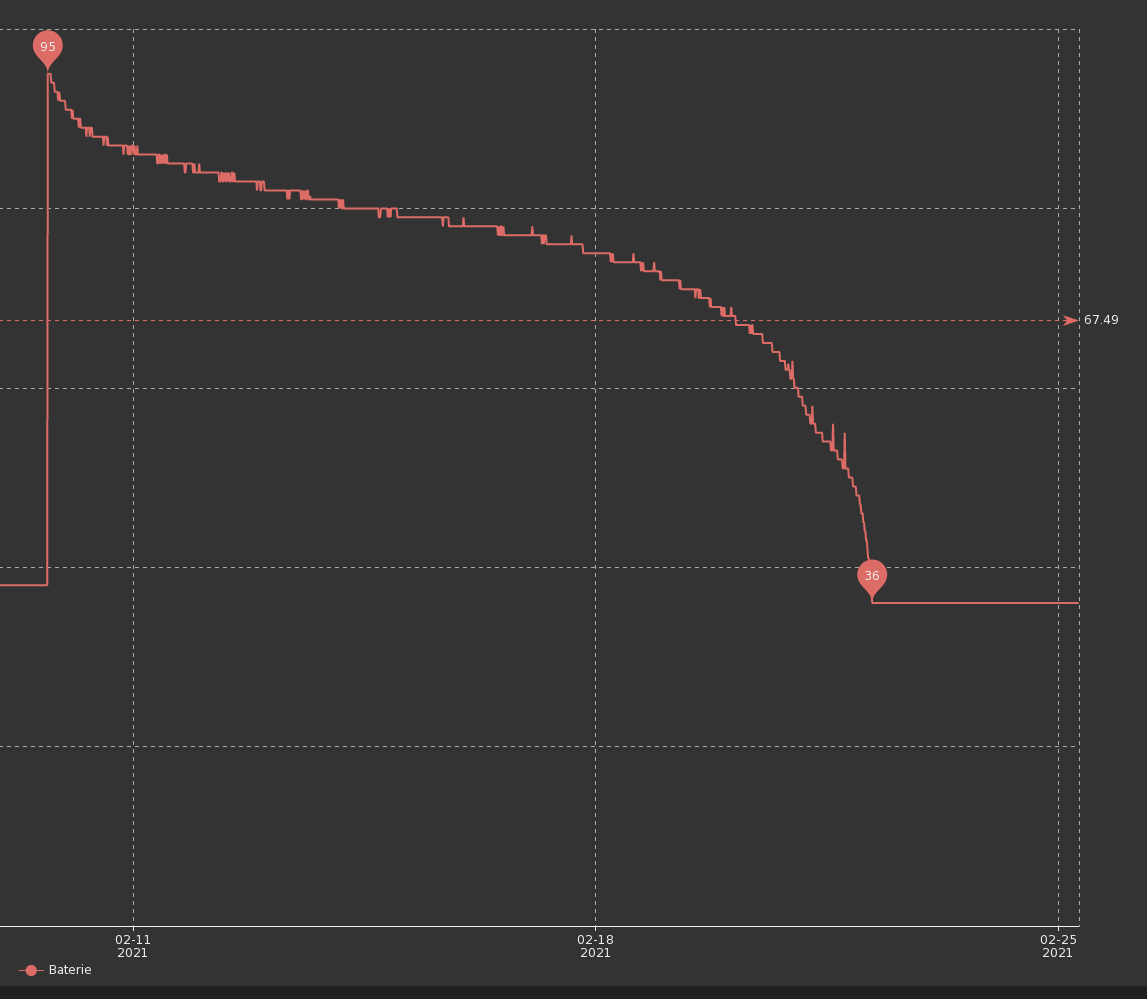
The node code is sleeping for 6 minutes between each sensing and sending data.
sleep(180000);14 days seems very short to me. Is that normal? Is there something I can to make it last longer?
Thanks
-
Hello
I would like to ask for help with passive battery powered node I created with following components:
- Arduino pro mini 8MHz - voltage regulator and power LED removed
- SX1276 based 868MHz LoRa radio
- BME680 sensor
- DC-DC 3.3V step-up booster
I created a battery measuring circuit according to scheme on this page ( https://www.mysensors.org/build/battery ).
The problem is the two fresh new AA batteries lasted less than 14 days and stopped when the circuit measured 36%.
2x1.5V AA Aerocell following start and end values:
09.02.2021 16:45 102% (start) : 1.610V and 1.610V
22.02.2021 04:15 36% (end) : 1.001V and -0.150VThe node code is sleeping for 6 minutes between each sensing and sending data.
sleep(180000);14 days seems very short to me. Is that normal? Is there something I can to make it last longer?
Thanks
@tssk could you post your sketch? Some things that could draw power:
- bme not turned off properly when sleeping the node
- lora transmits can take a long time, depending on which settings are used
Which booster are you using? A good booster will use almost no power when the node is sleeping. A bad booster will consume almost as much as if the node was not sleeping, so the performance of the booster will make a huge difference.
-
Hello
I would like to ask for help with passive battery powered node I created with following components:
- Arduino pro mini 8MHz - voltage regulator and power LED removed
- SX1276 based 868MHz LoRa radio
- BME680 sensor
- DC-DC 3.3V step-up booster
I created a battery measuring circuit according to scheme on this page ( https://www.mysensors.org/build/battery ).
The problem is the two fresh new AA batteries lasted less than 14 days and stopped when the circuit measured 36%.
2x1.5V AA Aerocell following start and end values:
09.02.2021 16:45 102% (start) : 1.610V and 1.610V
22.02.2021 04:15 36% (end) : 1.001V and -0.150VThe node code is sleeping for 6 minutes between each sensing and sending data.
sleep(180000);14 days seems very short to me. Is that normal? Is there something I can to make it last longer?
Thanks
@tssk Sending 240 messages a day is quite a lot for a battery node. I think you will need higher capacity batteries with that frequency of sending (is it really essential to send that often I wonder?).
Anyway, I am also testing battery nodes and as far as I can see the lora and bme are likely taking a lot of power. They must be 'put to sleep' as much as possible. AFAIK lora is an abbreviation of 'long range' and therefore means 'more power'. Can you test the current drawn by just the radio in sleep and transmitting?
Also, bootloader - I highly recommend using the minicore bootloader with internal 8MHz, bod as you wish (I ususally disable) and try again. My sleeping nodes use less than 5uA in sleep and I am trying to get that even lower this week.
Also check the value of pull-upresistors on the boards, they can be on the low side and perhaps better with higher value external ones (something I hope to test tomorrow as it happens).
Also temperature and humidity will have an effect. I put one test node on a colder NE facing window which has slept all the time except a twice daily battery check and send value only if changed. It is the only node to have changed from 100% to 99% in a week, so the colder window is clearly having an effect on the battery life in this situation.
As @mfalkvidd implied I would get rid of the stepup booster if at all possible, they are not so efficient and can produce a lot of noise on the power line. Can you go to 3xAA batteries? What about an 18650 li-on or two in parallel?
Finally check solder joints. A dry joint or cold joint may look OK but measure them with a meter just to make sure.





Hello! It looks like you're interested in this conversation, but you don't have an account yet.
Getting fed up of having to scroll through the same posts each visit? When you register for an account, you'll always come back to exactly where you were before, and choose to be notified of new replies (either via email, or push notification). You'll also be able to save bookmarks and upvote posts to show your appreciation to other community members.
With your input, this post could be even better 💗
Register Login