Skip to content
  • MySensors
  • OpenHardware.io
  • Categories
  • Recent
  • Tags
  • Popular
Skins
  • Light
  • Brite
  • Cerulean
  • Cosmo
  • Flatly
  • Journal
  • Litera
  • Lumen
  • Lux
  • Materia
  • Minty
  • Morph
  • Pulse
  • Sandstone
  • Simplex
  • Sketchy
  • Spacelab
  • United
  • Yeti
  • Zephyr
  • Dark
  • Cyborg
  • Darkly
  • Quartz
  • Slate
  • Solar
  • Superhero
  • Vapor

  • Default (No Skin)
  • No Skin
Collapse
Brand Logo
  1. Home
  2. Hardware
  3. 110v-230v AC to Mysensors PCB board

110v-230v AC to Mysensors PCB board

Scheduled Pinned Locked Moved Hardware
269 Posts 63 Posters 272.4k Views 68 Watching
  • Oldest to Newest
  • Newest to Oldest
  • Most Votes
Reply
  • Reply as topic
Log in to reply
This topic has been deleted. Only users with topic management privileges can see it.
  • P Porky6666

    Another source :

    50Pieces/Lot JRC-21F 4100 3V DC 6 Pins Miniature PCB Relay Brand New
    http://s.aliexpress.com/MNVv2myE

    GertSandersG Offline
    GertSandersG Offline
    GertSanders
    Hardware Contributor
    wrote on last edited by
    #209

    @Porky6666 : only switches 3A, SONGLE relay can switch 10A.

    1 Reply Last reply
    0
    • GertSandersG GertSanders

      @Yveaux No, also still waiting for the order to arrive. But a coil resistance of 20-25 Ohm means driving the coil with a FET. Not directly from a atmega328 pin.

      HenryWhiteH Offline
      HenryWhiteH Offline
      HenryWhite
      wrote on last edited by
      #210

      @GertSanders said:

      @Yveaux No, also still waiting for the order to arrive. But a coil resistance of 20-25 Ohm means driving the coil with a FET. Not directly from a atmega328 pin.

      Correct. Here's how I wired the songle relay on my Lithium Ion Sensor PCB:
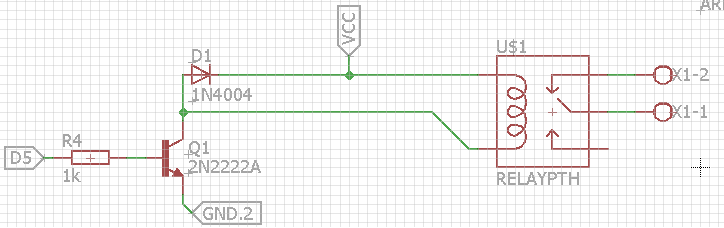
      0_1455277788002_123123.png

      @GertSanders said:

      @Porky6666 : only switches 3A, SONGLE relay can switch 10A.

      I wouldn't trust both of them when it comes to switching high amp devices over 3A. I think there is a reason no german electronics shop sells songle relays :smile:

      Plus, relays from an electronics shop in your country might cost the same than the songle relays or will just be a tiny bit more expensive.

      At least this is true for 5V relays. 3V relays are hard to find (at least in germany)

      GertSandersG 1 Reply Last reply
      0
      • HenryWhiteH HenryWhite

        @GertSanders said:

        @Yveaux No, also still waiting for the order to arrive. But a coil resistance of 20-25 Ohm means driving the coil with a FET. Not directly from a atmega328 pin.

        Correct. Here's how I wired the songle relay on my Lithium Ion Sensor PCB:

        0_1455277788002_123123.png

        @GertSanders said:

        @Porky6666 : only switches 3A, SONGLE relay can switch 10A.

        I wouldn't trust both of them when it comes to switching high amp devices over 3A. I think there is a reason no german electronics shop sells songle relays :smile:

        Plus, relays from an electronics shop in your country might cost the same than the songle relays or will just be a tiny bit more expensive.

        At least this is true for 5V relays. 3V relays are hard to find (at least in germany)

        GertSandersG Offline
        GertSandersG Offline
        GertSanders
        Hardware Contributor
        wrote on last edited by
        #211

        @HenryWhite said:

        I wouldn't trust both of them when it comes to switching high amp devices over 3A.

        I agree, I plan to switch lights, so my preference goes to the 10A model, just to be sure. I have used the SONGLE 5V versions, and none have ever given me reason to doubt their quality. Since I found a 3V3 powersupply I want to try building a full 3V3 board. Should be fun.

        1 Reply Last reply
        0
        • toabhishekvermaT Offline
          toabhishekvermaT Offline
          toabhishekverma
          wrote on last edited by
          #212

          @HenryWhite why do we need D1 Diode (if i am write) in that circuit? do this circuit will not work without diode?
          (sorry dont know much about electronics)

          HenryWhiteH 1 Reply Last reply
          0
          • toabhishekvermaT toabhishekverma

            @HenryWhite why do we need D1 Diode (if i am write) in that circuit? do this circuit will not work without diode?
            (sorry dont know much about electronics)

            HenryWhiteH Offline
            HenryWhiteH Offline
            HenryWhite
            wrote on last edited by HenryWhite
            #213

            @toabhishekverma https://en.m.wikipedia.org/wiki/Flyback_diode

            in short: It is needed to protect the NPN transistor from damage.
            The circuit will work without diode, But eventually damage the transistor.

            1 Reply Last reply
            0
            • m26872M Offline
              m26872M Offline
              m26872
              Hardware Contributor
              wrote on last edited by
              #214

              @GertSanders Have you breadboarded your 3.3V design? I'm a bit worried that removing linear converter will impair the performance of the our fussy nRF clones due to less power supply ripple rejection. I think those going for the ESP8266 are better off.

              GertSandersG 1 Reply Last reply
              0
              • T Offline
                T Offline
                tomkxy
                wrote on last edited by
                #215

                Anyone has an idea where to source the 5.5V varistor? I received a bunch from AliExpress following which seem to be broken.
                I found this link http://www.farnell.com/datasheets/575651.pdf. However, there seem to be a bunch of 5.5 V varistor. Can anybody help me figuring out the right ones?

                icebobI 1 Reply Last reply
                0
                • T tomkxy

                  Anyone has an idea where to source the 5.5V varistor? I received a bunch from AliExpress following which seem to be broken.
                  I found this link http://www.farnell.com/datasheets/575651.pdf. However, there seem to be a bunch of 5.5 V varistor. Can anybody help me figuring out the right ones?

                  icebobI Offline
                  icebobI Offline
                  icebob
                  wrote on last edited by
                  #216

                  @tomkxy I'm using this one: http://hu.farnell.com/multicomp/mcvz1206m050agt/varistor-multilayer-4vac-0402/dp/2462756

                  T 1 Reply Last reply
                  0
                  • m26872M m26872

                    @GertSanders Have you breadboarded your 3.3V design? I'm a bit worried that removing linear converter will impair the performance of the our fussy nRF clones due to less power supply ripple rejection. I think those going for the ESP8266 are better off.

                    GertSandersG Offline
                    GertSandersG Offline
                    GertSanders
                    Hardware Contributor
                    wrote on last edited by GertSanders
                    #217

                    @m26872 I have not used the 3V3 version of the Hilink converter, it was just shipped today (ordered last week). It will take a few more weeks to reach me. But then I will test it on my ac board. We will see.
                    23/FEB: Update: the converters are here. I will make a node with this converter version this weekend.

                    1 Reply Last reply
                    0
                    • icebobI icebob

                      @tomkxy I'm using this one: http://hu.farnell.com/multicomp/mcvz1206m050agt/varistor-multilayer-4vac-0402/dp/2462756

                      T Offline
                      T Offline
                      tomkxy
                      wrote on last edited by
                      #218

                      @icebob said:

                      @tomkxy I'm using this one: http://hu.farnell.com/multicomp/mcvz1206m050agt/varistor-multilayer-4vac-0402/dp/2462756

                      Thanks! It's a pity that the chinese "varistors" seem to be jumpers. I even saw in some offers on AliExpress that they are referred to as jumpers.

                      1 Reply Last reply
                      0
                      • T Offline
                        T Offline
                        tomkxy
                        wrote on last edited by
                        #219

                        How can I check whether the solid state relay works at all. My assembled board receives messages and sets state properly, I have 5V on the pin, however the relay does not seem to switch. Should I hear it? Any other ideas for "debugging"?

                        GertSandersG 1 Reply Last reply
                        0
                        • T tomkxy

                          How can I check whether the solid state relay works at all. My assembled board receives messages and sets state properly, I have 5V on the pin, however the relay does not seem to switch. Should I hear it? Any other ideas for "debugging"?

                          GertSandersG Offline
                          GertSandersG Offline
                          GertSanders
                          Hardware Contributor
                          wrote on last edited by GertSanders
                          #220

                          @tomkxy
                          Measure the resistance over the AC terminals of the SSR. It should be very high when "open" en very low when "closed". SSRs do not make sounds when they switch, so sound will not give a clue if they work.

                          1 Reply Last reply
                          0
                          • J Offline
                            J Offline
                            Jan Gatzke
                            wrote on last edited by
                            #221

                            Most SSRs cannot be checked this way because they can only switch AC and not DC. See https://en.wikipedia.org/wiki/Zero_cross_circuit

                            1 Reply Last reply
                            0
                            • Cliff KarlssonC Offline
                              Cliff KarlssonC Offline
                              Cliff Karlsson
                              wrote on last edited by
                              #222

                              I don't know if this has been answered already. But I have some major problems soldering the thermal fuse to the board. It always blows. Any tips ?

                              m26872M 1 Reply Last reply
                              0
                              • sundberg84S Offline
                                sundberg84S Offline
                                sundberg84
                                Hardware Contributor
                                wrote on last edited by
                                #223

                                @Cliff-Karlsson Be quick :)
                                I have the same problem - dont know any better sollution atm... solder for 0.5 sec and remove - then you need to let it cool down before adding more solder.

                                Controller: Proxmox VM - Home Assistant
                                MySensors GW: Arduino Uno - W5100 Ethernet, Gw Shield Nrf24l01+ 2,4Ghz
                                MySensors GW: Arduino Uno - Gw Shield RFM69, 433mhz
                                RFLink GW - Arduino Mega + RFLink Shield, 433mhz

                                1 Reply Last reply
                                0
                                • Cliff KarlssonC Offline
                                  Cliff KarlssonC Offline
                                  Cliff Karlsson
                                  wrote on last edited by
                                  #224

                                  I read something before about low temp thermal sensors usally being crimped to place. Do you know how this works and if it is usable on the pcb?

                                  Also the last times I tried to assemble the parts on the pcb I noticed that the holes for one of the fuses are too narrow for the standard brown(?) auto reset fuse. I have managed to destroy the solderpads every time I tried to drill the holes a little bigger.
                                  Can I use a standard glass fuse for this one with the same value?

                                  1 Reply Last reply
                                  0
                                  • C Offline
                                    C Offline
                                    csa02221862
                                    wrote on last edited by
                                    #225

                                    Just a couple of questions. Most of the components are 240V, are these the same as used for 110/120v in the US? Also one of the varistors is not available, suggested alternative?
                                    Thanks

                                    1 Reply Last reply
                                    0
                                    • V Offline
                                      V Offline
                                      vil1driver
                                      wrote on last edited by vil1driver
                                      #226

                                      Hi,

                                      thanks for your great work..
                                      great to have chosed a pwm output for the relay (ssr can be used as a dimmer)
                                      but is it possible to add a fuse on the ssr output too ?
                                      and a second switch

                                      and imho relay's trace is too near a nrf trace..
                                      and return the draw of le33 :p

                                      sry for my english
                                      thanks

                                      1 Reply Last reply
                                      0
                                      • Sefi NinioS Offline
                                        Sefi NinioS Offline
                                        Sefi Ninio
                                        wrote on last edited by Sefi Ninio
                                        #227

                                        Hello,

                                        I love your design!
                                        However, I must have missed something. Considering I want to retain the ability to turn the light off with the wall switch, this board does not allow to connect the relay as a 3-way switch.

                                        Also, considering it could be mounted inside the wall (and not only in the lamp base) - having 2-3 relays would be very functional! In my house, it is very common that a single wall mount has 3-4 switches that control 3-4 separate lamps. It will probably make the board bigger, more so if we support 3-way switches (see above comment), but it will be very versatile, especially for 4-way switches (see http://forum.mysensors.org/topic/3173/3-4-way-switch-with-a-relay )

                                        1 Reply Last reply
                                        0
                                        • toabhishekvermaT Offline
                                          toabhishekvermaT Offline
                                          toabhishekverma
                                          wrote on last edited by
                                          #228

                                          Hi Sefi Ninio,
                                          There are two ways you can do it, Either change relay to SPDT Relay which is two way relay. this option is not feasible with this pcb. But if you are not using same PCB you can try SPDT relays.

                                          Second option which can work with this setup is ,
                                          Your light switch has two pins, connect them with gpio and 3.3 power .
                                          when switch turn on/off gpio pin input goes high(when on) and low (when off).
                                          You have to write a code to monitor this gpio and if its state changes, you have to toggle the relay state.

                                          This is my idea, I havent tried it yet. and I am newbie too, Please comment.

                                          I hope I am clear enough

                                          Regards,
                                          Abhishek

                                          Sefi NinioS 1 Reply Last reply
                                          0
                                          Reply
                                          • Reply as topic
                                          Log in to reply
                                          • Oldest to Newest
                                          • Newest to Oldest
                                          • Most Votes


                                          29

                                          Online

                                          11.7k

                                          Users

                                          11.2k

                                          Topics

                                          113.1k

                                          Posts


                                          Copyright 2025 TBD   |   Forum Guidelines   |   Privacy Policy   |   Terms of Service
                                          • Login

                                          • Don't have an account? Register

                                          • Login or register to search.
                                          • First post
                                            Last post
                                          0
                                          • MySensors
                                          • OpenHardware.io
                                          • Categories
                                          • Recent
                                          • Tags
                                          • Popular