
Serial gateway, which example to follow??
-
@hek
So finally I got home to grab my arduino so I can do some hardware testing and not just software!It seems like the receive method is not running on the gateway, I have read through everything on the library api three times now, but I still can not figure out how the receive method are working. It runs inside the main loop, hence you can not use any sleep routine as far as I understood.
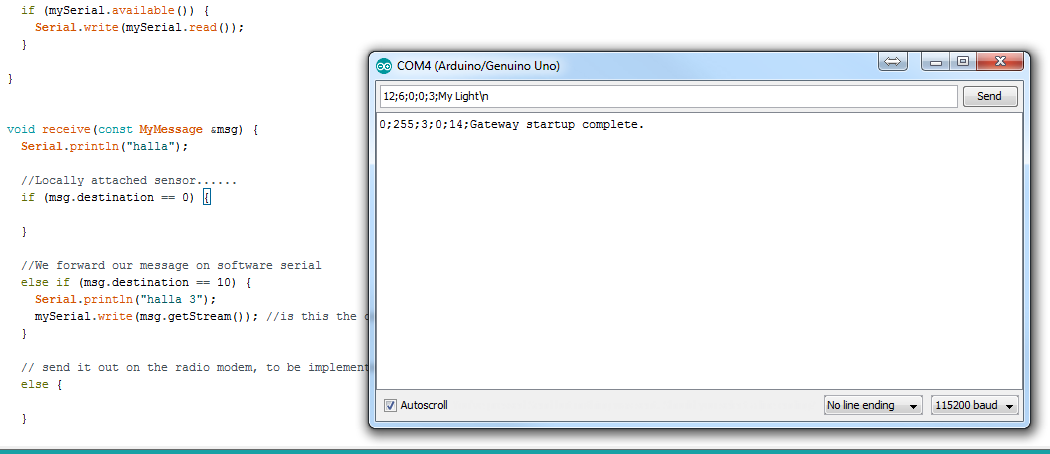 image url)
What can I do to get the receive method to run?
-
-
@skatun What do you want to accomplish? The "receive method" just runs if you receive messages from other sensors (not locally connected}.
@AWI
Basically I have my Gateway(Mega, might swap to Due, higher resolution ADC), on my gateway I have:
1 radio modem connected,
7 Arduino nano which are soldered to tx/rx(I might need to resolder those?),
12 motion sensors,
1 pulsePowerMeter,
6 ledstrips
1 IR generator(simulate my tv /stereo,etc remote)So if my controller Openhab:
sends or receive CHildID = 0 then send/receive data to locally attached sensor
sends or receive CHildID = 10-16 then send/receive data on software serial to the 7 arduino nano(Basically relay sensor nodes)
sends or receive CHildID = 20-31 then send/receive data on radio to my radio nodes(temperature mainly)My problem is that I can not figure out how to set up software serial with my sensor.
If msg.destination =16 sendTo software Serial on pin 34Below is a picture of my Gateway setup:
![0_1468414835666_IMG_20160713_145404[1].jpg](/uploads/files/1468414840084-img_20160713_145404-1.jpg)
-
@AWI
Basically I have my Gateway(Mega, might swap to Due, higher resolution ADC), on my gateway I have:
1 radio modem connected,
7 Arduino nano which are soldered to tx/rx(I might need to resolder those?),
12 motion sensors,
1 pulsePowerMeter,
6 ledstrips
1 IR generator(simulate my tv /stereo,etc remote)So if my controller Openhab:
sends or receive CHildID = 0 then send/receive data to locally attached sensor
sends or receive CHildID = 10-16 then send/receive data on software serial to the 7 arduino nano(Basically relay sensor nodes)
sends or receive CHildID = 20-31 then send/receive data on radio to my radio nodes(temperature mainly)My problem is that I can not figure out how to set up software serial with my sensor.
If msg.destination =16 sendTo software Serial on pin 34Below is a picture of my Gateway setup:
@skatun I'm still confused. Looks like you are forcing the MySensors protocol to do your own thing.
Your topology has different nano's (nodes) connected via tx/rx to the gateway. The MySensors way to communicate with these is to treat them as 'nodes' and communicate to them by means of the wired protocol. Each of these nodes needs a different node number.
Then if you want to combine this with radio communication you need a different gateway which communicates by means of the wireless (rf24) protocol with the remote nodes. -
@skatun I'm still confused. Looks like you are forcing the MySensors protocol to do your own thing.
Your topology has different nano's (nodes) connected via tx/rx to the gateway. The MySensors way to communicate with these is to treat them as 'nodes' and communicate to them by means of the wired protocol. Each of these nodes needs a different node number.
Then if you want to combine this with radio communication you need a different gateway which communicates by means of the wireless (rf24) protocol with the remote nodes.Quote:"means of the wired protocol"
I was so fortunate that I could connect most of my nodes and sensors wired, more reliable, no need to change battery so I tried todo so with most of my nodes and sensors.Quote : "Then if you want to combine this with radio communication you need a different gateway"
Why do I need two gateways, why cant one gateway handle both wired and radio? For now I don't need the radio, just locally and wired connectionQuote:" Each of these nodes needs a different node number."
Yupp thats why I try to give them static node numbers: So the one on balcony gets ID 11 the one in the bar is 13 and so on. (my idea was to group ID numbers, 0 locally sensor, 10-19 software serial, >20 radio nodes, >50 wifi nodes ,>70 rs485 nodes)The benefit of using MySensor is that the Openhab has a binding for it, I can use the example codes for my nodes(like the relay with button sketch) and I need some format of the string sended/received from the controller to my nodes anyway, so why not use the mysensor format?
so My orignally Idea was to use the serial event:
void serialEvent() {
  while (Serial.available()) {
    // get the new byte:
    char inChar = (char)Serial.read();
    // if the incoming character is a newline, set a flag
    // so the main loop can do something about it:
    if (inputPos < MAX_RECEIVE_LENGTH - 1 && !commandComplete) {
      if (inChar == '\n') {
        inputString[inputPos] = 0;
        commandComplete = true;
      } else {
        // add it to the inputString:
        inputString[inputPos] = inChar;
        inputPos++;
      }
    } else {
      // Incoming message too long. Throw away
      inputPos = 0;
    }
  }
}
and then use the Message class to split the input buffer the string based
","like in vba I would just usearrayMy = split(inputBuffer,",")Then If ID=11 forward the whole thing to software serial to the balcony, then the code on that node would be exactly the same as if the message came over the radio link.
That was my orginally idea, but then @hek suggested that I should rather use the receive method since this grab the buffer from serial somehow.
I am open to all solutions:) I just have limited space on some of my nodes which makes it hard to implement a radio link on them as well as an rs485 shield. (even using nano is hard)
-
Quote:"means of the wired protocol"
I was so fortunate that I could connect most of my nodes and sensors wired, more reliable, no need to change battery so I tried todo so with most of my nodes and sensors.Quote : "Then if you want to combine this with radio communication you need a different gateway"
Why do I need two gateways, why cant one gateway handle both wired and radio? For now I don't need the radio, just locally and wired connectionQuote:" Each of these nodes needs a different node number."
Yupp thats why I try to give them static node numbers: So the one on balcony gets ID 11 the one in the bar is 13 and so on. (my idea was to group ID numbers, 0 locally sensor, 10-19 software serial, >20 radio nodes, >50 wifi nodes ,>70 rs485 nodes)The benefit of using MySensor is that the Openhab has a binding for it, I can use the example codes for my nodes(like the relay with button sketch) and I need some format of the string sended/received from the controller to my nodes anyway, so why not use the mysensor format?
so My orignally Idea was to use the serial event:
void serialEvent() {
  while (Serial.available()) {
    // get the new byte:
    char inChar = (char)Serial.read();
    // if the incoming character is a newline, set a flag
    // so the main loop can do something about it:
    if (inputPos < MAX_RECEIVE_LENGTH - 1 && !commandComplete) {
      if (inChar == '\n') {
        inputString[inputPos] = 0;
        commandComplete = true;
      } else {
        // add it to the inputString:
        inputString[inputPos] = inChar;
        inputPos++;
      }
    } else {
      // Incoming message too long. Throw away
      inputPos = 0;
    }
  }
}
and then use the Message class to split the input buffer the string based
","like in vba I would just usearrayMy = split(inputBuffer,",")Then If ID=11 forward the whole thing to software serial to the balcony, then the code on that node would be exactly the same as if the message came over the radio link.
That was my orginally idea, but then @hek suggested that I should rather use the receive method since this grab the buffer from serial somehow.
I am open to all solutions:) I just have limited space on some of my nodes which makes it hard to implement a radio link on them as well as an rs485 shield. (even using nano is hard)
@hek
I am making great progress on my gateway:) I am almost done wiring everything and software is coming along. So my sensors sends out data nicely to the controller, however I can not receive commands, which is essentials for my RGB led strips.I am trying to send this from the Serial Monitor in arduino: 0,30,1,0,40,ff0000\n
However the received method never gets called, what am I missing?
// Enable debug prints to serial monitor //#define MY_DEBUG // Enable serial gateway #define MY_GATEWAY_SERIAL #include <SoftwareSerial.h> #include <SPI.h> #include <MySensors.h> #include <ChainableLED.h> SoftwareSerial mySerial(10, 11); // RX, TX MyMessage msg1(1, V_LIGHT); //RGB int NUM_LEDS = 34; ChainableLED leds(5, 6, NUM_LEDS); // CLK, DATA, LEDS //PowerMeter #define DIGITAL_INPUT_SENSOR 3 // The digital input you attached your light sensor. (Only 2 and 3 generates interrupt!) #define PULSE_FACTOR 1000 // Nummber of blinks per KWH of your meeter #define SLEEP_MODE false // Watt-value can only be reported when sleep mode is false. #define MAX_WATT 10000 // Max watt value to report. This filetrs outliers. #define CHILD_ID_POWER 2 // Id of the sensor child #define CHILD_ID_RGB_START 30 #define NUM_LEDS_STRIPS 5 int counter[NUM_LEDS_STRIPS]; int current[NUM_LEDS_STRIPS][3]; int step[NUM_LEDS_STRIPS][3]; unsigned long SEND_FREQUENCY = 20000; // Minimum time between send (in milliseconds). We don't wnat to spam the gateway. double ppwh = ((double)PULSE_FACTOR) / 1000; // Pulses per watt hour boolean pcReceived = false; volatile unsigned long pulseCount = 0; volatile unsigned long lastBlink = 0; volatile unsigned long watt = 0; unsigned long oldPulseCount = 0; unsigned long oldWatt = 0; double oldKwh; unsigned long lastSend; MyMessage wattMsg(CHILD_ID_POWER, V_WATT); MyMessage kwhMsg(CHILD_ID_POWER, V_KWH); MyMessage pcMsg(CHILD_ID_POWER, V_VAR1); void setup() { //Set up all our software serial ports... mySerial.begin(9600); // Setup locally attached sensors //RGB leds.init(); for (byte CHILD_ID_RGB = CHILD_ID_RGB_START; CHILD_ID_RGB < NUM_LEDS_STRIPS; CHILD_ID_RGB++) { counter[CHILD_ID_RGB] = 0; current[CHILD_ID_RGB][0] = 0; current[CHILD_ID_RGB][1] = 0; current[CHILD_ID_RGB][2] = 0; step[CHILD_ID_RGB][0] = 0; step[CHILD_ID_RGB][1] = 0; step[CHILD_ID_RGB][2] = 0; leds.setColorRGB(CHILD_ID_RGB, current[CHILD_ID_RGB][0], current[CHILD_ID_RGB][1], current[CHILD_ID_RGB][2]); // Turn of on startup } // Power Meter // Fetch last known pulse count value from gw request(CHILD_ID_POWER, V_VAR1); // Use the internal pullup to be able to hook up this sketch directly to an energy meter with S0 output // If no pullup is used, the reported usage will be too high because of the floating pin pinMode(DIGITAL_INPUT_SENSOR, INPUT_PULLUP); attachInterrupt(digitalPinToInterrupt(DIGITAL_INPUT_SENSOR), onPulse, RISING); lastSend = millis(); } void presentation() { // Present locally attached sensors //RGB 0,30,1,0,40,ff0000\n sendSketchInfo("RGB Led", "1.2"); for (byte CHILD_ID_RGB = CHILD_ID_RGB_START; CHILD_ID_RGB < NUM_LEDS_STRIPS; CHILD_ID_RGB++) { present(CHILD_ID_RGB, S_RGB_LIGHT); } //RELAY sendSketchInfo("Relay & Button", "1.0"); // Register all sensors to gw (they will be created as child devices) present(1, S_LIGHT); //POWER METER // Send the sketch version information to the gateway and Controller sendSketchInfo("Energy Meter", "1.0"); // Register this device as power sensor present(CHILD_ID_POWER, S_POWER); } void loop() { // Send locally attached sensor data here //send(msg1.set(true), true); // Send new state and request ack back if (mySerial.available()) { Serial.write(mySerial.read()); } //RGB for (byte CHILD_ID_RGB = CHILD_ID_RGB_START; CHILD_ID_RGB < NUM_LEDS_STRIPS; CHILD_ID_RGB++) { if (counter[CHILD_ID_RGB] >= 0) { counter[CHILD_ID_RGB]--; int i = 1020 - counter[CHILD_ID_RGB]; current[CHILD_ID_RGB][0] = calculateVal(step[CHILD_ID_RGB][0], current[CHILD_ID_RGB][0], i); current[CHILD_ID_RGB][1] = calculateVal(step[CHILD_ID_RGB][1], current[CHILD_ID_RGB][1], i); current[CHILD_ID_RGB][2] = calculateVal(step[CHILD_ID_RGB][2], current[CHILD_ID_RGB][2], i); leds.setColorRGB(CHILD_ID_RGB, current[CHILD_ID_RGB][0], current[CHILD_ID_RGB][1], current[CHILD_ID_RGB][2]); } } //POWER unsigned long now = millis(); // Only send values at a maximum frequency or woken up from sleep bool sendTime = now - lastSend > SEND_FREQUENCY; if (pcReceived && (SLEEP_MODE || sendTime)) { // New watt value has been calculated if (!SLEEP_MODE && watt != oldWatt) { // Check that we dont get unresonable large watt value. // could hapen when long wraps or false interrupt triggered if (watt < ((unsigned long)MAX_WATT)) { send(wattMsg.set(watt)); // Send watt value to gw } Serial.print("Watt:"); Serial.println(watt); oldWatt = watt; } // Pulse cout has changed if (pulseCount != oldPulseCount) { send(pcMsg.set(pulseCount)); // Send pulse count value to gw Serial.print("PulseCount:"); Serial.println(pulseCount); double kwh = ((double)pulseCount / ((double)PULSE_FACTOR)); oldPulseCount = pulseCount; if (kwh != oldKwh) { send(kwhMsg.set(kwh, 4)); // Send kwh value to gw oldKwh = kwh; Serial.print("KWh:"); Serial.println(kwh); } } lastSend = now; } else if (sendTime && !pcReceived) { // No count received. Try requesting it again request(CHILD_ID_POWER, V_VAR1); Serial.println("requesting a new value"); lastSend = now; } } //PowerMeter void onPulse() { unsigned long newBlink = micros(); unsigned long interval = newBlink - lastBlink; if (interval < 10000L) { // Sometimes we get interrupt on RISING return; } watt = (3600000000.0 / interval) / ppwh; lastBlink = newBlink; pulseCount++; } //RGB void setColor(byte led, int R, int G, int B) { step[led][0] = calculateStep(current[led][0], R); step[led][1] = calculateStep(current[led][1], G); step[led][2] = calculateStep(current[led][2], B); counter[led] = 255; } int calculateStep(int prevValue, int endValue) { int step = endValue - prevValue; // What's the overall gap? if (step) { // If its non-zero, step = 255 / step; // divide by 1020 } return step; } int calculateVal(int step, int val, int i) { if ((step) && i % step == 0) { // If step is non-zero and its time to change a value, if (step > 0) { // increment the value if step is positive... val += 1; } else if (step < 0) { // ...or decrement it if step is negative val -= 1; } } // Defensive driving: make sure val stays in the range 0-255 if (val > 255) { val = 255; } else if (val < 0) { val = 0; } return val; } void receive(const MyMessage & msg) { Serial.println("Hello"); //send(msg1.set(true), true); if (msg.type == V_RGB) { String hexstring = msg.getString(); long number = (long) strtol( &hexstring[0], NULL, 16); int colorR = number >> 16; int colorG = number >> 8 & 0xFF; int colorB = number & 0xFF; // Write some debug info Serial.print("Incoming change for sensor:"); Serial.print(msg.sensor); Serial.print(", Red: "); Serial.print(colorR); Serial.print(", Green: "); Serial.print(colorG); Serial.print(", Blue: "); Serial.print(colorB); Serial.print(", New status: "); Serial.println(msg.getString()); setColor(msg.sensor, colorR, colorG, colorB); //leds.setColorRGB(message.sensor, colorR, colorG, colorB); } //POWER if (msg.type == V_VAR1) { pulseCount = oldPulseCount = msg.getLong(); Serial.print("Received last pulse count from gw:"); Serial.println(pulseCount); pcReceived = true; } //Locally attached sensor...... if (msg.destination == 0) { } //We forward our message on software serial else if (msg.destination == 10) { Serial.println("halla 3"); //mySerial.write(msg.getStream()); //is this the complete message?? } // send it out on the radio modem, to be implemented later else { } } -
@hek
I am making great progress on my gateway:) I am almost done wiring everything and software is coming along. So my sensors sends out data nicely to the controller, however I can not receive commands, which is essentials for my RGB led strips.I am trying to send this from the Serial Monitor in arduino: 0,30,1,0,40,ff0000\n
However the received method never gets called, what am I missing?
// Enable debug prints to serial monitor //#define MY_DEBUG // Enable serial gateway #define MY_GATEWAY_SERIAL #include <SoftwareSerial.h> #include <SPI.h> #include <MySensors.h> #include <ChainableLED.h> SoftwareSerial mySerial(10, 11); // RX, TX MyMessage msg1(1, V_LIGHT); //RGB int NUM_LEDS = 34; ChainableLED leds(5, 6, NUM_LEDS); // CLK, DATA, LEDS //PowerMeter #define DIGITAL_INPUT_SENSOR 3 // The digital input you attached your light sensor. (Only 2 and 3 generates interrupt!) #define PULSE_FACTOR 1000 // Nummber of blinks per KWH of your meeter #define SLEEP_MODE false // Watt-value can only be reported when sleep mode is false. #define MAX_WATT 10000 // Max watt value to report. This filetrs outliers. #define CHILD_ID_POWER 2 // Id of the sensor child #define CHILD_ID_RGB_START 30 #define NUM_LEDS_STRIPS 5 int counter[NUM_LEDS_STRIPS]; int current[NUM_LEDS_STRIPS][3]; int step[NUM_LEDS_STRIPS][3]; unsigned long SEND_FREQUENCY = 20000; // Minimum time between send (in milliseconds). We don't wnat to spam the gateway. double ppwh = ((double)PULSE_FACTOR) / 1000; // Pulses per watt hour boolean pcReceived = false; volatile unsigned long pulseCount = 0; volatile unsigned long lastBlink = 0; volatile unsigned long watt = 0; unsigned long oldPulseCount = 0; unsigned long oldWatt = 0; double oldKwh; unsigned long lastSend; MyMessage wattMsg(CHILD_ID_POWER, V_WATT); MyMessage kwhMsg(CHILD_ID_POWER, V_KWH); MyMessage pcMsg(CHILD_ID_POWER, V_VAR1); void setup() { //Set up all our software serial ports... mySerial.begin(9600); // Setup locally attached sensors //RGB leds.init(); for (byte CHILD_ID_RGB = CHILD_ID_RGB_START; CHILD_ID_RGB < NUM_LEDS_STRIPS; CHILD_ID_RGB++) { counter[CHILD_ID_RGB] = 0; current[CHILD_ID_RGB][0] = 0; current[CHILD_ID_RGB][1] = 0; current[CHILD_ID_RGB][2] = 0; step[CHILD_ID_RGB][0] = 0; step[CHILD_ID_RGB][1] = 0; step[CHILD_ID_RGB][2] = 0; leds.setColorRGB(CHILD_ID_RGB, current[CHILD_ID_RGB][0], current[CHILD_ID_RGB][1], current[CHILD_ID_RGB][2]); // Turn of on startup } // Power Meter // Fetch last known pulse count value from gw request(CHILD_ID_POWER, V_VAR1); // Use the internal pullup to be able to hook up this sketch directly to an energy meter with S0 output // If no pullup is used, the reported usage will be too high because of the floating pin pinMode(DIGITAL_INPUT_SENSOR, INPUT_PULLUP); attachInterrupt(digitalPinToInterrupt(DIGITAL_INPUT_SENSOR), onPulse, RISING); lastSend = millis(); } void presentation() { // Present locally attached sensors //RGB 0,30,1,0,40,ff0000\n sendSketchInfo("RGB Led", "1.2"); for (byte CHILD_ID_RGB = CHILD_ID_RGB_START; CHILD_ID_RGB < NUM_LEDS_STRIPS; CHILD_ID_RGB++) { present(CHILD_ID_RGB, S_RGB_LIGHT); } //RELAY sendSketchInfo("Relay & Button", "1.0"); // Register all sensors to gw (they will be created as child devices) present(1, S_LIGHT); //POWER METER // Send the sketch version information to the gateway and Controller sendSketchInfo("Energy Meter", "1.0"); // Register this device as power sensor present(CHILD_ID_POWER, S_POWER); } void loop() { // Send locally attached sensor data here //send(msg1.set(true), true); // Send new state and request ack back if (mySerial.available()) { Serial.write(mySerial.read()); } //RGB for (byte CHILD_ID_RGB = CHILD_ID_RGB_START; CHILD_ID_RGB < NUM_LEDS_STRIPS; CHILD_ID_RGB++) { if (counter[CHILD_ID_RGB] >= 0) { counter[CHILD_ID_RGB]--; int i = 1020 - counter[CHILD_ID_RGB]; current[CHILD_ID_RGB][0] = calculateVal(step[CHILD_ID_RGB][0], current[CHILD_ID_RGB][0], i); current[CHILD_ID_RGB][1] = calculateVal(step[CHILD_ID_RGB][1], current[CHILD_ID_RGB][1], i); current[CHILD_ID_RGB][2] = calculateVal(step[CHILD_ID_RGB][2], current[CHILD_ID_RGB][2], i); leds.setColorRGB(CHILD_ID_RGB, current[CHILD_ID_RGB][0], current[CHILD_ID_RGB][1], current[CHILD_ID_RGB][2]); } } //POWER unsigned long now = millis(); // Only send values at a maximum frequency or woken up from sleep bool sendTime = now - lastSend > SEND_FREQUENCY; if (pcReceived && (SLEEP_MODE || sendTime)) { // New watt value has been calculated if (!SLEEP_MODE && watt != oldWatt) { // Check that we dont get unresonable large watt value. // could hapen when long wraps or false interrupt triggered if (watt < ((unsigned long)MAX_WATT)) { send(wattMsg.set(watt)); // Send watt value to gw } Serial.print("Watt:"); Serial.println(watt); oldWatt = watt; } // Pulse cout has changed if (pulseCount != oldPulseCount) { send(pcMsg.set(pulseCount)); // Send pulse count value to gw Serial.print("PulseCount:"); Serial.println(pulseCount); double kwh = ((double)pulseCount / ((double)PULSE_FACTOR)); oldPulseCount = pulseCount; if (kwh != oldKwh) { send(kwhMsg.set(kwh, 4)); // Send kwh value to gw oldKwh = kwh; Serial.print("KWh:"); Serial.println(kwh); } } lastSend = now; } else if (sendTime && !pcReceived) { // No count received. Try requesting it again request(CHILD_ID_POWER, V_VAR1); Serial.println("requesting a new value"); lastSend = now; } } //PowerMeter void onPulse() { unsigned long newBlink = micros(); unsigned long interval = newBlink - lastBlink; if (interval < 10000L) { // Sometimes we get interrupt on RISING return; } watt = (3600000000.0 / interval) / ppwh; lastBlink = newBlink; pulseCount++; } //RGB void setColor(byte led, int R, int G, int B) { step[led][0] = calculateStep(current[led][0], R); step[led][1] = calculateStep(current[led][1], G); step[led][2] = calculateStep(current[led][2], B); counter[led] = 255; } int calculateStep(int prevValue, int endValue) { int step = endValue - prevValue; // What's the overall gap? if (step) { // If its non-zero, step = 255 / step; // divide by 1020 } return step; } int calculateVal(int step, int val, int i) { if ((step) && i % step == 0) { // If step is non-zero and its time to change a value, if (step > 0) { // increment the value if step is positive... val += 1; } else if (step < 0) { // ...or decrement it if step is negative val -= 1; } } // Defensive driving: make sure val stays in the range 0-255 if (val > 255) { val = 255; } else if (val < 0) { val = 0; } return val; } void receive(const MyMessage & msg) { Serial.println("Hello"); //send(msg1.set(true), true); if (msg.type == V_RGB) { String hexstring = msg.getString(); long number = (long) strtol( &hexstring[0], NULL, 16); int colorR = number >> 16; int colorG = number >> 8 & 0xFF; int colorB = number & 0xFF; // Write some debug info Serial.print("Incoming change for sensor:"); Serial.print(msg.sensor); Serial.print(", Red: "); Serial.print(colorR); Serial.print(", Green: "); Serial.print(colorG); Serial.print(", Blue: "); Serial.print(colorB); Serial.print(", New status: "); Serial.println(msg.getString()); setColor(msg.sensor, colorR, colorG, colorB); //leds.setColorRGB(message.sensor, colorR, colorG, colorB); } //POWER if (msg.type == V_VAR1) { pulseCount = oldPulseCount = msg.getLong(); Serial.print("Received last pulse count from gw:"); Serial.println(pulseCount); pcReceived = true; } //Locally attached sensor...... if (msg.destination == 0) { } //We forward our message on software serial else if (msg.destination == 10) { Serial.println("halla 3"); //mySerial.write(msg.getStream()); //is this the complete message?? } // send it out on the radio modem, to be implemented later else { } } -
@tekka Thanks for the feedback, does that implies if I download the dev branch from git now it should be fixed?
here is the output from my serial monitor when i enabled logging:
0;255;3;0;9;Starting gateway (R-NGA-, 2.0.0-beta)
0;255;3;0;14;Gateway startup complete.
0;2;2;0;24;
0;255;3;0;9;No registration required
0;255;3;0;9;Init complete, id=0, parent=0, distance=0, registration=1
0;2;2;0;24;
I am trying to get my RGB lights to work:
#define CHILD_ID_RGB_START 30
#define NUM_LEDS_STRIPS 5

void presentation() {
  // Present locally attached sensors

  //RGB 0,30,1,0,40,ff0000\n
  sendSketchInfo("RGB Led", "1.2");
  Serial.println("Lets present some RGB");
  for (byte CHILD_ID_RGB = CHILD_ID_RGB_START; CHILD_ID_RGB < NUM_LEDS_STRIPS; CHILD_ID_RGB++) {
    Serial.print("RGB ID: ");
    Serial.println(CHILD_ID_RGB);
    present(CHILD_ID_RGB, S_RGB_LIGHT);
  }
How can I add logging to Serial monitor to gateway, because
Serial.println("Lets present some RGB");does not produce any output?shouldn't this line registered my lights as sensors in MYSController?
present(CHILD_ID_RGB, S_RGB_LIGHT);So I am afraid there is something wrong with my for loop, even though i can not spot the mistake.
-
@tekka Thanks for the feedback, does that implies if I download the dev branch from git now it should be fixed?
here is the output from my serial monitor when i enabled logging:
0;255;3;0;9;Starting gateway (R-NGA-, 2.0.0-beta)
0;255;3;0;14;Gateway startup complete.
0;2;2;0;24;
0;255;3;0;9;No registration required
0;255;3;0;9;Init complete, id=0, parent=0, distance=0, registration=1
0;2;2;0;24;
I am trying to get my RGB lights to work:
#define CHILD_ID_RGB_START 30
#define NUM_LEDS_STRIPS 5

void presentation() {
  // Present locally attached sensors

  //RGB 0,30,1,0,40,ff0000\n
  sendSketchInfo("RGB Led", "1.2");
  Serial.println("Lets present some RGB");
  for (byte CHILD_ID_RGB = CHILD_ID_RGB_START; CHILD_ID_RGB < NUM_LEDS_STRIPS; CHILD_ID_RGB++) {
    Serial.print("RGB ID: ");
    Serial.println(CHILD_ID_RGB);
    present(CHILD_ID_RGB, S_RGB_LIGHT);
  }
How can I add logging to Serial monitor to gateway, because
Serial.println("Lets present some RGB");does not produce any output?shouldn't this line registered my lights as sensors in MYSController?
present(CHILD_ID_RGB, S_RGB_LIGHT);So I am afraid there is something wrong with my for loop, even though i can not spot the mistake.
-
@skatun looks like you didn't define a radio on your GW, so your RGB example runs locally on the GW?



Hello! It looks like you're interested in this conversation, but you don't have an account yet.
Getting fed up of having to scroll through the same posts each visit? When you register for an account, you'll always come back to exactly where you were before, and choose to be notified of new replies (either via email, or push notification). You'll also be able to save bookmarks and upvote posts to show your appreciation to other community members.
With your input, this post could be even better 💗
Register Login