How to sleep the Arduino but still have it respond to the Vera?
-
Hi all!
Soldered a cable between D3 and the IRQ on the RFID-chip and it seems to have solved my problem. The response time is a bit slow - I need to keep my tag pressed to the RFID-chip for 2-5 seconds before it switches mode. Any idea why that would be? Note that I'm using the sleep function from http://forum.mysensors.org/topic/1112/how-low-can-arduino-can-go/20 and not gw.sleep();
My sketch looks like this:
/* RFID Lock sensor/actuator Henrik Ekblad <henrik.ekblad@mysensors.org> Use RFID tag to lock/unlock a door or trigger a scene on your controller. This example sketch allows you to add an optional relay or solenoid which can be activated/opened by RFID or controller. Use the I2C wiring option for your RFID module and connect to the following Arduino pins. RFID Arduino ----- ------- GND -> GND VCC -> +5V SCL -> A5 SDA -> A4 Use normal wiring for NRF24L01 radio Attach a optional relay or solonoid lock to pin 4 */ #include <MySensor.h> #include <SPI.h> #include <Wire.h> #include <PN532_I2C.h> #include <PN532.h> #include <avr/sleep.h> // Add your valid rfid keys here. To find you your key just run sketch; hold your new RFID tag in fron ot the reader; // and copy the key from serial output of this sketch. const uint8_t maxKeyLength = 7; uint8_t validKeys[][maxKeyLength] = { //Removed my keys here when posting the sketch }; int keyCount = sizeof validKeys / maxKeyLength; #define CHILD_ID 99 // Id of the sensor child #define YELLOWLED 5 // Pin for the Yellow led. /*Pin definitions*/ const int lockPin = 4; // (Digital 4) The pin that activates the relay/solenoid lock. bool lockStatus; MySensor gw; MyMessage lockMsg(CHILD_ID, V_LOCK_STATUS); PN532_I2C pn532i2c(Wire); PN532 nfc(pn532i2c); void setup() { pinMode(lockPin, OUTPUT); pinMode(YELLOWLED, OUTPUT); nfc.begin(); uint32_t versiondata = nfc.getFirmwareVersion(); if (! versiondata) { Serial.print("Couldn't find PN53x board"); while (1); // halt } Serial.print("Found NFC chip PN5"); Serial.println((versiondata>>24) & 0xFF, HEX); Serial.print("Firmware ver. "); Serial.print((versiondata>>16) & 0xFF, DEC); Serial.print('.'); Serial.println((versiondata>>8) & 0xFF, DEC); // Set the max number of retry attempts to read from a card // This prevents us from waiting forever for a card, which is // the default behaviour of the PN532. nfc.setPassiveActivationRetries(0x3); // configure board to read RFID tags nfc.SAMConfig(); // Init mysensors library gw.begin(incomingMessage); gw.sendSketchInfo("RFID Lock", "1.0"); gw.present(CHILD_ID, S_LOCK); lockStatus = gw.loadState(0); // Read last lock status from eeprom setLockState(lockStatus, true); // Now set the last known state and send it to controller } void loop() { gw.process(); // Process incomming messages boolean success; uint8_t key[] = { 0, 0, 0, 0, 0, 0, 0 }; // Buffer to store the returned UID uint8_t currentKeyLength; // Length of the UID (4 or 7 bytes depending on ISO14443A card type) // Wait for an ISO14443A type cards (Mifare, etc.). When one is found // 'uid' will be populated with the UID, and uidLength will indicate // if the uid is 4 bytes (Mifare Classic) or 7 bytes (Mifare Ultralight) success = nfc.readPassiveTargetID(PN532_MIFARE_ISO14443A, &key[0], ¤tKeyLength); if (success) { Serial.print("Found tag id: "); for (uint8_t i=0; i < currentKeyLength; i++) { if (i>0) Serial.print(","); Serial.print("0x");Serial.print(key[i], HEX); } for (uint8_t i=currentKeyLength; i < maxKeyLength; i++) { Serial.print(",0x00"); } Serial.println(""); boolean valid = false; // Compare this key to the valid once registered here in sketch for (int i=0;i<keyCount && !valid;i++) { for (int j=0;i<currentKeyLength && !valid;j++) { if (key[j] != validKeys[i][j]) { break; } if (j==currentKeyLength-1) { valid = true; } } } if (valid) { // Switch lock status setLockState(!lockStatus, true); } // Wait for card/tag to leave reader while(nfc.readPassiveTargetID(PN532_MIFARE_ISO14443A, &key[0], ¤tKeyLength)); //gw.sleep(2000); } sleep(); } // Unlocks the door. void setLockState(bool state, bool send){ if (state) { Serial.println("close lock"); digitalWrite(YELLOWLED, HIGH);} else { Serial.println("open lock"); digitalWrite(YELLOWLED, LOW);} if (send) gw.send(lockMsg.set(state)); digitalWrite(lockPin, state); gw.saveState(0,state); lockStatus = state; } void incomingMessage(const MyMessage &message) { // We only expect one type of message from controller. But we better check anyway. if (message.type==V_LOCK_STATUS) { // Change relay state setLockState(message.getBool(), false); // Write some debug info Serial.print("Incoming lock status:"); Serial.println(message.getBool()); } } void sleep(){ // disable ADC ADCSRA = 0; // clear various "reset" flags MCUSR = 0; // allow changes, disable reset WDTCSR = bit (WDCE) | bit (WDE); // set interrupt mode and an interval WDTCSR = bit (WDIE) | bit (WDP3) | bit (WDP0); // set WDIE, and 1 second delay wdt_reset(); // pat the dog set_sleep_mode (SLEEP_MODE_PWR_DOWN); noInterrupts (); // timed sequence follows sleep_enable(); // turn off brown-out enable in software MCUCR = bit (BODS) | bit (BODSE); MCUCR = bit (BODS); interrupts (); // guarantees next instruction executed sleep_cpu (); // cancel sleep as a precaution sleep_disable(); } -
Hi all!
Soldered a cable between D3 and the IRQ on the RFID-chip and it seems to have solved my problem. The response time is a bit slow - I need to keep my tag pressed to the RFID-chip for 2-5 seconds before it switches mode. Any idea why that would be? Note that I'm using the sleep function from http://forum.mysensors.org/topic/1112/how-low-can-arduino-can-go/20 and not gw.sleep();
My sketch looks like this:
/* RFID Lock sensor/actuator Henrik Ekblad <henrik.ekblad@mysensors.org> Use RFID tag to lock/unlock a door or trigger a scene on your controller. This example sketch allows you to add an optional relay or solenoid which can be activated/opened by RFID or controller. Use the I2C wiring option for your RFID module and connect to the following Arduino pins. RFID Arduino ----- ------- GND -> GND VCC -> +5V SCL -> A5 SDA -> A4 Use normal wiring for NRF24L01 radio Attach a optional relay or solonoid lock to pin 4 */ #include <MySensor.h> #include <SPI.h> #include <Wire.h> #include <PN532_I2C.h> #include <PN532.h> #include <avr/sleep.h> // Add your valid rfid keys here. To find you your key just run sketch; hold your new RFID tag in fron ot the reader; // and copy the key from serial output of this sketch. const uint8_t maxKeyLength = 7; uint8_t validKeys[][maxKeyLength] = { //Removed my keys here when posting the sketch }; int keyCount = sizeof validKeys / maxKeyLength; #define CHILD_ID 99 // Id of the sensor child #define YELLOWLED 5 // Pin for the Yellow led. /*Pin definitions*/ const int lockPin = 4; // (Digital 4) The pin that activates the relay/solenoid lock. bool lockStatus; MySensor gw; MyMessage lockMsg(CHILD_ID, V_LOCK_STATUS); PN532_I2C pn532i2c(Wire); PN532 nfc(pn532i2c); void setup() { pinMode(lockPin, OUTPUT); pinMode(YELLOWLED, OUTPUT); nfc.begin(); uint32_t versiondata = nfc.getFirmwareVersion(); if (! versiondata) { Serial.print("Couldn't find PN53x board"); while (1); // halt } Serial.print("Found NFC chip PN5"); Serial.println((versiondata>>24) & 0xFF, HEX); Serial.print("Firmware ver. "); Serial.print((versiondata>>16) & 0xFF, DEC); Serial.print('.'); Serial.println((versiondata>>8) & 0xFF, DEC); // Set the max number of retry attempts to read from a card // This prevents us from waiting forever for a card, which is // the default behaviour of the PN532. nfc.setPassiveActivationRetries(0x3); // configure board to read RFID tags nfc.SAMConfig(); // Init mysensors library gw.begin(incomingMessage); gw.sendSketchInfo("RFID Lock", "1.0"); gw.present(CHILD_ID, S_LOCK); lockStatus = gw.loadState(0); // Read last lock status from eeprom setLockState(lockStatus, true); // Now set the last known state and send it to controller } void loop() { gw.process(); // Process incomming messages boolean success; uint8_t key[] = { 0, 0, 0, 0, 0, 0, 0 }; // Buffer to store the returned UID uint8_t currentKeyLength; // Length of the UID (4 or 7 bytes depending on ISO14443A card type) // Wait for an ISO14443A type cards (Mifare, etc.). When one is found // 'uid' will be populated with the UID, and uidLength will indicate // if the uid is 4 bytes (Mifare Classic) or 7 bytes (Mifare Ultralight) success = nfc.readPassiveTargetID(PN532_MIFARE_ISO14443A, &key[0], ¤tKeyLength); if (success) { Serial.print("Found tag id: "); for (uint8_t i=0; i < currentKeyLength; i++) { if (i>0) Serial.print(","); Serial.print("0x");Serial.print(key[i], HEX); } for (uint8_t i=currentKeyLength; i < maxKeyLength; i++) { Serial.print(",0x00"); } Serial.println(""); boolean valid = false; // Compare this key to the valid once registered here in sketch for (int i=0;i<keyCount && !valid;i++) { for (int j=0;i<currentKeyLength && !valid;j++) { if (key[j] != validKeys[i][j]) { break; } if (j==currentKeyLength-1) { valid = true; } } } if (valid) { // Switch lock status setLockState(!lockStatus, true); } // Wait for card/tag to leave reader while(nfc.readPassiveTargetID(PN532_MIFARE_ISO14443A, &key[0], ¤tKeyLength)); //gw.sleep(2000); } sleep(); } // Unlocks the door. void setLockState(bool state, bool send){ if (state) { Serial.println("close lock"); digitalWrite(YELLOWLED, HIGH);} else { Serial.println("open lock"); digitalWrite(YELLOWLED, LOW);} if (send) gw.send(lockMsg.set(state)); digitalWrite(lockPin, state); gw.saveState(0,state); lockStatus = state; } void incomingMessage(const MyMessage &message) { // We only expect one type of message from controller. But we better check anyway. if (message.type==V_LOCK_STATUS) { // Change relay state setLockState(message.getBool(), false); // Write some debug info Serial.print("Incoming lock status:"); Serial.println(message.getBool()); } } void sleep(){ // disable ADC ADCSRA = 0; // clear various "reset" flags MCUSR = 0; // allow changes, disable reset WDTCSR = bit (WDCE) | bit (WDE); // set interrupt mode and an interval WDTCSR = bit (WDIE) | bit (WDP3) | bit (WDP0); // set WDIE, and 1 second delay wdt_reset(); // pat the dog set_sleep_mode (SLEEP_MODE_PWR_DOWN); noInterrupts (); // timed sequence follows sleep_enable(); // turn off brown-out enable in software MCUCR = bit (BODS) | bit (BODSE); MCUCR = bit (BODS); interrupts (); // guarantees next instruction executed sleep_cpu (); // cancel sleep as a precaution sleep_disable(); }@twosh said:
Note that I'm using the sleep function from http://forum.mysensors.org/topic/1112/how-low-can-arduino-can-go/20 and not gw.sleep();
I'd try gw.sleep( ) because you can attach the card read function to the interrupt/wakeup event, and avoid the MCU cycling through unnecessary code to get to card read (e.g. gw.process( )).
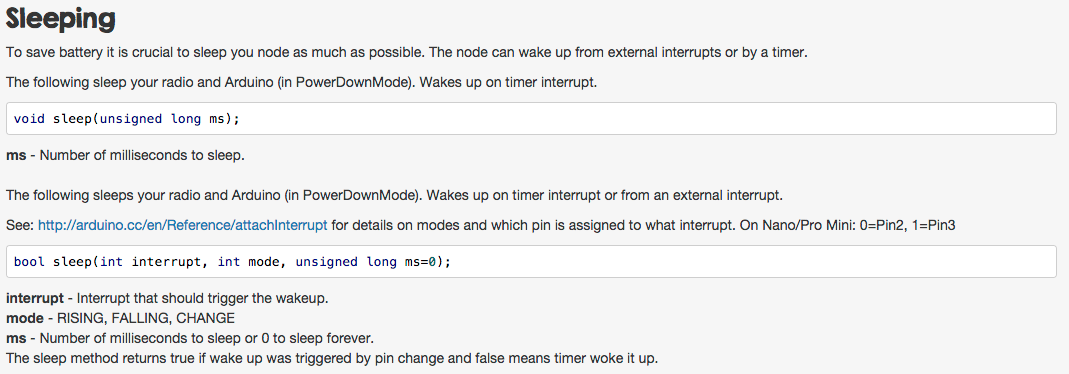
-
attachInterrupt( ) -
@BulldogLowell Isn't that the part that the MySensors libs (should) take care of?
Fulltime Servoy Developer
Parttime Moderator MySensors boardI use Domoticz as controller for Z-Wave and MySensors (previously Indigo and OpenHAB).
I have a FABtotum to print cases. -
@BulldogLowell Isn't that the part that the MySensors libs (should) take care of?
@marceltrapman said:
@BulldogLowell Isn't that the part that the MySensors libs (should) take care of?
Good point.
Does gw.sleep( ) accept both interrupts?
-
Hi @hek and thanks for the info!
However, I'm not sure that I find anything regarding listening for both D2 and D3-pins in MySensors.h, I only find:
*/**
	 * Sleep (PowerDownMode) the Arduino and radio. Wake up on timer or pin change.
	 * See: http://arduino.cc/en/Reference/attachInterrupt for details on modes and which pin
	 * is assigned to what interrupt. On Nano/Pro Mini: 0=Pin2, 1=Pin3
	 * @param interrupt Interrupt that should trigger the wakeup
	 * @param mode RISING, FALLING, CHANGE
	 * @param ms Number of milliseconds to sleep or 0 to sleep forever
	 * @return true if wake up was triggered by pin change and false means timer woke it up.
	 */
	bool sleep(int interrupt, int mode, unsigned long ms=0);
Which is the same as the documentation, right?
-
Hi again!
I've tried different approaches now with the gw.sleep(); func without success, using CHANGE, RISING or FALLING. No reaction either from tag or the Vera.
// Wait for card/tag to leave reader while(nfc.readPassiveTargetID(PN532_MIFARE_ISO14443A, &key[0], ¤tKeyLength)); // gw.sleep(2000); } gw.sleep(0, CHANGE, 1, CHANGE, 0); // int8_t sleep(uint8_t interrupt1, uint8_t mode1, uint8_t interrupt2, uint8_t mode2, unsigned long ms=0); }I've also tried adding this to setup();
interrupts();as well as this:
  attachInterrupt(0, loop, CHANGE);
  attachInterrupt(1, loop, CHANGE);
Nothing happens. It just continues to sleep...
-
I'm back to choosing between no sleep, and the sleep(); function posted above. I can't get gw.sleep(); to work with either one or two interrupts, with or without declaring interrupts(); and/or attachInterrupt();.
I'm ready to try more stuff if anyone got any ideas, but with my own limited understanding of both hardware in general and arduino in particular it feels like I'm running on fumes here. :o
Thanks everyone for your contribution, and @hek - you've done a great job with MySensors! :clap: