Skip to content
  • MySensors
  • OpenHardware.io
  • Categories
  • Recent
  • Tags
  • Popular
Skins
  • Light
  • Brite
  • Cerulean
  • Cosmo
  • Flatly
  • Journal
  • Litera
  • Lumen
  • Lux
  • Materia
  • Minty
  • Morph
  • Pulse
  • Sandstone
  • Simplex
  • Sketchy
  • Spacelab
  • United
  • Yeti
  • Zephyr
  • Dark
  • Cyborg
  • Darkly
  • Quartz
  • Slate
  • Solar
  • Superhero
  • Vapor

  • Default (No Skin)
  • No Skin
Collapse
Brand Logo
  1. Home
  2. Hardware
  3. Battery powered sensor last 1 week

Battery powered sensor last 1 week

Scheduled Pinned Locked Moved Hardware
29 Posts 7 Posters 8.0k Views 6 Watching
  • Oldest to Newest
  • Newest to Oldest
  • Most Votes
Reply
  • Reply as topic
Log in to reply
This topic has been deleted. Only users with topic management privileges can see it.
  • Martin TellblomM Martin Tellblom

    @sundberg84 said:

    to HIGH to power the sensor and then LOW before you sleep the node.

    If you have a multimeter

    Alright so if I connect the Vcc sron the sensor to D2 (since I use D3 for measurement) and set that HIGH before I measure, should I have a sleep for it to power up aswell?

    Something Like this?

      digitalWrite(SOIL_POWER_PIN , HIGH);  
      delayMicroseconds(25);
    
      moisture = analogRead(SOIL_SENSE_PIN);
      
      delayMicroseconds(25);
      digitalWrite(SOIL_POWER_PIN , LOW);  
    
    Nca78N Offline
    Nca78N Offline
    Nca78
    Hardware Contributor
    wrote on last edited by
    #21

    @Martin-Tellblom said:

    Alright so if I connect the Vcc sron the sensor to D2

    Hello, you should use another digital pin than D2 as it is used by MySensors library and on the EastPCB it is connected to the INT pin of the NRF24. I had problems using D2 pin before because of this reason. Use D4,5,6,7 or 8 and you will be sure to have no problem.

    sundberg84S 1 Reply Last reply
    0
    • N Nicklas Starkel

      @Martin-Tellblom , I'm in this mess as well. Just ordered a new Multimeter off aliexpress :)

      @sundberg84 , have you tried other batteries? I bough some ultrafire 3.7V 8800mAh and will try these.
      They were cheap so no loss if they do not work out..

      sundberg84S Offline
      sundberg84S Offline
      sundberg84
      Hardware Contributor
      wrote on last edited by
      #22

      @Nicklas-Starkel - Nope I have not, but @AWI has experienced with some other batteries and i know he recommends some sort to be able to avoid the booster.

      Controller: Proxmox VM - Home Assistant
      MySensors GW: Arduino Uno - W5100 Ethernet, Gw Shield Nrf24l01+ 2,4Ghz
      MySensors GW: Arduino Uno - Gw Shield RFM69, 433mhz
      RFLink GW - Arduino Mega + RFLink Shield, 433mhz

      1 Reply Last reply
      0
      • Martin TellblomM Offline
        Martin TellblomM Offline
        Martin Tellblom
        wrote on last edited by
        #23

        Alright, my sensor has used 5% battery in 124,5 hrs that means that 100% is almost 104 days. Don't know how low the battery works but let say 20% at that is 83 days.

        I will start another test with D4 and see how that goes .....

        MySensors MQTT Client Gateway, Openhab, Dashing, Razberry, 1-wire

        1 Reply Last reply
        0
        • Nca78N Nca78

          @Martin-Tellblom said:

          Alright so if I connect the Vcc sron the sensor to D2

          Hello, you should use another digital pin than D2 as it is used by MySensors library and on the EastPCB it is connected to the INT pin of the NRF24. I had problems using D2 pin before because of this reason. Use D4,5,6,7 or 8 and you will be sure to have no problem.

          sundberg84S Offline
          sundberg84S Offline
          sundberg84
          Hardware Contributor
          wrote on last edited by
          #24

          @Nca78 - good! And i have this fixed with a jumper in the upcoming rev 9 of EasyPCB as well so it will be possible to use D2.

          Controller: Proxmox VM - Home Assistant
          MySensors GW: Arduino Uno - W5100 Ethernet, Gw Shield Nrf24l01+ 2,4Ghz
          MySensors GW: Arduino Uno - Gw Shield RFM69, 433mhz
          RFLink GW - Arduino Mega + RFLink Shield, 433mhz

          1 Reply Last reply
          0
          • N Offline
            N Offline
            Nicklas Starkel
            wrote on last edited by
            #25

            @Martin-Tellblom , how is your project going!
            Did you manage to get longer lasting nodes?

            I have one reed magnetic switch. It seems this only draws 7-10ua in sleep mode and upwards 17ma when sending.
            However, it still drains my batteries very quick which I find odd.
            It wakes up once every hour to send and that should not be much..
            Could be that my rechargable battery is bad so I'll try to replace it with 2AA instead of one 3,7v.

            Martin TellblomM 1 Reply Last reply
            0
            • N Nicklas Starkel

              @Martin-Tellblom , how is your project going!
              Did you manage to get longer lasting nodes?

              I have one reed magnetic switch. It seems this only draws 7-10ua in sleep mode and upwards 17ma when sending.
              However, it still drains my batteries very quick which I find odd.
              It wakes up once every hour to send and that should not be much..
              Could be that my rechargable battery is bad so I'll try to replace it with 2AA instead of one 3,7v.

              Martin TellblomM Offline
              Martin TellblomM Offline
              Martin Tellblom
              wrote on last edited by
              #26

              @Nicklas-Starkel
              I did not with the Soil Moisture sensor. I choose the easy way to use the Xiaomi Mi plant sensor that I check with BlueTooth instead.

              But I did succeed with a DHT22 sensor that now have been running 32 days and sending every hour with battery level of 98% now so that one is a success.

              MySensors MQTT Client Gateway, Openhab, Dashing, Razberry, 1-wire

              1 Reply Last reply
              0
              • bjacobseB Offline
                bjacobseB Offline
                bjacobse
                wrote on last edited by
                #27

                The DHT22 sensor will also quickly use all your battery power
                Replace your NRF24L01+ module, I have had a few that consume too much power, and drain the battery...

                sundberg84S 1 Reply Last reply
                1
                • bjacobseB bjacobse

                  The DHT22 sensor will also quickly use all your battery power
                  Replace your NRF24L01+ module, I have had a few that consume too much power, and drain the battery...

                  sundberg84S Offline
                  sundberg84S Offline
                  sundberg84
                  Hardware Contributor
                  wrote on last edited by
                  #28

                  @bjacobse @Martin-Tellblom I have DHT22 sensor lasting 1.5year, no worries but there are better options! (Both battery and for how good the can measure).

                  Controller: Proxmox VM - Home Assistant
                  MySensors GW: Arduino Uno - W5100 Ethernet, Gw Shield Nrf24l01+ 2,4Ghz
                  MySensors GW: Arduino Uno - Gw Shield RFM69, 433mhz
                  RFLink GW - Arduino Mega + RFLink Shield, 433mhz

                  bjacobseB 1 Reply Last reply
                  0
                  • sundberg84S sundberg84

                    @bjacobse @Martin-Tellblom I have DHT22 sensor lasting 1.5year, no worries but there are better options! (Both battery and for how good the can measure).

                    bjacobseB Offline
                    bjacobseB Offline
                    bjacobse
                    wrote on last edited by bjacobse
                    #29

                    @sundberg84
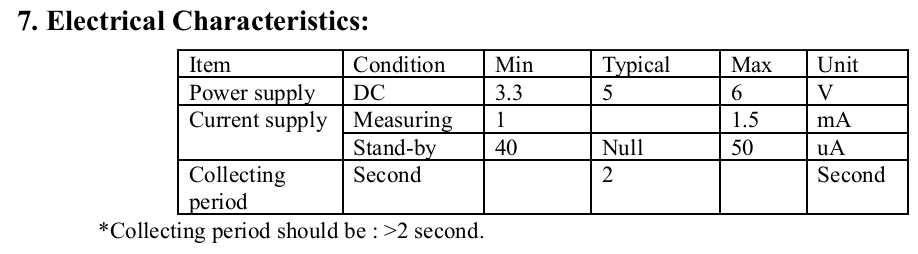
                    Can I assume that you are using power to DHT22 via a FET or directly from Arduino pin, so you are controlling when the DHT22 is getting power/voltage?
                    I personally think using a DHT22 that requires min 3.3 V is not a good option for battery device - but I understand it can be managed ;-)

                    http://www.datasheetcafe.com/dht22-datasheet-pdf/
                    DHT22:
                    0_1478973630852_DHT22.png

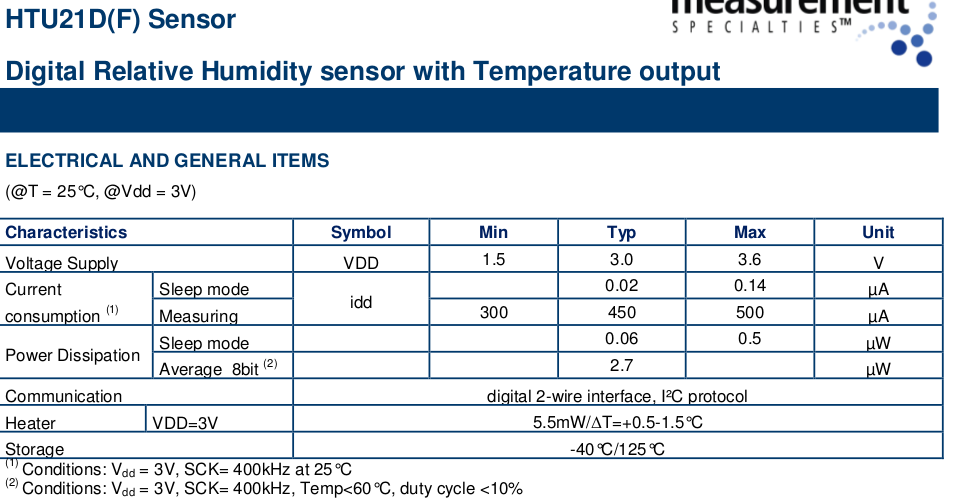
                    My opinion is is use HTU21D instead since it can operate on a much lower battery voltage. Watch out, some breakout boards have a 3,3V voltage regulator, that is just using battery consumption and isn't needed when using Arduino 3.3V 1Mhz battery operated
                    0_1478974581628_HTU21D.png

                    1 Reply Last reply
                    2
                    Reply
                    • Reply as topic
                    Log in to reply
                    • Oldest to Newest
                    • Newest to Oldest
                    • Most Votes


                    11

                    Online

                    11.7k

                    Users

                    11.2k

                    Topics

                    113.1k

                    Posts


                    Copyright 2025 TBD   |   Forum Guidelines   |   Privacy Policy   |   Terms of Service
                    • Login

                    • Don't have an account? Register

                    • Login or register to search.
                    • First post
                      Last post
                    0
                    • MySensors
                    • OpenHardware.io
                    • Categories
                    • Recent
                    • Tags
                    • Popular