
Node running on supercaps and a solar panel.
-
I have got my hands on 30F 2.7V supercapacitor.
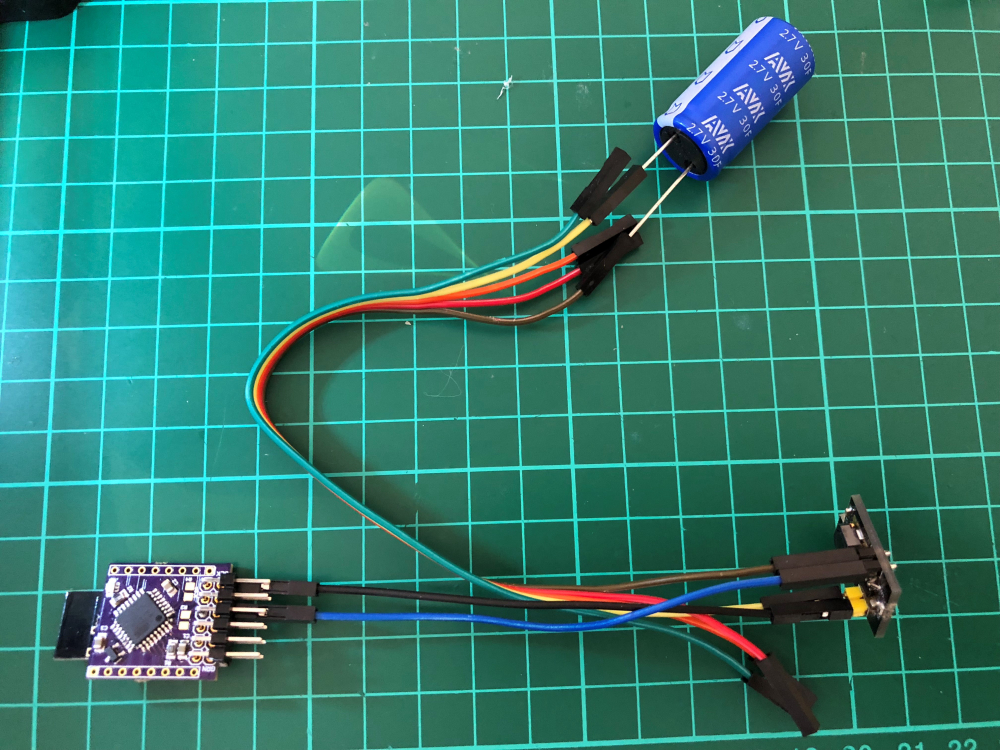
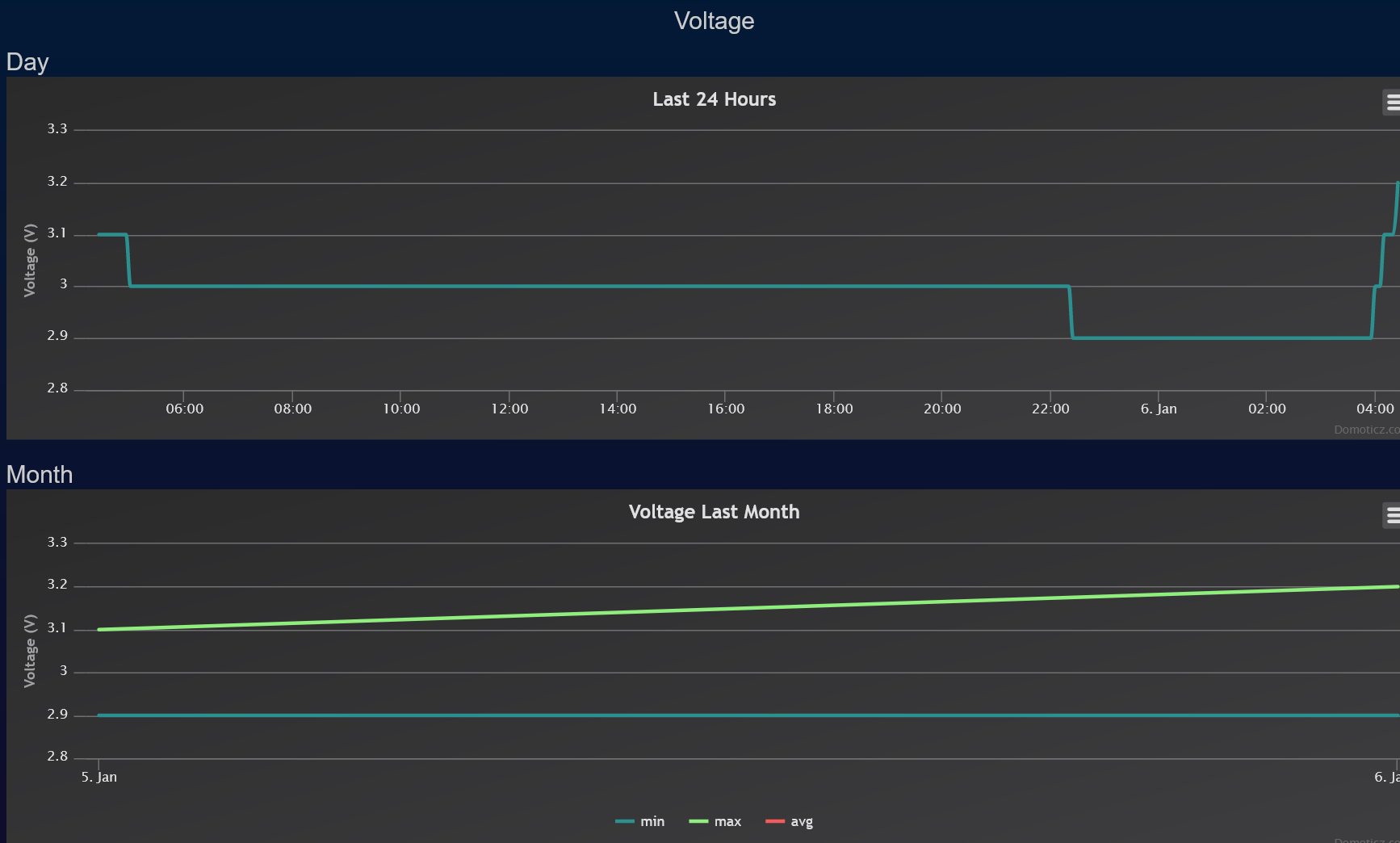
With it was charged for the first time, it only lasted sending 2583 times (1 time a minute voltage and an 20ms LED pulse and then sleeping; sleeping consumption is 4-5uA). The number is a bit disappointing. It is however connected via boost MCP1640 to provide the node with a stable 3.3V. I may try to get the supercapacitor connected directly to the node to see if I can extract more packets.
@alexsh1 said in Node running on supercaps and a solar panel.:
I may try to get the supercapacitor connected directly to the node to see if I can extract more packets.
That's your best choice, unless you're also running a PIR or something that requires a higher minimum voltage. In that case, you could switch to this boost converter, which has only 7ua quiescent current:
https://www.openhardware.io/view/285/33v-Boost-Converter-with-Pass-Through -
@alexsh1 said in Node running on supercaps and a solar panel.:
I may try to get the supercapacitor connected directly to the node to see if I can extract more packets.
That's your best choice, unless you're also running a PIR or something that requires a higher minimum voltage. In that case, you could switch to this boost converter, which has only 7ua quiescent current:
https://www.openhardware.io/view/285/33v-Boost-Converter-with-Pass-Through@neverdie I think you are right. I have tinkered with your other boost converter - https://www.openhardware.io/view/279/Adjustable-Boost-Converter-with-Pass-Through
MCP1640's quiescent current is much higher 19uA.
Now, I'll try to run it from the supercapacitor directly. Pity that anything below 1.9V is going to be wasted (nrf24l01+ is unstable around 1.9V)
-
I bet you will see a proportional drop according to the number of values you want to report. I am still stressing it a bit, so I think there may be margin to save some power by sending less important values with a lower frequency
@gohan Just to let you know. I have been running this node with Si1132 + Si7021 + another sensor (reporting more than 6 values every 5-10 mins) for weeks now. I have just measured the caps = 4.8V (peak is around 5.2V) - it is late at night. In the morning the voltage will go up. I managed to find a very small, but efficient solar cell smaller than in the photo.
The key is to have a low sleeping consumption, i.e. all sensors must sleep properly. In this case you get 4-8uA sleeping current and can live on supercaps for days without recharge.
-
@gohan Just to let you know. I have been running this node with Si1132 + Si7021 + another sensor (reporting more than 6 values every 5-10 mins) for weeks now. I have just measured the caps = 4.8V (peak is around 5.2V) - it is late at night. In the morning the voltage will go up. I managed to find a very small, but efficient solar cell smaller than in the photo.
The key is to have a low sleeping consumption, i.e. all sensors must sleep properly. In this case you get 4-8uA sleeping current and can live on supercaps for days without recharge.
@alexsh1 said in Node running on supercaps and a solar panel.:
I managed to find a very small, but efficient solar cell smaller than in the photo.
Please do tell: what did you find? And where?
-
@neverdie I think you are right. I have tinkered with your other boost converter - https://www.openhardware.io/view/279/Adjustable-Boost-Converter-with-Pass-Through
MCP1640's quiescent current is much higher 19uA.
Now, I'll try to run it from the supercapacitor directly. Pity that anything below 1.9V is going to be wasted (nrf24l01+ is unstable around 1.9V)
@alexsh1 said in Node running on supercaps and a solar panel.:
MCP1640's quiescent current is much higher 19uA.
Or, better yet, just turn it on prior to your sensor readings, and then turn it off.
-
@alexsh1 said in Node running on supercaps and a solar panel.:
MCP1640's quiescent current is much higher 19uA.
Or, better yet, just turn it on prior to your sensor readings, and then turn it off.
-
@alexsh1 said in Node running on supercaps and a solar panel.:
I managed to find a very small, but efficient solar cell smaller than in the photo.
Please do tell: what did you find? And where?
@neverdie sure - this is the one i am very much happy with. Previous one was not supplying enough juice to charge fully supercaps.
-
@neverdie you mean like using a mosfet or something?
It is used to supply 3.3v to atmega328p, I do not think I can just turn it off.@alexsh1 said in Node running on supercaps and a solar panel.:
@neverdie you mean like using a mosfet or something?
It is used to supply 3.3v to atmega328p, I do not think I can just turn it off.Sorry, I meant switch to "pass through".
-
@alexsh1 said in Node running on supercaps and a solar panel.:
@neverdie you mean like using a mosfet or something?
It is used to supply 3.3v to atmega328p, I do not think I can just turn it off.Sorry, I meant switch to "pass through".
-
That is something you can do by leaving the supercap on a desk for 24 hours and a multimeter 😁
-
Did anyone try using 3V solar cell for 2.7V caps?
Seems a perfect fit - no need to use two supercaps in series -
@alexsh1 said in Node running on supercaps and a solar panel.:
@neverdie you mean like using a mosfet or something?
It is used to supply 3.3v to atmega328p, I do not think I can just turn it off.Sorry, I meant switch to "pass through".
@neverdie Did you make any estimates running your mote on supercap? I cannot understand how come on RFM69HW (lowpowerlab), this guy managed to extract 14,111 packets transmitted https://lowpowerlab.com/forum/projects/a-solar-supercap-powered-moteino/
This is on 15F supercap.
-
@neverdie Did you make any estimates running your mote on supercap? I cannot understand how come on RFM69HW (lowpowerlab), this guy managed to extract 14,111 packets transmitted https://lowpowerlab.com/forum/projects/a-solar-supercap-powered-moteino/
This is on 15F supercap.
-
@neverdie I am not questioning his numbers. I am trying to understand why with a normal transceiver (non-H) I am getting so much less. I must admit also that with BQ25570, I have 2x10F in series, which makes it 5F in total only vs 15F.
I should wait until my 30F cap runs out of juice and see how many packets I extracted
-
If you are happy with your setup to power the node, why are you bothering that much to send that many more packets if you actually don't need them anyway?
-
If you are happy with your setup to power the node, why are you bothering that much to send that many more packets if you actually don't need them anyway?
@gohan However, in the nutshell you are right. With a small solar battery (53mm x 30mm, 5V 0.15W), this is what I get:
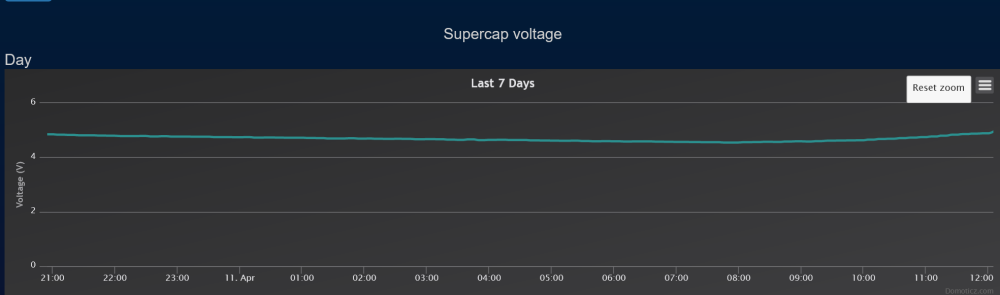
and today is an extremely cloudy day (no sun at all). Harvesting works really well.
I implemented a voltage divider yesterday with 1.8M / 470k resistors. Now I can monitor voltage in Domoticz:
voltage at 22:00 yesterday - 4.797V
voltage at 12:00 today - 4.887V

Hello! It looks like you're interested in this conversation, but you don't have an account yet.
Getting fed up of having to scroll through the same posts each visit? When you register for an account, you'll always come back to exactly where you were before, and choose to be notified of new replies (either via email, or push notification). You'll also be able to save bookmarks and upvote posts to show your appreciation to other community members.
With your input, this post could be even better 💗
Register Login