
NRF24L01+ genuine vs. counterfeit - checked some modules
-
@VaZso
Today i tested this method, and ... It works :-D:-D:-D:-D
Fake over 1mA, genuine about 0,5uA :-D
Thank you.But this can't be probably used as proof in disputes on aliexpress. But for quick test is this method insuperable.
@xlibor It is true, but if you find a trustable seller / modules (like the modules above), you may order more from that seller.
Another indicator may be the price.
Original Nordic NRF24L01+ IC is about 1.78 USD per piece (+TAX) if you buy 1000 pieces. So let's say IC's price may be about 1 USD in high volume - a complete module in the range of 1 USD per piece (including PCB, crystal, etc.) is hard to believe to be original - however, expensive module also may be counterfeit...Otherwise, yesterday I was not sure if I was remember well, but today my colleague confirmed that those modules which I said to consumed more than 4μA is true, but the measured value was ~660μA, so it was also almost 1mA in my case - much worse than modules with original IC.
Anyway, those small modules with counterfeit chips also worked surprisingly well - using a genuine module with PA one side, that counterfeit module (without PA) could also communicate hundreds of meters in open field, but most other modules from China failed that way (one problem could be the unusable external antenna anyway, but other modules with integrated PCB antenna were also worse than this module).
These are the modules I am speaking about: https://www.aliexpress.com/item/10-pcs-Free-Shipping-2-4GHz-NRF24l01-Wireless-Module-Mini-Version/32297159921.htmlTheir pinout is the same as the pinout of RF24L01F20 - that module is only a little bit larger, but with PA and certs, so it has much better range and quality.
-
Hi!
Today, my colleague and me were checked some modules to find out if they are using counterfeit or genuine NRF24L01+ chips inside.
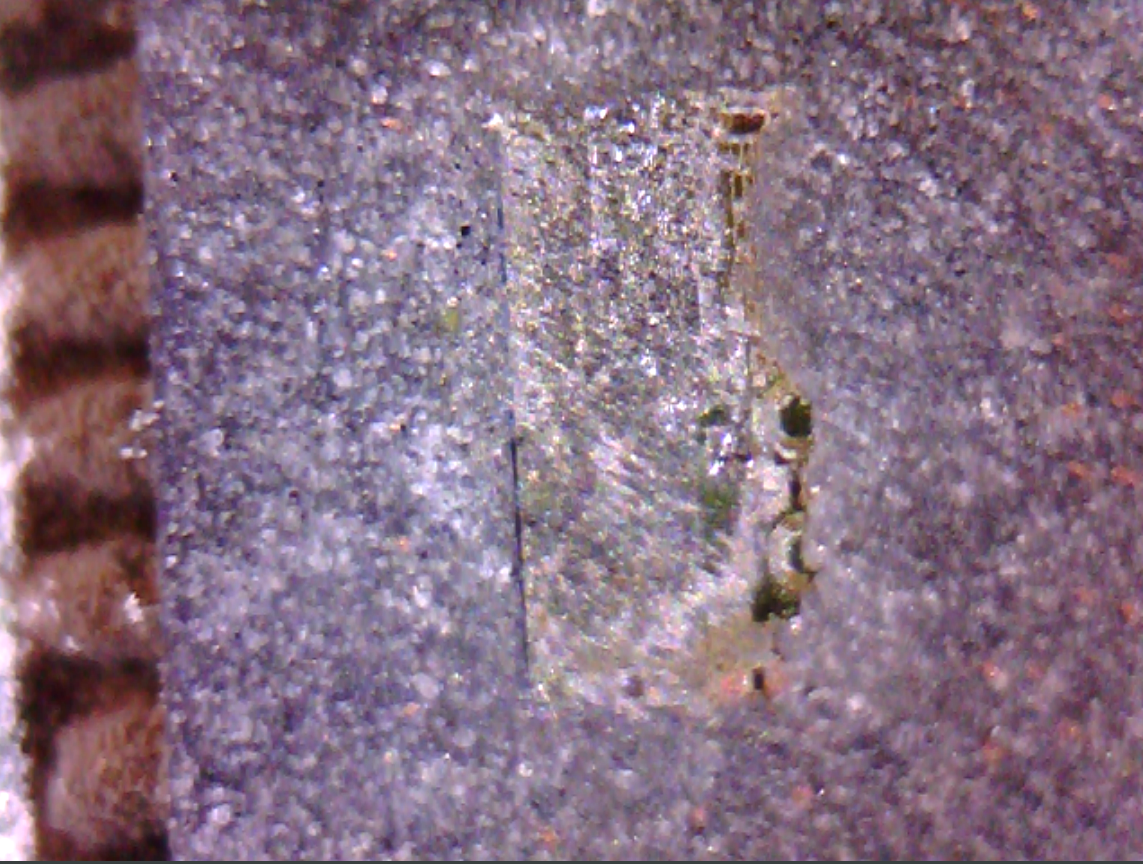
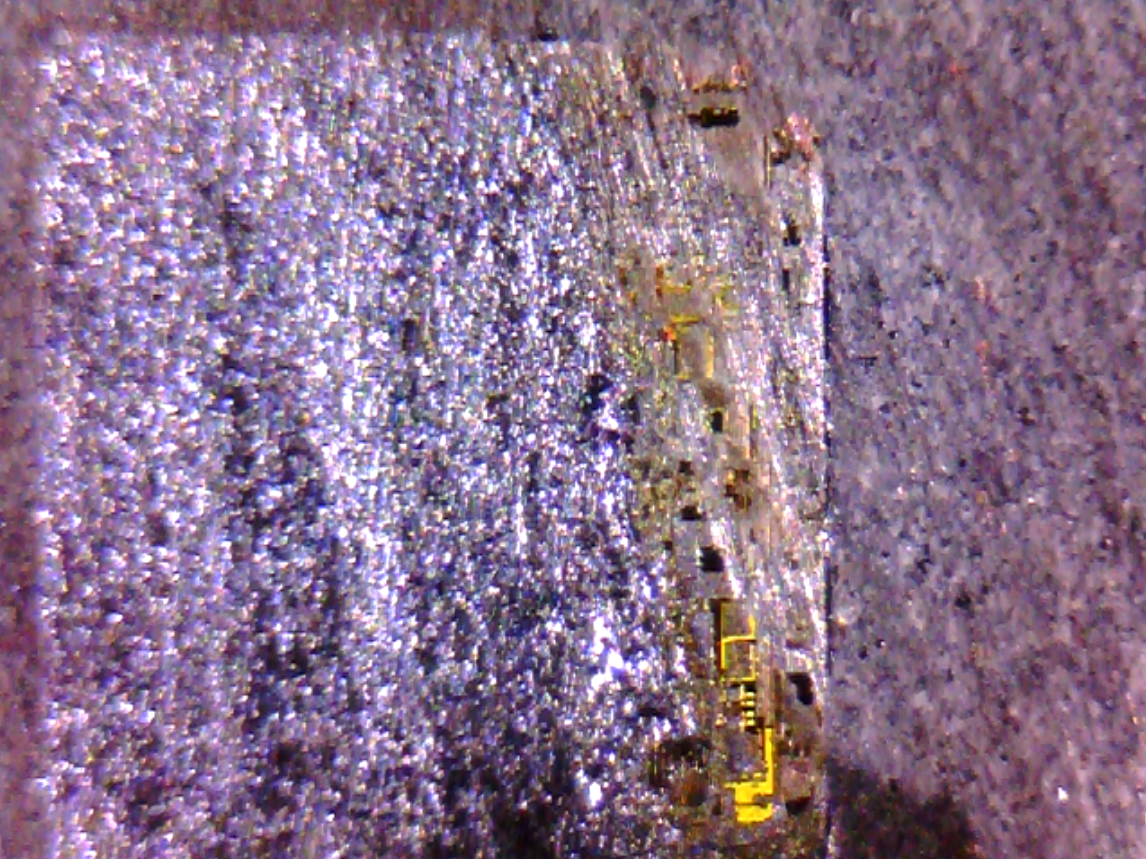
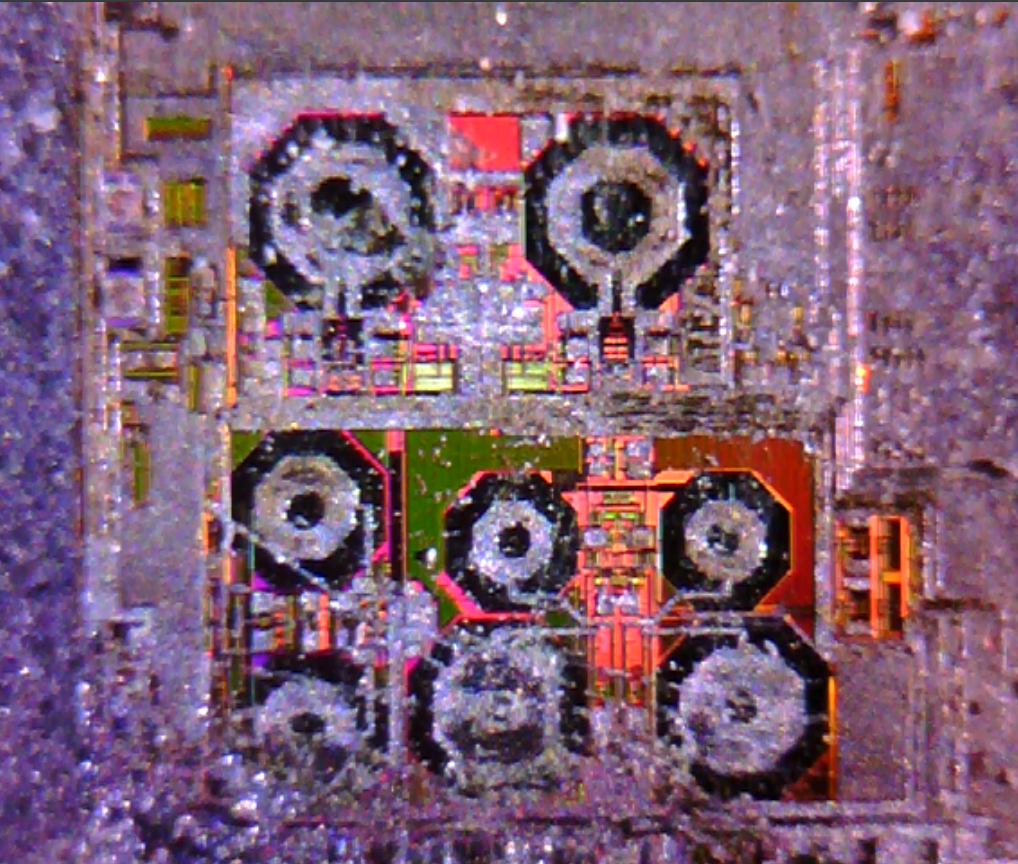
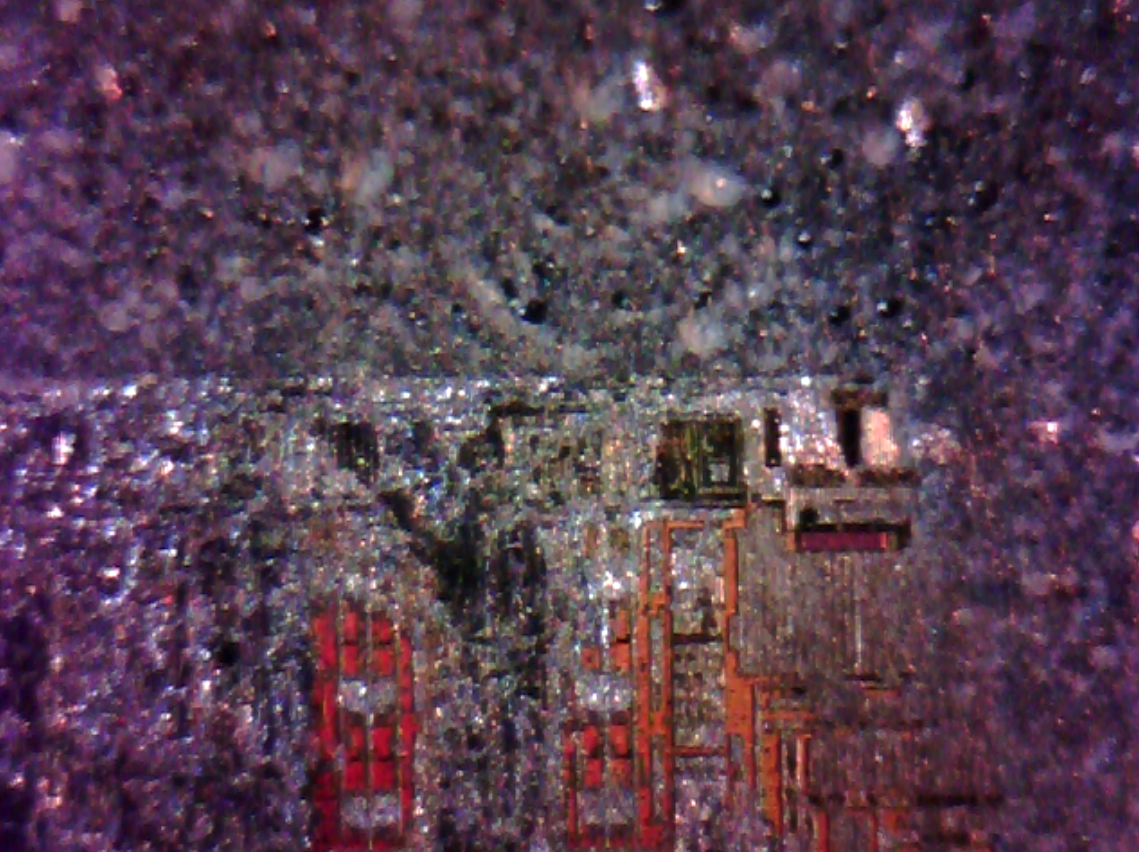
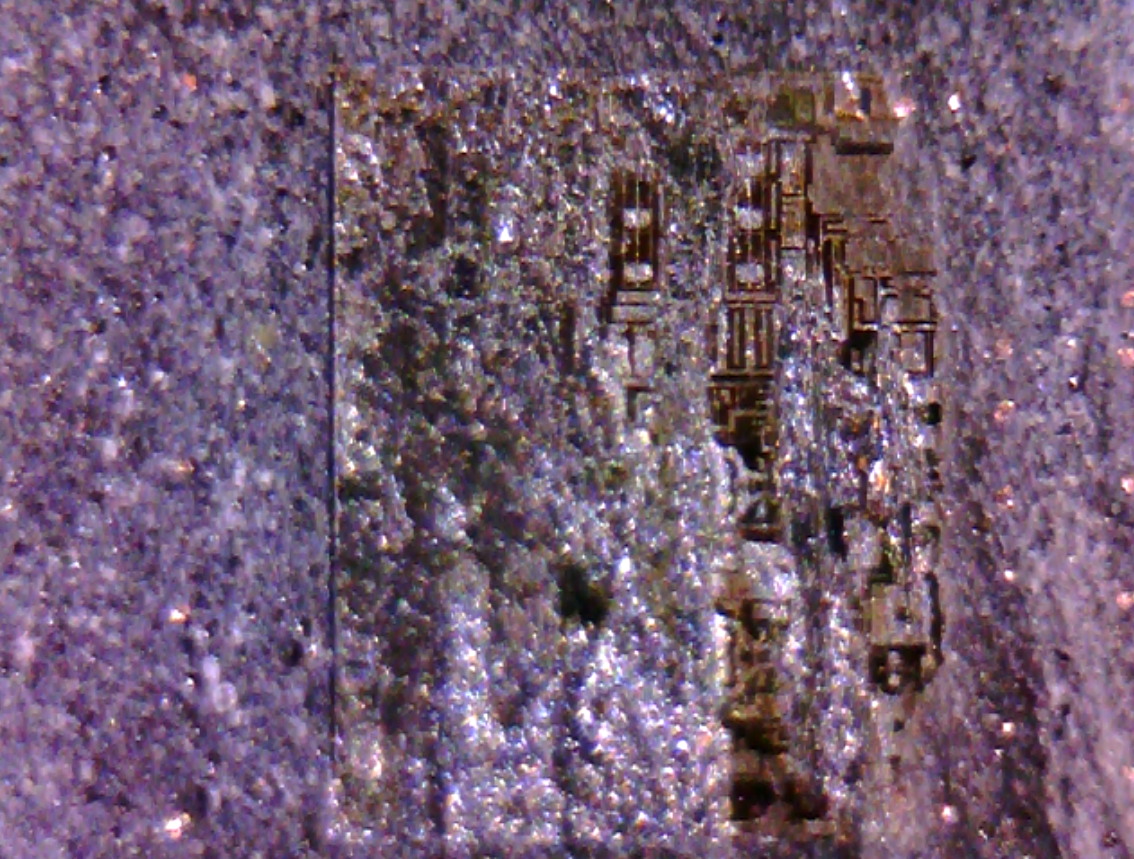
We removed the top of the IC and compared the internals with the photos found here:
https://zeptobars.com/en/read/Nordic-NRF24L01P-SI24R1-real-fake-copyIn really cheap modules, we found counterfeit IC-s.
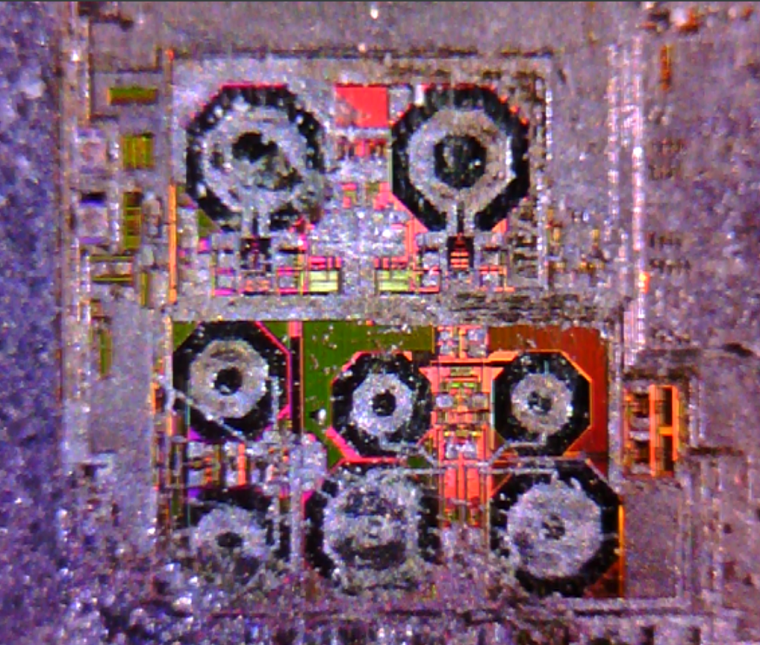
Those modules are similar like the following one (however, they work surprisingly well, but they are counterfeit):
https://www.aliexpress.com/item/Free-Shipping-Power-enhanced-version-SMD-NRF24L01-Wireless-Module-Mini-module-wireless-data-transmission-module/1885195107.html
Edit - I have tested these modules (so they are counterfeit):
https://www.aliexpress.com/item/10-pcs-Free-Shipping-2-4GHz-NRF24l01-Wireless-Module-Mini-Version/32297159921.htmlWe also checked the modules bought here:
https://www.aliexpress.com/item/2PCS-RF2401F20-FCC-Approval-nRF24L01-Chip-Module-RF2401F20-with-126-Channels-20dBm/32520822647.htmlIt is an official store of Nicerf, the module can be found at their website here: http://nicerf.com/product_147_88.html
In RF24L01F20, we found authentic NRF24L01+ IC inside.
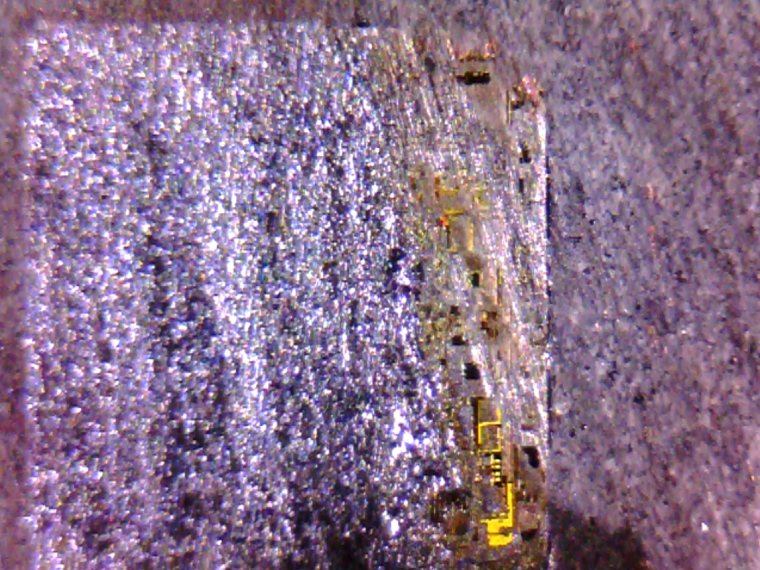
We also found original IC in these modules:
https://www.aliexpress.com/item/2-pcs-L24L01-D03-1000-Meters-Distance-NRF24L01-PA-LNA-Wireless-Module-Original-NRF24L01P-with-Antenna/32335491233.html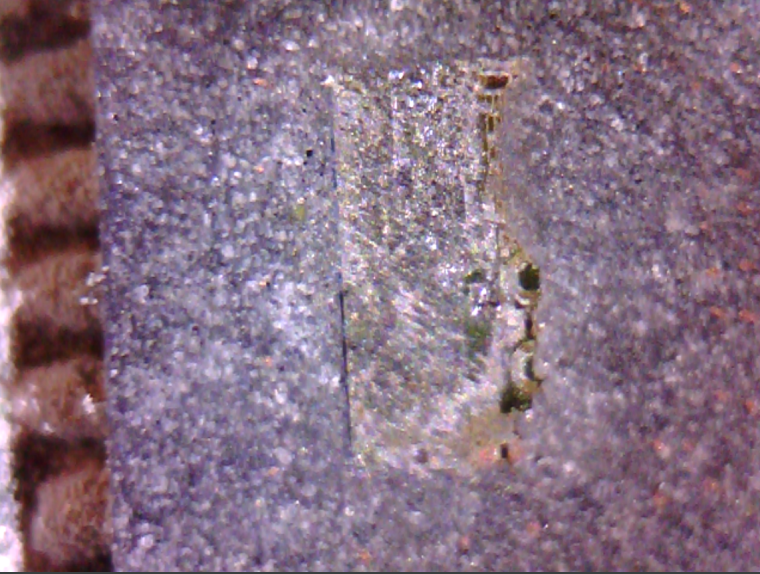
RF2401F20 module is better as it also has CE / IC / FCC certifications, so it is a much complete solution.
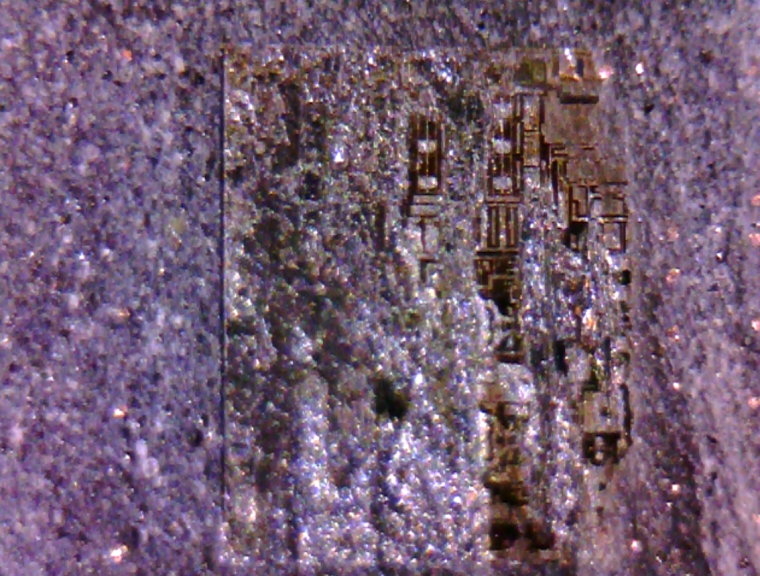
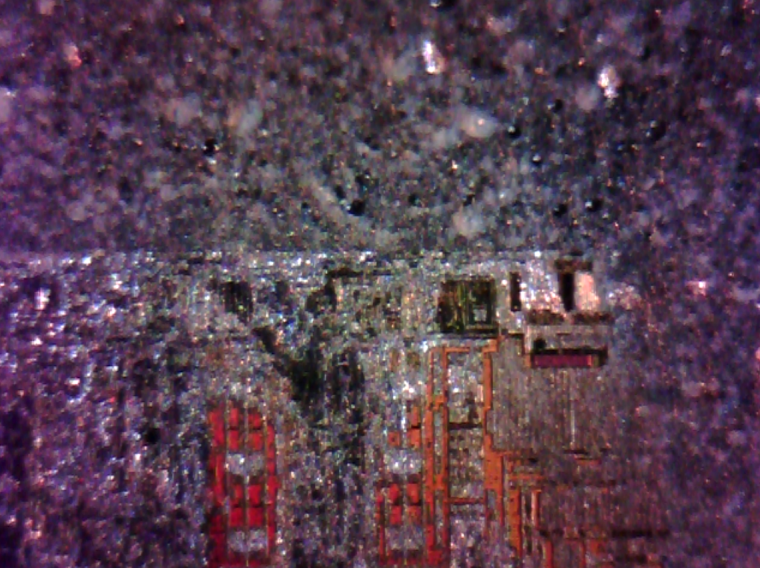
These photos are not really good and the process was way too destructive, but we were able to clearly identify that RF24L01F20 and L24L01-D03 modules are built with genuine Nordic NRF24L01+ IC.
Also, these modules produced the best performance of those I have tried. Good to know they both use original chips inside.
I hope this experiment also helps others as well.
Edit:
Here is a photo of RF24L01F20 without metal cap:
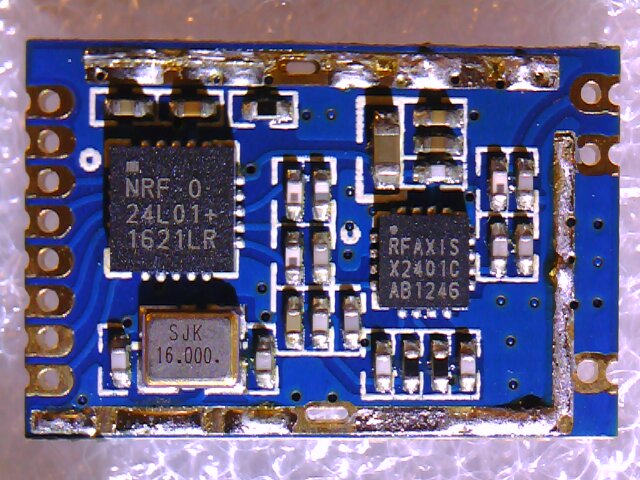
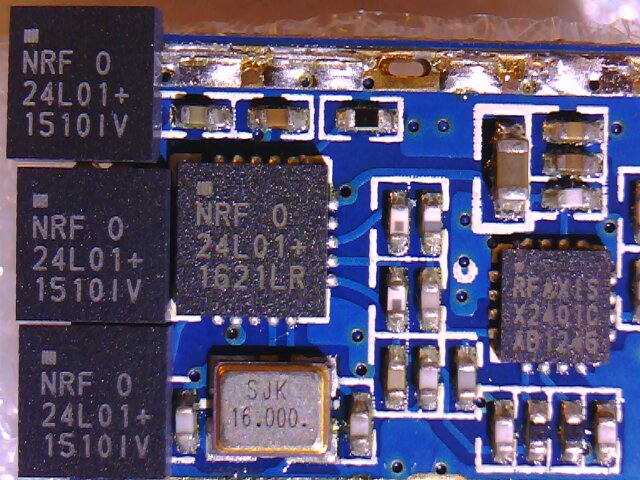
Here is the same module with three genuine ICs on the left which have been purchased from Mouser:
This is a photo of the IC in L24L01-D03 module without metal cap:
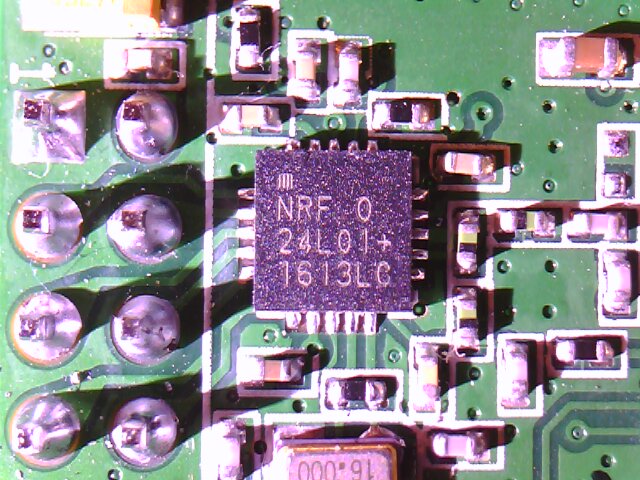
Above ICs are all genuine.
Counterfeit ICs had also a bit different printout - for example, the top left square sign was circle on them and text alignment usually was not perfect, but it may not be a good way to identify if they are genuine or counterfeit.
I hope this may be a good starting point for others who also looking for original products.
Earlier, I said we were able to do some tests at an exhibition using really expansive instruments with a help of a professional in that field.
At that time, we did not know if we have any original modules, but later it has been revealed that most of our modules were genuine, so we tested our modules with authentic IC on board.
We bought two development boards with us where NRF modules were plugged in to do some tests.
One of those modules was sending at 256k (and in some tests at 1M and 2M), other one just received the packets and acked it (when it was turned on). Payload was 32 byte, but we also tested in another module of us with 4 byte payload and same results.
So, after ack has been received (or an about 1ms timeout exceeded), the module sent another message.We chose a frequency for our test where no other transmitter was working.
The transmitter had an antenna attached and the analyzer also had an antenna connected - they were placed close to each other.We looked at the spectrum (using a realtime spectrum analyzer / EMI Test Receiver) and saw some strange noise near the chosen frequency which started to fill near frequencies in the spectrum with peak hold activated.
We looked the frequency deeper and found the signal sometimes not looks to be as narrow as other times.
The instrument was set to trigger and hold the signal when it has beat the trigger field (reddish rectangle in the top left of the photo). We saw this:
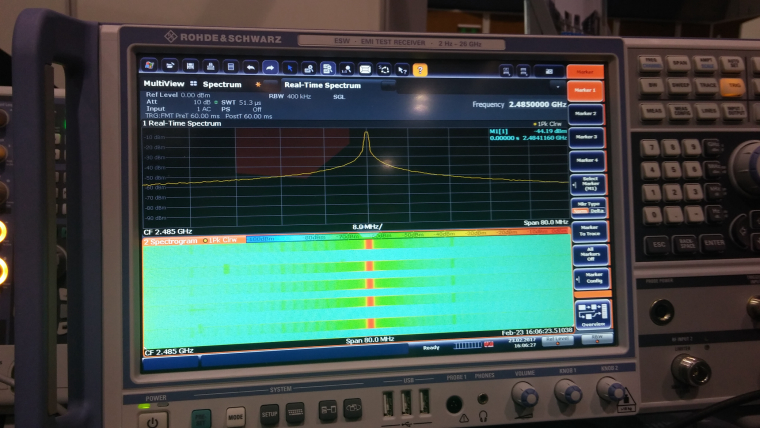
...and this:
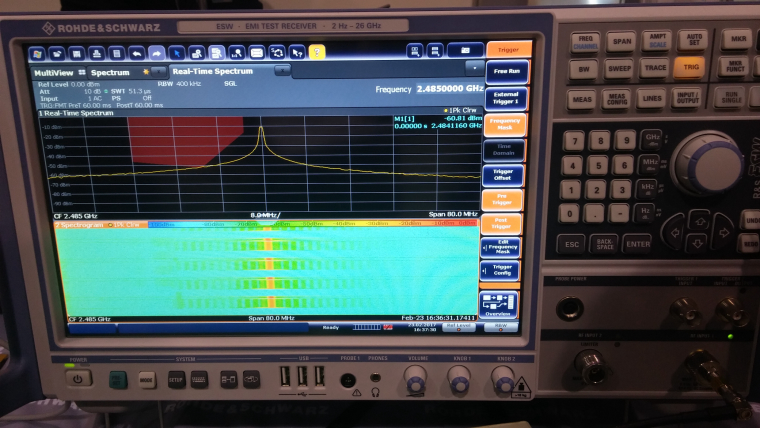
...and so on.
We took two videos of it.
In this one, the trigger was on and the instrument was holding the problematic frame a short time:
https://www.youtube.com/watch?v=SSkCnxgcOp8In this one it is harder to see the problem, but you may notice some wider signals:
https://www.youtube.com/watch?v=hXIK1C5dHzQAs we did not know if the module we used was original IC and we did not have NRF24L01+ from authentic source that time, we desoldered the IC from one of our authentic modules (as later revealed) and replaced it with an IC found in a Gigabyte mouse's receiver (so these two ICs were interchanged). It was an NRF24L01 (without "+"), so it did not support 256k mode, but otherwise it worked well... but with the same behaviour in frequency band.
Also, nothing has changed when we set the transmitter to another channel (other frequency).
Then we tried to examine the communication of the Gigabyte (and a Logitech) mouse, but it was much harder as they are doing frequency hopping like bluetooth technology does.
So, we were less sure about what we see, but we noticed they also produced this symptom.Back to our modules... so all of the modules we tried had similar behaviour, with or without PA, with external antenna or with PCB antenna, be it a module with authentic or counterfeit IC, did not matter. When we turned the module off, the wider frequency component has also disappeared, so it was not some noise from elsewhere. Also mice seemed to have the same problem.
We tried to modify our source code, but it has not helped.
We also examined the receiver board, so when it has transmitted acks - it did the exact same peaks.Between two communications, NRF was in standby-II mode.
Actual library was the same, but in two different boards, one with AVR and other one with STM32, not speaking about mice.It made us a bit unsure if we are allowed to use this module (by regulations) or not.
So, it produces much less noise than a WLAN does, but WLAN is also much higher in bandwidth.The following thread seems to describe the same problem:
https://devzone.nordicsemi.com/question/83443/fccce-rf-certification-fail/Also, many manufacturers use the same IC in commercial equipments, so I assume this problem is not as huge as we thought, also the module above could pass the tests of certification.
Maybe the instrument we used was too high-class (with its price above 200 thousands of USD) or the specific rules allow this behaviour.These examinations led us to look what modules have genuine IC and what modules don't, and how to distinguish them... I have created this thread as a result of our findings initiated by these measurements.
What are your opinions about this?
I would like to know how others see this problem, or if someone knows more about regulations especially in Europe / EU (as we live here), but it would be interesting to hear about the same also from other parts of the globe.Maybe there are professionals here who know much more about it and may share their knowledge.
Thank you in advance.
-
I received these modules https://www.aliexpress.com/item/2-pcs-L24L01-D03-1000-Meters-Distance-NRF24L01-P-LNA-Wireless-Module-with-Antenna/32335491233.html
I have to say they definitely they have a longer range but not as much as I would have expected indoor. Does anybody know what are the 2 additional pins under the radio module?PS does anybody have a link for good NRF24L01+ non PA version?
-
@xlibor It is true, but if you find a trustable seller / modules (like the modules above), you may order more from that seller.
Another indicator may be the price.
Original Nordic NRF24L01+ IC is about 1.78 USD per piece (+TAX) if you buy 1000 pieces. So let's say IC's price may be about 1 USD in high volume - a complete module in the range of 1 USD per piece (including PCB, crystal, etc.) is hard to believe to be original - however, expensive module also may be counterfeit...Otherwise, yesterday I was not sure if I was remember well, but today my colleague confirmed that those modules which I said to consumed more than 4μA is true, but the measured value was ~660μA, so it was also almost 1mA in my case - much worse than modules with original IC.
Anyway, those small modules with counterfeit chips also worked surprisingly well - using a genuine module with PA one side, that counterfeit module (without PA) could also communicate hundreds of meters in open field, but most other modules from China failed that way (one problem could be the unusable external antenna anyway, but other modules with integrated PCB antenna were also worse than this module).
These are the modules I am speaking about: https://www.aliexpress.com/item/10-pcs-Free-Shipping-2-4GHz-NRF24l01-Wireless-Module-Mini-Version/32297159921.htmlTheir pinout is the same as the pinout of RF24L01F20 - that module is only a little bit larger, but with PA and certs, so it has much better range and quality.
@VaZso said in NRF24L01+ genuine vs. counterfeit - checked some modules:
These are the modules I am speaking about: https://www.aliexpress.com/item/10-pcs-Free-Shipping-2-4GHz-NRF24l01-Wireless-Module-Mini-Version/32297159921.html
Their pinout is the same as the pinout of RF24L01F20 - that module is only a little bit larger, but with PA and certs, so it has much better range and quality.
I am using those, from another AliExpress supplier but looking exactly the same including markings on the "NRF24" counterfeit chip. And when in sleep mode (without watchdog times) my nodes (atmega + radio) seem to consume around 2µA so less than the 4uA you measured for radio only, I'm a bit surprised ? But maybe I'm tricked by my multimeter...
-
I received these modules https://www.aliexpress.com/item/2-pcs-L24L01-D03-1000-Meters-Distance-NRF24L01-P-LNA-Wireless-Module-with-Antenna/32335491233.html
I have to say they definitely they have a longer range but not as much as I would have expected indoor. Does anybody know what are the 2 additional pins under the radio module?PS does anybody have a link for good NRF24L01+ non PA version?
@gohan They seem to be connected to GND.
Range depends on the specific ennvironment (walls, used materials like metals, etc), the channel used (if there are other noises like WLAN and so), reflections and such things.
You may also try better antennas or to reduce TX power to see if it runs better. -
@VaZso said in NRF24L01+ genuine vs. counterfeit - checked some modules:
These are the modules I am speaking about: https://www.aliexpress.com/item/10-pcs-Free-Shipping-2-4GHz-NRF24l01-Wireless-Module-Mini-Version/32297159921.html
Their pinout is the same as the pinout of RF24L01F20 - that module is only a little bit larger, but with PA and certs, so it has much better range and quality.
I am using those, from another AliExpress supplier but looking exactly the same including markings on the "NRF24" counterfeit chip. And when in sleep mode (without watchdog times) my nodes (atmega + radio) seem to consume around 2µA so less than the 4uA you measured for radio only, I'm a bit surprised ? But maybe I'm tricked by my multimeter...
-
@gohan They seem to be connected to GND.
Range depends on the specific ennvironment (walls, used materials like metals, etc), the channel used (if there are other noises like WLAN and so), reflections and such things.
You may also try better antennas or to reduce TX power to see if it runs better. -
@VaZso those modules comes with a 20cm long antenna, I don't have anything bigger than that.
Anyway I'm looking for normal nrf24 modules to fit into smaller projects. -
@gohan External size is one thing, internals are more important - there are better (properly tuned) antennas in small size.
The RF24L01F20 module seems to be really good. Albeit it has PA, you may lowering the outside power a bit if necessary. -
-
@gohan External size is one thing, internals are more important - there are better (properly tuned) antennas in small size.
The RF24L01F20 module seems to be really good. Albeit it has PA, you may lowering the outside power a bit if necessary. -
@VaZso the problem is how to determine which antenna is better
PS I checked the addition pins and they are indeed ground. I just wonder what is the need to have them there.
-
-
-
@Nca78 I have measured less than 1μA for real modules and about 660μA for counterfeit ones.
However, multimeter may also give invalid result...@VaZso said in NRF24L01+ genuine vs. counterfeit - checked some modules:
@Nca78 I have measured less than 1μA for real modules and about 660μA for counterfeit ones.
However, multimeter may also give invalid result...That's huge, I'm running a few nodes with those modules on CR2025 and CR2032 they would die in 2 weeks with such a draw and obviously that's not the case. And I don't think a multimeter can be that far from reality ...
-
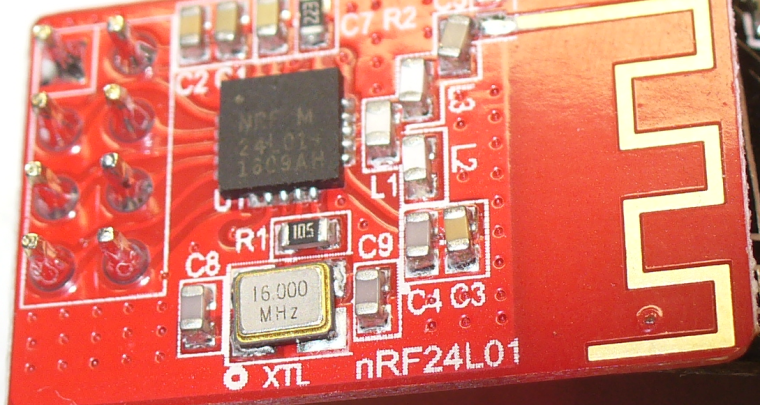
This a module I just got from Amazon produced by Sunfounder but it seems it has the same chip as the fake ones I got also from Amazon
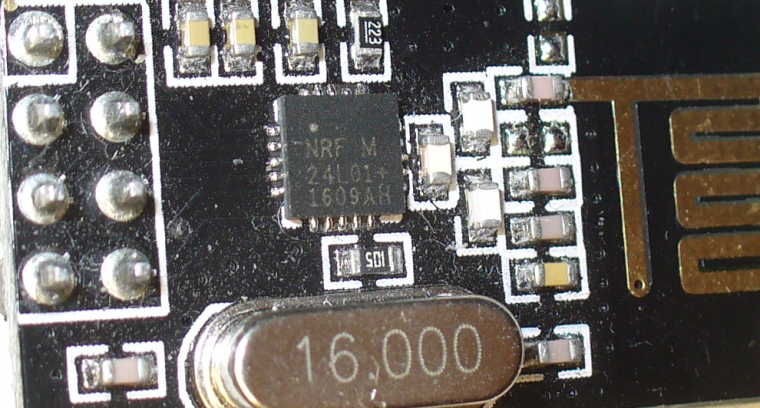
The red one has actually a better range of about 3 meters more indoor but they cost 4.5€ each while the others cost 1.2€. I think I am going to return them and get some from Itead
-
i only saw this post today. So i dont have any nrf24 that have this square on top righ of the chip. all have a solid circle. that means they are fake right?
obvius i already expect that because they cost 80cents on ebay righ now.... ::blush: -
@VaZso said in NRF24L01+ genuine vs. counterfeit - checked some modules:
@Nca78 I have measured less than 1μA for real modules and about 660μA for counterfeit ones.
However, multimeter may also give invalid result...That's huge, I'm running a few nodes with those modules on CR2025 and CR2032 they would die in 2 weeks with such a draw and obviously that's not the case. And I don't think a multimeter can be that far from reality ...
-
@Nca78 Yes, it is true - if 240 mAh is the battery capacity, it would last for ~15 days.
However, I have measured my modules uninitialized, so it may be better if one sends it to sleep mode by software... I have not measured them in other modes.@VaZso said in NRF24L01+ genuine vs. counterfeit - checked some modules:
However, I have measured my modules uninitialized, so it may be better if one sends it to sleep mode by software... I have not measured them in other modes.
Ah yes that's probably the reason, I will test before I connect them.
@gohan I thing your better range is due to the antenna design, same "style" than the one on "F" ESP8266 modules which also have a slightly better range.
-
This a module I just got from Amazon produced by Sunfounder but it seems it has the same chip as the fake ones I got also from Amazon
The red one has actually a better range of about 3 meters more indoor but they cost 4.5€ each while the others cost 1.2€. I think I am going to return them and get some from Itead
For better range, a lot of people seem to like this modification: http://www.instructables.com/id/Enhanced-NRF24L01/





Hello! It looks like you're interested in this conversation, but you don't have an account yet.
Getting fed up of having to scroll through the same posts each visit? When you register for an account, you'll always come back to exactly where you were before, and choose to be notified of new replies (either via email, or push notification). You'll also be able to save bookmarks and upvote posts to show your appreciation to other community members.
With your input, this post could be even better 💗
Register Login