
Battery reporting keeps increasing not decreasing
-
Hello,
I have a normal door sensor based on My Slim node design. It has been running for around 3 months till now but the battery percentage is abnormal.
At the beginning I remember that the percentage begun as 72% so I thought maybe this is because my max voltage is defined as 3.3v not 3v. After some time, maybe 2 weeks it was 75%. It has been like this for like 2 months. Then I switched my gateway OFF for 3 weeks and switched it back ON now to see the battery voltage percentage and found it to be 80% :)
The batteries are two AAA 1.5v each.
Sketch:
/**
 * The MySensors Arduino library handles the wireless radio link and protocol
 * between your home built sensors/actuators and HA controller of choice.
 * The sensors forms a self healing radio network with optional repeaters. Each
 * repeater and gateway builds a routing tables in EEPROM which keeps track of the
 * network topology allowing messages to be routed to nodes.
 *
 * Created by Henrik Ekblad <henrik.ekblad@mysensors.org>
 * Copyright (C) 2013-2015 Sensnology AB
 * Full contributor list: https://github.com/mysensors/Arduino/graphs/contributors
 *
 * Documentation: http://www.mysensors.org
 * Support Forum: http://forum.mysensors.org
 *
 * This program is free software; you can redistribute it and/or
 * modify it under the terms of the GNU General Public License
 * version 2 as published by the Free Software Foundation.
 *
 *******************************
 *
 * REVISION HISTORY
 * Version 1.0 - Henrik Ekblad
 *
 * DESCRIPTION
 * Motion Sensor example using HC-SR501
 * http://www.mysensors.org/build/motion
 *
 */

#define MY_BAUD_RATE 9600 // For 1 MHz

// Enable debug prints
#define MY_DEBUG

#ifdef MY_DEBUG
#define DEBUG
#endif

#ifdef DEBUG
#define DEBUG_SERIAL(x) Serial.begin(x)
#define DEBUG_PRINT(x) Serial.print(x)
#define DEBUG_PRINTLN(x) Serial.println(x)
#else
#define DEBUG_SERIAL(x)
#define DEBUG_PRINT(x)
#define DEBUG_PRINTLN(x)
#endif


// Enable and select radio type attached
#define MY_RADIO_NRF24
//#define MY_RADIO_RFM69


#if 0
// Select soft/hardware signing method
#define MY_SIGNING_SOFT //!< Software signing
//#define MY_SIGNING_ATSHA204 //!< Hardware signing using ATSHA204A

// Enable node whitelisting
//#define MY_SIGNING_NODE_WHITELISTING {{.nodeId = GATEWAY_ADDRESS,.serial = {0x09,0x08,0x07,0x06,0x05,0x04,0x03,0x02,0x01}}}
// Enable this if you want destination node to sign all messages sent to this node.
#define MY_SIGNING_REQUEST_SIGNATURES


// SETTINGS FOR MY_SIGNING_SOFT
/// Set the soft_serial value to an arbitrary value for proper security (9 bytes)
#define MY_SIGNING_SOFT_SERIAL 0x11,0x02,0x03,0x04,0x05,0x06,0x07,0x08,0x09
/// Key to use for HMAC calculation in soft signing (32 bytes)
#define MY_SIGNING_SOFT_HMAC_KEY 0x10,0x20,0x30,0x00,0x00,0x00,0x00,0x00,0x00,0x00,0x00,0x00,0x00,0x00,0x00,0x00,0x00,0x00,0x00,0x00,0x00,0x00,0x00,0x00,0x00,0x00,0x00,0x00,0x00,0x00,0x00,0x00

#define MY_SIGNING_SOFT_RANDOMSEED_PIN A7 //!< Unconnected analog pin for random seed

#endif

#include <SPI.h>
#include <MySensor.h>
unsigned long SLEEP_TIME = 120000; // Sleep time between reports (in milliseconds)
#define DIGITAL_INPUT_SENSOR 3   // The digital input you attached your motion sensor.  (Only 2 and 3 generates interrupt!)
#define INTERRUPT DIGITAL_INPUT_SENSOR-2 // Usually the interrupt = pin -2 (on uno/nano anyway)
#define CHILD_ID 0   // Id of the sensor child
#define CHILD_ID_BATTERY 1

//#define BATTERY_FULL 3000 // 3,000 millivolts for 2xAA (DOLA - changed to 5000 as it was tested on a laptop)
//#define BATTERY_ZERO 1900 // 1,900 millivolts (1.9V, limit for nrf24l01 without step-up. 2.8V limit for Atmega328 without BOD disabled))
#define VMIN 1900
#define VMAX 3300


long readVcc();

// Initialize motion message
MyMessage msg(CHILD_ID, V_TRIPPED);

unsigned int ADCValue;
double Voltage;
double Vcc;
long oldvoltage = 0;

void setup()
{
  pinMode(DIGITAL_INPUT_SENSOR, INPUT);      // sets the motion sensor digital pin as input
}

void presentation()  {
  // Send the sketch version information to the gateway and Controller
  sendSketchInfo("Door Sensor", "1.0");

  // Register all sensors to gw (they will be created as child devices)
  present(CHILD_ID, S_MOTION);

}

void loop()
{
  wait(25);       // Short delay to allow switch to properly settle

  // Read digital motion value
  boolean tripped = digitalRead(DIGITAL_INPUT_SENSOR) == HIGH;

//  Serial.println(tripped);
//  send(msg.set(tripped?"OPEN":"CLOSED"));  // Send tripped value to gw (OPENHAB)
  send(msg.set(tripped?"1":"0"));  // Send tripped value to gw (Domoticz)

 /*
  Vcc = readVcc()/1000.0;
  ADCValue = analogRead(0);
  Voltage = (ADCValue / 1023.0) * Vcc;
*/
long voltage = readVcc();
//Serial.println(voltage);
  if (oldvoltage != voltage) { // Only send battery information if voltage has changed, to conserve battery.

    long batteryVolt = readVcc();
    DEBUG_PRINT("Battery voltage: "); DEBUG_PRINT(batteryVolt); DEBUG_PRINTLN(" mV");
    uint8_t batteryPcnt = constrain(map(batteryVolt,VMIN,VMAX,0,100),0,255);
    DEBUG_PRINT("Battery percent: "); DEBUG_PRINT(batteryPcnt); DEBUG_PRINTLN(" %");
    sendBatteryLevel(batteryPcnt);


 //   sendBatteryLevel(round((voltage - BATTERY_ZERO) * 100.0 / (BATTERY_FULL - BATTERY_ZERO)));
    oldvoltage = voltage;

  }
//  Serial.print(Vcc);
//  Serial.print ( " " );
//  Serial.println(Voltage);

  // Sleep until interrupt comes in on motion sensor. Send update every two minute.
  sleep(INTERRUPT,CHANGE);
}

long readVcc() {
  // From http://provideyourown.com/2012/secret-arduino-voltmeter-measure-battery-voltage/
  // Read 1.1V reference against AVcc
  // set the reference to Vcc and the measurement to the internal 1.1V reference
#if defined(__AVR_ATmega32U4__) || defined(__AVR_ATmega1280__) || defined(__AVR_ATmega2560__)
  ADMUX = _BV(REFS0) | _BV(MUX4) | _BV(MUX3) | _BV(MUX2) | _BV(MUX1);
#elif defined (__AVR_ATtiny24__) || defined(__AVR_ATtiny44__) || defined(__AVR_ATtiny84__)
  ADMUX = _BV(MUX5) | _BV(MUX0);
#elif defined (__AVR_ATtiny25__) || defined(__AVR_ATtiny45__) || defined(__AVR_ATtiny85__)
  ADMUX = _BV(MUX3) | _BV(MUX2);
#else
  ADMUX = _BV(REFS0) | _BV(MUX3) | _BV(MUX2) | _BV(MUX1);
#endif

  delay(2); // Wait for Vref to settle
  ADCSRA |= _BV(ADSC); // Start conversion
  while (bit_is_set(ADCSRA, ADSC)); // measuring

  uint8_t low  = ADCL; // must read ADCL first - it then locks ADCH
  uint8_t high = ADCH; // unlocks both

  long result = (high << 8) | low;

  result = 1125300L / result; // Calculate Vcc (in mV); 1125300 = 1.1*1023*1000
  return result; // Vcc in millivolts
}
Code has lots of unused variables and commented lines and the signing is not compiled in the project. a bit messy and needs to be cleaned up.
Thanks. -
I think I remembered some graph on this forum. A battery will report a higher percentage when it's starting lose it's power. So the readings seem to be normal.
-
Hello,
I have a normal door sensor based on My Slim node design. It has been running for around 3 months till now but the battery percentage is abnormal.
At the beginning I remember that the percentage begun as 72% so I thought maybe this is because my max voltage is defined as 3.3v not 3v. After some time, maybe 2 weeks it was 75%. It has been like this for like 2 months. Then I switched my gateway OFF for 3 weeks and switched it back ON now to see the battery voltage percentage and found it to be 80% :)
The batteries are two AAA 1.5v each.
Sketch:
/**
 * The MySensors Arduino library handles the wireless radio link and protocol
 * between your home built sensors/actuators and HA controller of choice.
 * The sensors forms a self healing radio network with optional repeaters. Each
 * repeater and gateway builds a routing tables in EEPROM which keeps track of the
 * network topology allowing messages to be routed to nodes.
 *
 * Created by Henrik Ekblad <henrik.ekblad@mysensors.org>
 * Copyright (C) 2013-2015 Sensnology AB
 * Full contributor list: https://github.com/mysensors/Arduino/graphs/contributors
 *
 * Documentation: http://www.mysensors.org
 * Support Forum: http://forum.mysensors.org
 *
 * This program is free software; you can redistribute it and/or
 * modify it under the terms of the GNU General Public License
 * version 2 as published by the Free Software Foundation.
 *
 *******************************
 *
 * REVISION HISTORY
 * Version 1.0 - Henrik Ekblad
 *
 * DESCRIPTION
 * Motion Sensor example using HC-SR501
 * http://www.mysensors.org/build/motion
 *
 */

#define MY_BAUD_RATE 9600 // For 1 MHz

// Enable debug prints
#define MY_DEBUG

#ifdef MY_DEBUG
#define DEBUG
#endif

#ifdef DEBUG
#define DEBUG_SERIAL(x) Serial.begin(x)
#define DEBUG_PRINT(x) Serial.print(x)
#define DEBUG_PRINTLN(x) Serial.println(x)
#else
#define DEBUG_SERIAL(x)
#define DEBUG_PRINT(x)
#define DEBUG_PRINTLN(x)
#endif


// Enable and select radio type attached
#define MY_RADIO_NRF24
//#define MY_RADIO_RFM69


#if 0
// Select soft/hardware signing method
#define MY_SIGNING_SOFT //!< Software signing
//#define MY_SIGNING_ATSHA204 //!< Hardware signing using ATSHA204A

// Enable node whitelisting
//#define MY_SIGNING_NODE_WHITELISTING {{.nodeId = GATEWAY_ADDRESS,.serial = {0x09,0x08,0x07,0x06,0x05,0x04,0x03,0x02,0x01}}}
// Enable this if you want destination node to sign all messages sent to this node.
#define MY_SIGNING_REQUEST_SIGNATURES


// SETTINGS FOR MY_SIGNING_SOFT
/// Set the soft_serial value to an arbitrary value for proper security (9 bytes)
#define MY_SIGNING_SOFT_SERIAL 0x11,0x02,0x03,0x04,0x05,0x06,0x07,0x08,0x09
/// Key to use for HMAC calculation in soft signing (32 bytes)
#define MY_SIGNING_SOFT_HMAC_KEY 0x10,0x20,0x30,0x00,0x00,0x00,0x00,0x00,0x00,0x00,0x00,0x00,0x00,0x00,0x00,0x00,0x00,0x00,0x00,0x00,0x00,0x00,0x00,0x00,0x00,0x00,0x00,0x00,0x00,0x00,0x00,0x00

#define MY_SIGNING_SOFT_RANDOMSEED_PIN A7 //!< Unconnected analog pin for random seed

#endif

#include <SPI.h>
#include <MySensor.h>
unsigned long SLEEP_TIME = 120000; // Sleep time between reports (in milliseconds)
#define DIGITAL_INPUT_SENSOR 3   // The digital input you attached your motion sensor.  (Only 2 and 3 generates interrupt!)
#define INTERRUPT DIGITAL_INPUT_SENSOR-2 // Usually the interrupt = pin -2 (on uno/nano anyway)
#define CHILD_ID 0   // Id of the sensor child
#define CHILD_ID_BATTERY 1

//#define BATTERY_FULL 3000 // 3,000 millivolts for 2xAA (DOLA - changed to 5000 as it was tested on a laptop)
//#define BATTERY_ZERO 1900 // 1,900 millivolts (1.9V, limit for nrf24l01 without step-up. 2.8V limit for Atmega328 without BOD disabled))
#define VMIN 1900
#define VMAX 3300


long readVcc();

// Initialize motion message
MyMessage msg(CHILD_ID, V_TRIPPED);

unsigned int ADCValue;
double Voltage;
double Vcc;
long oldvoltage = 0;

void setup()
{
  pinMode(DIGITAL_INPUT_SENSOR, INPUT);      // sets the motion sensor digital pin as input
}

void presentation()  {
  // Send the sketch version information to the gateway and Controller
  sendSketchInfo("Door Sensor", "1.0");

  // Register all sensors to gw (they will be created as child devices)
  present(CHILD_ID, S_MOTION);

}

void loop()
{
  wait(25);       // Short delay to allow switch to properly settle

  // Read digital motion value
  boolean tripped = digitalRead(DIGITAL_INPUT_SENSOR) == HIGH;

//  Serial.println(tripped);
//  send(msg.set(tripped?"OPEN":"CLOSED"));  // Send tripped value to gw (OPENHAB)
  send(msg.set(tripped?"1":"0"));  // Send tripped value to gw (Domoticz)

 /*
  Vcc = readVcc()/1000.0;
  ADCValue = analogRead(0);
  Voltage = (ADCValue / 1023.0) * Vcc;
*/
long voltage = readVcc();
//Serial.println(voltage);
  if (oldvoltage != voltage) { // Only send battery information if voltage has changed, to conserve battery.

    long batteryVolt = readVcc();
    DEBUG_PRINT("Battery voltage: "); DEBUG_PRINT(batteryVolt); DEBUG_PRINTLN(" mV");
    uint8_t batteryPcnt = constrain(map(batteryVolt,VMIN,VMAX,0,100),0,255);
    DEBUG_PRINT("Battery percent: "); DEBUG_PRINT(batteryPcnt); DEBUG_PRINTLN(" %");
    sendBatteryLevel(batteryPcnt);


 //   sendBatteryLevel(round((voltage - BATTERY_ZERO) * 100.0 / (BATTERY_FULL - BATTERY_ZERO)));
    oldvoltage = voltage;

  }
//  Serial.print(Vcc);
//  Serial.print ( " " );
//  Serial.println(Voltage);

  // Sleep until interrupt comes in on motion sensor. Send update every two minute.
  sleep(INTERRUPT,CHANGE);
}

long readVcc() {
  // From http://provideyourown.com/2012/secret-arduino-voltmeter-measure-battery-voltage/
  // Read 1.1V reference against AVcc
  // set the reference to Vcc and the measurement to the internal 1.1V reference
#if defined(__AVR_ATmega32U4__) || defined(__AVR_ATmega1280__) || defined(__AVR_ATmega2560__)
  ADMUX = _BV(REFS0) | _BV(MUX4) | _BV(MUX3) | _BV(MUX2) | _BV(MUX1);
#elif defined (__AVR_ATtiny24__) || defined(__AVR_ATtiny44__) || defined(__AVR_ATtiny84__)
  ADMUX = _BV(MUX5) | _BV(MUX0);
#elif defined (__AVR_ATtiny25__) || defined(__AVR_ATtiny45__) || defined(__AVR_ATtiny85__)
  ADMUX = _BV(MUX3) | _BV(MUX2);
#else
  ADMUX = _BV(REFS0) | _BV(MUX3) | _BV(MUX2) | _BV(MUX1);
#endif

  delay(2); // Wait for Vref to settle
  ADCSRA |= _BV(ADSC); // Start conversion
  while (bit_is_set(ADCSRA, ADSC)); // measuring

  uint8_t low  = ADCL; // must read ADCL first - it then locks ADCH
  uint8_t high = ADCH; // unlocks both

  long result = (high << 8) | low;

  result = 1125300L / result; // Calculate Vcc (in mV); 1125300 = 1.1*1023*1000
  return result; // Vcc in millivolts
}
Code has lots of unused variables and commented lines and the signing is not compiled in the project. a bit messy and needs to be cleaned up.
Thanks.@ahmedadelhosni There is a (positive) voltage - temperature relation with Alkaline cells. So for Egypt it could be an explanation..
With lithium cells I also found that voltage tends to decrease during a "stress" period and returns slowly to a higher voltage.
-
Impressive and annoying :)
So is there any workaround to solve this ? looks like it is a normal behavior and reproducible.
-
Impressive and annoying :)
So is there any workaround to solve this ? looks like it is a normal behavior and reproducible.
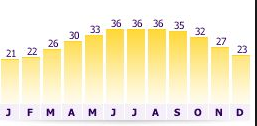
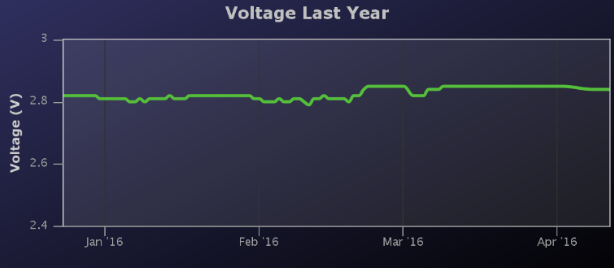
@ahmedadelhosni There is nothing to solve ... My Electric car runs 40 km on a load in winter (-2 C) and 80km in summer (22 C). Your sensor could run a few years if well built and using low self discharge batteries.
A graph of one of my sensors...you can see the temperature effect (although small).

Hello! It looks like you're interested in this conversation, but you don't have an account yet.
Getting fed up of having to scroll through the same posts each visit? When you register for an account, you'll always come back to exactly where you were before, and choose to be notified of new replies (either via email, or push notification). You'll also be able to save bookmarks and upvote posts to show your appreciation to other community members.
With your input, this post could be even better 💗
Register Login