
Leaf Wetness
-
@epierre said:
heavy signs of oxydation
You're definitely not the first to report this.... I've read many negative reviews of these cheap sensors.
-
some returns:
- from Sept 11th to 15th, the batteries (3*1.5V) went from 4.5V to 3.2 as mesured today, it stopped emitting on sept 15th
- the leaf sensor shows heavy signs of oxydation without any rain during the period... this is a real problem with all those copies around... that is not a very viable solution...
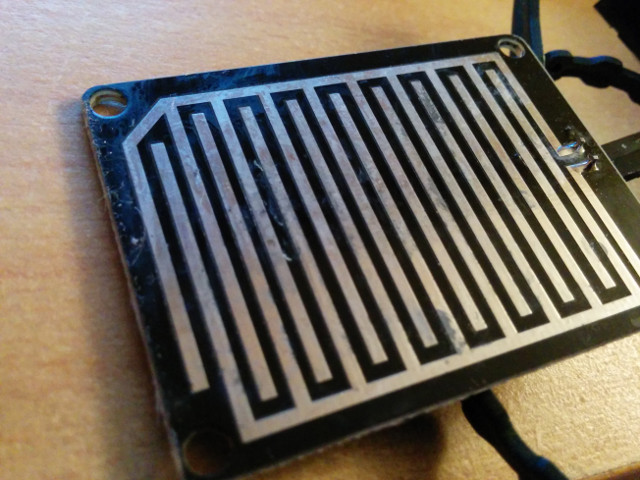
I've seen another product from Spain at Liebllium that I guess I will test for I haven't found any other item...
-
@epierre any idea why your sensor lasted this short?
How often did it report its value to the gateway? Was it sleeping in between? Any other sensors connected?@Yveaux several ideas:
- it reported every 10000
- it has no other sensor (this was my first try on batteries...)
- I had an AMS1117 in entry but I didn't needed it
- I haven't hacked the 3.3V core with the websites @a-lurker ideas
I'm waiting for the batteries from my other post because using so fast batteries is not environment friendly...
Has there been simulation of energy usage for those arduini ? e.g. for a spark core it isadvertized at 500mW
-
I've finally received from cooking hacks the leaf wetness sensor board that should be better than the one from china...
It is the one from hobby boards:
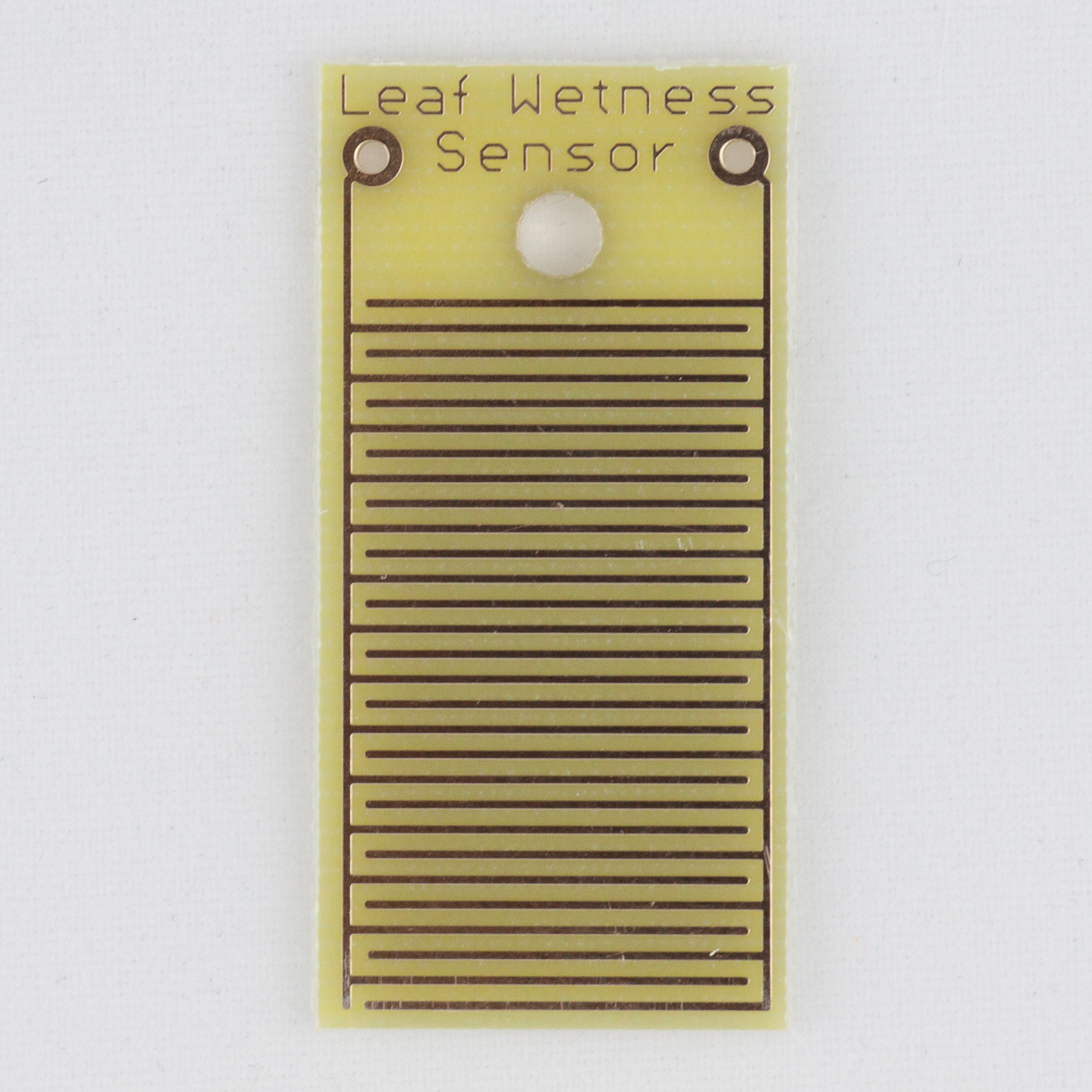
I guess I can recycle the lectronic from the cheap one on this one ?
-
-
yes it is, from the hobby board site it is $2, but it is a quarter the china's size.
sorry I missed your point, it is gold plated, immersion gold.
-
Ok, so I made some adjustments from my last try:
- hobbyboard immersion gold sensor
- I kept the comparator from the other sensor to facilitate work with the arduino
- I've added a 18650 LiOn battery (5000mAh) to have an extended life cycle
Here is the sketch:
https://github.com/empierre/arduino/blob/master/LeafWetnessSensor.inoWhat I can say, is that it is very sensitive. It is now outside live in the cold.
This could be used for a leak sensor easily.
-
so my 5000mAh lasted outside... 4 days... btw I didn't remove all leds from the comparator that could be an improvement and the outside weather is quite cold.
I had a reading every 30 secs, way to quick surely...
@hek is there a way to power the radio only when necessary ? I guess the gw.sleep could be a gw.sleep and a gw.wakeup and manage the delay outside ?
z-wave - Vera -> Domoticz
rfx - Domoticz <- MyDomoAtHome <- Imperihome
mysensors -> mysensors-gw -> Domoticz -
so my 5000mAh lasted outside... 4 days... btw I didn't remove all leds from the comparator that could be an improvement and the outside weather is quite cold.
I had a reading every 30 secs, way to quick surely...
@hek is there a way to power the radio only when necessary ? I guess the gw.sleep could be a gw.sleep and a gw.wakeup and manage the delay outside ?
-
gw.sleep() sleeps the radio as well. What do you mean by power down radio? Like cutting power using digital pin?
@hek said:
gw.sleep() sleeps the radio as well. What do you mean by power down radio? Like cutting power using digital pin?
yes, now you combine sleep for the radio and delay, what I mean is to have loop() run without radio, and if a transmission is needed to have a command that power it.If you have a long dry period, a device on battery will consume a lot of power having the radion on and off, if it is always off until a sensor finds something, that would save more power, no ?
-
Wake only on interrupt?
-
In my idea, a value above 0 would mean sending the info, an interrupt could be generated this way ?
-
Hey,
I am a newbie (in the forum) and in the arduino/sensors development. I bought the Leaf Wetness from cooking-hacks.com. Can I connected it to my Arduino via Analog input? Is it easy? -
Hey,
I am a newbie (in the forum) and in the arduino/sensors development. I bought the Leaf Wetness from cooking-hacks.com. Can I connected it to my Arduino via Analog input? Is it easy?@elisavetgrig Welcome to the forum. The answer is yes to both questions. Given that the sensor is a resistive element, you need to build a voltage divider. Google "voltage divider" Arduino and you'll find lots of examples.
Cheers
Al -
Measuring the current with DC doesn't seem to be the ideal solution:
thread -
Measuring the current with DC doesn't seem to be the ideal solution:
thread@FotoFieber That thread is regarding soil moisture measurements which is different than leaf wetness. For soil, capacitive is the best way to go IMHO.
Cheers
Al -
-
ok...Thank you... I will try the "voltage divider" and I will see what will happen!
-
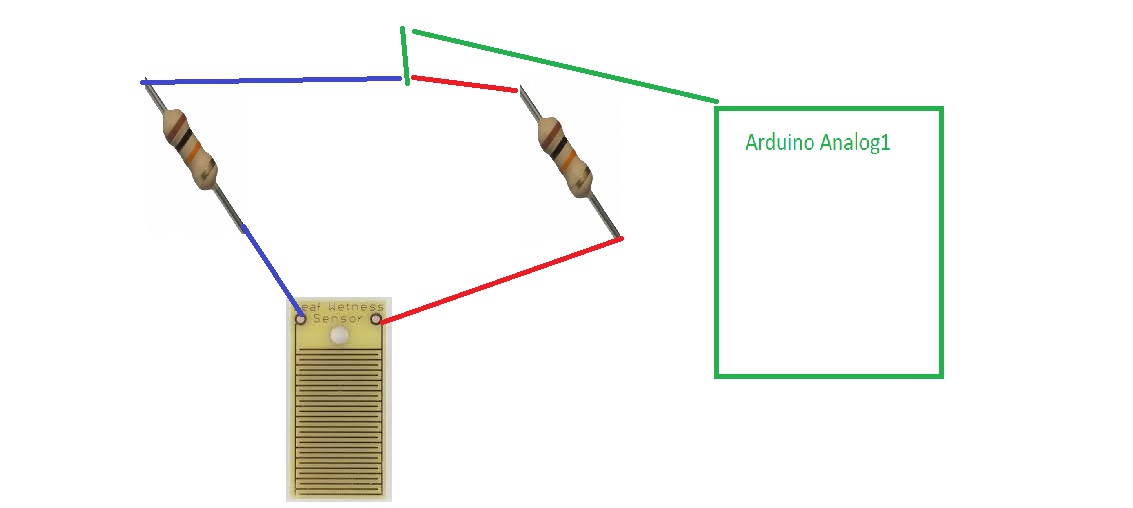
-
Did you mean something like the figure above? Or I only need to connect one resistor to one wire and the other wire to another pin in the Arduino?







Hello! It looks like you're interested in this conversation, but you don't have an account yet.
Getting fed up of having to scroll through the same posts each visit? When you register for an account, you'll always come back to exactly where you were before, and choose to be notified of new replies (either via email, or push notification). You'll also be able to save bookmarks and upvote posts to show your appreciation to other community members.
With your input, this post could be even better 💗
Register Login