Skip to content

General Discussion

A place to talk about whateeeever you want
1.5k Topics 14.2k Posts
  • room/air quality sensor

    1
    0 Votes
    1 Posts
    115 Views
    No one has replied
  • NRF51822

    nrf51 gatway mqtt
    3
    0 Votes
    3 Posts
    277 Views
    Puneit ThukralP
    Hello Thanks it worked -- with mock sensor sketch for now. I think I should be able to use this in production. :-) Cheers Puneit
  • Receiver that creates details about data transmission errors

    1
    2
    0 Votes
    1 Posts
    161 Views
    No one has replied
  • wristwatches that invite development

    33
    0 Votes
    33 Posts
    1k Views
    NeverDieN
    Quite a large number of inexpensive nRF51/nRF52832 watches which appear to have already been hacked, documented, and made available for others to now hack too: https://github.com/curtpw/nRF5x-device-reverse-engineering
  • Flaky ATmega328Ps from China

    13
    1
    0 Votes
    13 Posts
    711 Views
    BearWithBeardB
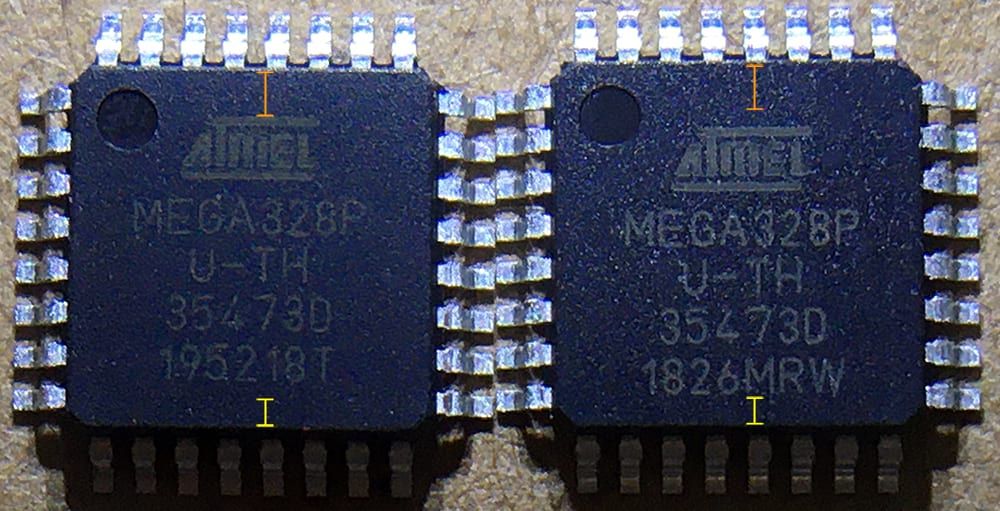
    @NeverDie Nah, I'm fine. It's always helpful to get opinions and views from others, especially if they are more experienced in the matter, if only to set one's own viewpoint straight. I'm grateful for all you guys replies, but I don't feel like bothering Microchip with this. Regarding Nordic - besides the circulating copies / clones (like the SI24R1), I guess it's also not helping that they are fabless, unlike Atmel / Microchip, in which case it seems totally reasonable that the various fabs may have slight marking variations. I just didn't expect that from those ATmegas which seem to have been produced in one and the same factory. But it's certainly a neat touch from Nordic to offer a free test.
  • 0 Votes
    3 Posts
    246 Views
    T
    @Boots33 Thanks a lot for the quick response. I now have my Nano running as a serial gateway and it is connected via a USB cable directly to my controller (Raspberry Pi 4 running Home Assistant / Hass.io). I added a local motion sensor to the Nano gateway HW and pasted the mysensors MotionSensor example code to the setup(), presentation() and loop() functions as well as to the definitions in the top of the GatewaySerial example code. I disabled the radio definitions as I currently have no radio capability in my gateway (not sure if this was necessary). In Home Assistant / Hass.io I updated the configuration.yaml with the following text (as described on the Home Assistant integration help): mysensors: gateways: - device: '/dev/ttyUSB0' And it works :) In Home Assistant Developer Tools under States I can now see my motion sensor go on and off by the flick of my hand. I had expected a bit more bumps on the road just to get this far, but wow - I am obviously walking in the foot prints of people who have worked hard to make it easy for the rest of us. I am sure I will hit bumps on the way when the radios have to send results to the gateway (thick concrete walls with lots of steel), but for now I will enjoy this big success. Thanks again Boots33
  • Pro Mini + RFM95 and two ISR-watched buttons possible?

    16
    0 Votes
    16 Posts
    540 Views
    J
    PS: one downside will probably be not being able to wake up programmatically and double the node as a e.g. temperature / climate sensor, as I had in mind. Sorry for the confusion above, too little sleep in the last days (at least I hope that explains it :-) ) Perhaps @Yveaux can help here on how to combine pin change interrupts and timer wake into a successful sleep() command? So far it looks like that would be possible with Low-Power lib, but this is not compiling in conjunction with MySensors 2.3.2.
  • Step motor &control for CNC router

    1
    0 Votes
    1 Posts
    105 Views
    No one has replied
  • Can I run multiple Analog capacitive moisture sensors per nano

    9
    0 Votes
    9 Posts
    391 Views
    M
    Thanks for the replies. I think I will just go with 3 sensors per raised bed, per nano. That will keep the runs under 10'
  • RFM69HW - Wow, I didn't expect this range

    15
    1
    6 Votes
    15 Posts
    507 Views
    G
    I use RFM69HW 433 MHz with a wire antenna (straight or spiral). When I start to test my devices, I had a range of about 100 - 150 m (transmitter in my house, receiver outside), so it was very good result for me. Unfortunately, after building the nodes, now I have the stable range less than 10 m inside my house :( (I use maximum MY_RFM69_MAX_POWER_LEVEL_DBM (20)). Sometimes it is better, sometimes worse, it depends on various conditions. Congratulations on such good results of your gateway, but I'm afraid that stable transmition will be much smaller.

  • [Solved] Getting Arduino IDE error with Relay Actuator sketch

    6
    0 Votes
    6 Posts
    253 Views
    M
    @tekka I moved the library and reinstalled. The sketch works now. Thank you for pointing me in the right direction!
  • Which vector network analyzer should we buy?

    17
    2 Votes
    17 Posts
    796 Views
    M
    @skywatch said in Which vector network analyzer should we buy?: It will be interesting to see the reviews of the new unit though..... Big discussion was at https://groups.io/g/nanovna-users/topic/first_pcb_pictures_of_the_v2/68761814. Now it seem continued to the https://groups.io/g/nanovna-users/topic/v2_design/71480430. These topics also explain why some shielding wasn't installed. Please note, there is also the NanoVNA2 by edy555, but the name has been taken.
  • Inventory webpage

    8
    0 Votes
    8 Posts
    1k Views
    rvendrameR
    @Nca78 Agree. But I liked the idea of a simple text search, where you enter for example 'MOSFET' and it lights up all bins with mosfets ... It is now in my list 'projects to investigate after finishing all ongoing' ;-)
  • Serial gateway running on coin cells. Needs to sleep

    24
    0 Votes
    24 Posts
    691 Views
    Jason RennieJ
    @scalz said in Serial gateway running on coin cells. Needs to sleep: also forget bad coincell brands, not good at all for lifetime. This is my biggest concern at the moment. With the watch device I can resort to Lipo and recharge if needed, but the sender is best encased in silicone to protect it so its crucial that I get a long reliable battery life from it. My only option there is to use inductive charging. Which might be easy but I've not looked at the details. I would also need to do shipping safety sheets if I use lipo but I think that it's probably just an expense. Not a project risk.
  • New home - what to choose?

    11
    0 Votes
    11 Posts
    4k Views
    1
    OP has surely decided and built his new home by now, but for other's that are deciding for KNX or Loxone wired smart home, this might be useful. I'm not affiliated with each of those companies so my thoughts are unbiased. Firstly, let’s emphasize that you can hardly go wrong selecting either KNX or Loxone home automation ecosystem. But what are the pros and cons of each? https://www.1home.io/blog/loxone-or-knx/
  • Raspberry PI killing memory cards

    18
    0 Votes
    18 Posts
    637 Views
    I
    Thank you all for the advice! I will try first with log2ram, but for long term I want to install an SSD. A nice week to all!
  • Compile errors with Nodemanager

    1
    0 Votes
    1 Posts
    66 Views
    No one has replied
  • Need clarification on soil-moisture build

    3
    0 Votes
    3 Posts
    203 Views
    M
    That is the direction I am going but this is the only tutorial I could find that used the NRF24L01+ radios to send data to Home Assistant. For now, I am just trying to get it to send accurate measurements and move to capacitive sensors as soon as I figure out how to send the data via NRF24L01+
  • NRF serial to usb for gateway?

    14
    0 Votes
    14 Posts
    495 Views
    Pascal JEANPIERREP
    @Dreded Thank you for your encouragement, I would not fail to contact you for any explanations as simple as you described it.
  • Waterproofing by embedding in epoxy

    17
    0 Votes
    17 Posts
    3k Views
    NeverDieN
    @Jens-Jensen Thanks for posting that video. I wonder if in Julien's' case there might have been moisture penetration through the insulated wiring ingress points. If the outer insulation coating were sufficient, then waterproof wiring wouldn't require that sticky goo they put underneath it. Once it gets inside the "sealed" enclosure by travelling through the insulation, it can do its damage with nothing to stop it. So....maybe if Julien had applied something like Corrosion X or some other conformal coating and then sealed it all up it might have lasted longer. I think extending the heatshrink to completely cover the wiring so that only the metal connection terminals on the end are exposed may be the only way to prevent the moisture ingress, assuming the heatshrink stuff really is moisture proof. In contrast, I suppose in the Great Scott epoxy filled approach, even if moisture does ingress through the wiring insulation, it has nowhere to go since all the electronics are protected with the epoxy. For those who don't know: something can be waterproof without being moisture proof. Housewrap would be a perfect example of that, as would gortex raincoats. So, having something that's waterproof rated doesn't tell you enough information. i.e. even something rated at ip68 could let in moisture. A lot of plastics are waterproof, but not moistureproof. Also, from what I've read, the most commonly used hot glues are not moistureproof. And of course if you have any air at all inside, the moisture in it might condense into water if it gets cold enough.... So, I think Julien's setup is prone to eventual failure for a whole host of reasons in addition to those that he mentioned: the host glue, the wire insulation travel path, and the trapped air. I did once try an experiment using just hot glue to seal cheap corrosion prone chinese electronics (pretty much engulfing it in hot glue as Julien tries at the end of his video), and I was surprised that it failed in just a month or two of wet outdoor weather.

8

Online

11.8k

Users

11.2k

Topics

113.2k

Posts